
The often unrecognized man behind Motown

Tara Fletcher
Special PhotoBy Tara Dyer-Stoyle
Staff Correspondent
On July 10, 1888, Berry Gordy Sr. was born in Sandersville, Georgia. Berry Sr. was not the famous member of his family; he was born to the first Berry Gordy, the son of a white plantation owner by the name of James Gordy and his female slave.
The half-brother of the first Berry Gordy was President Jimmy Carter’s grandfather, so this family’s Georgia roots ran deep and intertwined in very interesting ways.
It was Berry Sr. who had the foresight to move his family north to Detroit, Michigan, where he heard there were lots of opportunities for colored folks. He worked hard as a contractor and his wife an insurance agent to support their eight children. It would be this work ethic, an $800 loan and the audacity to believe in a dream that would make Berry Sr.’s son, Berry Gordy Jr., a household name.
If you don’t recognize the name Berry Gordy, maybe you’ll recognize this one: Motown.
Berry Gordy, decided to drop out of school in the 11th grade to make money as a professional boxer, which he did until he was drafted to serve in the Korean war. When he had served his required time, Gordy went back to Detroit and opened a record store, 3-D Record Mart, where he sold jazz albums and 3-D glasses. Although he was determined to educate the public on jazz music, sure that they would love it and purchase records, the Detroit factory workers were more interested in Blues music. Gordy’s store closed its doors. But when one door closes…
Berry Jr. took a job with Ford Motor Co., and when he saw how the cars were assembled, he had an epiphany — we can do this with musicians.
He applied for a $1,000 loan from his family’s “bank” called the Ber-Berry Co-Operative. This was a fund set up for members of the family to use as seed money to start businesses. He was granted $800 of the $1,000 requested, and he started his business, Tamla Records. About a year later the name was changed to Motown, short for Motor Town.
The details of how he did it are complex, and instead of getting too deep into those, I encourage you to read his story. For now, let’s talk about the music.
We often hear the term “musical genius” thrown around without merit. Taylor Swift and Kanye West — not geniuses. Bob Dylan, Berry Gordy, John Lennon, Quincy Jones — geniuses. Gordy said in retrospect that all he really wanted to do was “make music, make money and get some girls” — which he did. But that is the most humble understatement I’ve ever heard.
What he did was groom and develop groups and artists like The Supremes, The Four Tops, The Jackson 5, Stevie Wonder, Marvin Gaye, The Temptations and many other other superstars under various labels.
And he developed the Motown sound. He told artists that they should get his attention in the first 8-10 seconds of a song, and that made for some of the most recognizable songs introductions of all time. In a racially divided time, he brought black artists into white households through radio, television and record players. He hired women and Jews and Italians and promoted love and hard work — what an amazing human being.
If not for Berry Gordy, we may have missed out on Smokey Robinson’s “Tears Of A Clown,” “Superstition” by Stevie Wonder, The Supremes’ “Ain’t No Mountain High Enough,” “Psychedelic Shack” by The Temptations and hundreds of other perfect classic soul songs that came through the hit factory.
Today, as music is broken down into color and genre and radio stations and album collections, the music of Motown has a reserved spot in the hearts of every true music lover.
Mr. Gordy turned 90 this year and is still going strong. On his last day, I hope he’ll be proud of how he changed music and the world and I hope he’ll see his grandfather so he can thank him for paving the way.
Related Articles

‘Sounds Like a Mutiny.’ Secret Recording Exposes Claims of Toxic Leadership After a Marine’s Suicide
This week’s War Horse story follows the systemic failures before and after the death of Cpl. Drew Mobley who was the third in two years at Marine Corps Base Quantico to die by suicide.

Southwest Georgia artists recognized at packed opening of exhibition
The annual juried exhibition, one of the region’s largest showcases of visual art, features approximately 46 artists and nearly 90 works spanning painting, sculpture, ceramics, photography and mixed media.
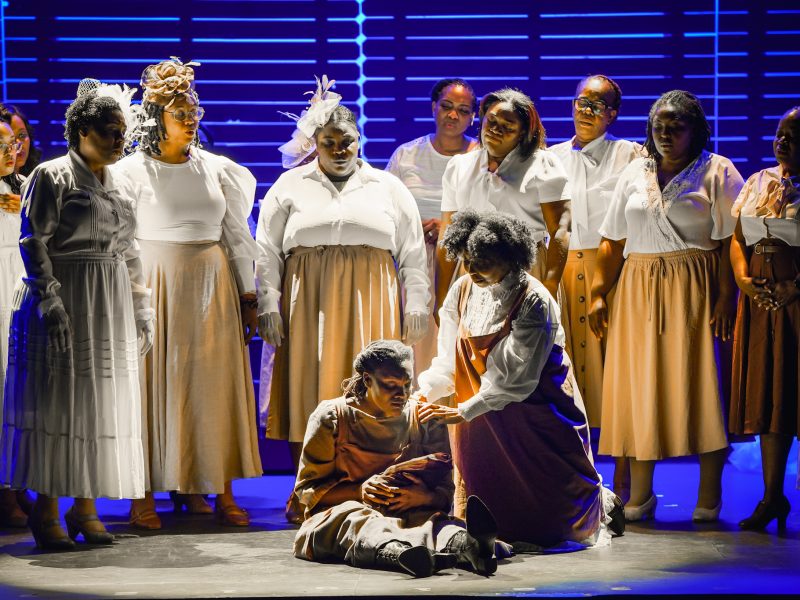
Powerful performances drive Theatre Albany’s ‘The Color Purple’
From the street, strands of purple ribbon wind around the white columns of the historic theater, hinting at the story waiting beyond its doors. Inside the foyer, a carefully curated slideshow flickers across a large screen, cycling through the faces of the cast. Some are seasoned performers. Others are stepping onto a stage for the very first time. Teachers stand alongside former students. Parents perform beside their children. People who worship in different churches, work different jobs and come from different corners of Southwest Georgia gather beneath the same lights to tell the same story.
