
It’s an age-old adage that holds true: Use enough gun
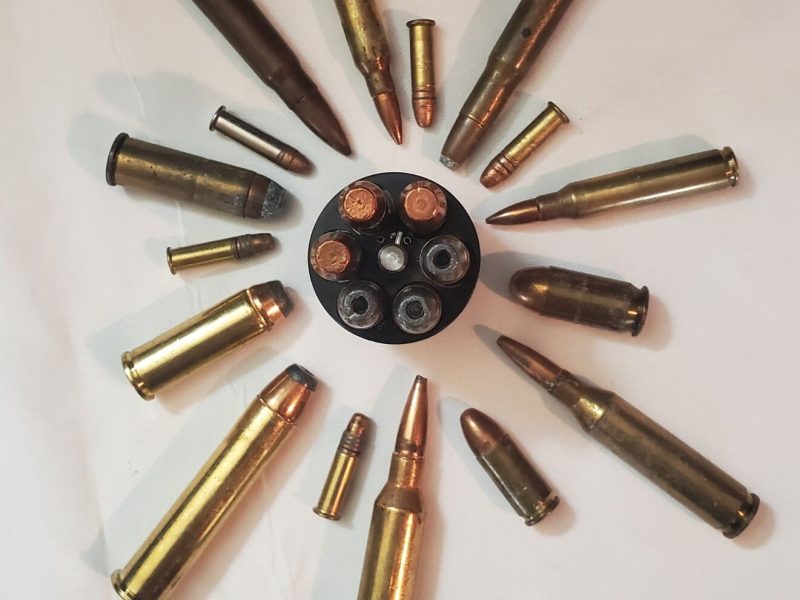
When it comes to hunting big game, hunters should first use enough gun for the game sought and then choose the right bullet for the hunt.
Staff Photo: Tom SeegmuellerBy Tom Seegmueller
[email protected]
ALBANY ‒ “Use Enough Gun,” is the title of Robert Ruark’s celebrated posthumous anthology of his experiences while on safari in Africa. While the quote is associated with hunting dangerous big game in Africa, it is applicable to the selection of firearms for any hunting scenario. When it comes to hunting dangerous game, the right gun choices would seem to be a matter of commonsense.
However, when it comes to selecting appropriate rifles and ammunition for hunting dangerous game, there is often the temptation that the hunter try something different, ignoring tradition, the advice of guides, or in some cases, legal restrictions. The need to use enough gun goes beyond the personal safety of the hunter and those in the hunting party. The decision also ensures that when the sights are on any game and the trigger is pulled, the results are both an ethical and humane harvest.
For those not initiated into the realm of firearms esoterica, it would seem that making the choice would be a straightforward decision based on simple ballistic information. Ballistics being the study of physics relating to the relationships between force matter and motion concerning the launching, flight behavior and impact of projectiles. Ever since men began throwing rocks at each other, they’ve looked for ways to make them fly faster, flatter and hit harder.
The study of ballistics as it applies to firearms is broken into three categories: Internal Ballistics, which are the things that happen in the barrel of the firearm from the time the trigger is pulled until the projectile leaves the barrel; External Ballistics, is everything that happens to the projectile once it leaves the barrel until it reaches the target, and Terminal Ballistics is the analysis of what happens when the bullet hits the target and is one of the most critical aspects for the hunter.
In the simplest terms, a firearm is simply a tube (the barrel) designed to discharge projectiles (the bullet), most commonly by the rapid combustion of a propellant (gun powder). The projectile acts as an unattached piston moving down the length of the barrel to sufficient speed that it takes ‘flight” as it leaves the barrel. Although all this would seem to make things simple, it is the multiple variables involved in these measurements that are where things are open for debate.
Internal ballistics focuses on the energy and resulting pressure from the powder charge that propels the bullet down the barrel. Although this is important, it is not of great concern to most shooters as they are using factory-loaded ammunition that is made to exacting standards relating to safety. However, for anyone hand-loading their own ammunition, this is a critical aspect of ballistics. If you are loading your own ammunition, you already know this and could have written the rest of this article.
Knowing the external ballistics of the cartridge you are shooting is critical to being able to hit your target where you are aiming. The greater the distance between the shooter and the target, the more critical this becomes. This is the study of the true flight path or trajectory of your projectile versus your straight line of sight when you aim the firearm.
The terminal ballistics of the bullet you are shooting and how much energy it retains at any given distance along its trajectory will determine not only how hard it impacts the target but how deeply the projectile penetrates upon impact? Did the projectile both expand and retain its mass upon impact?
The evolution of the debate over using enough gun has gone through a series of reincarnations, most related to new technologies or firearms developments. One of the first would relate to the debates over a century ago with the advent of smokeless powder. Americans’ first exposure to this technological advancement came during the Spanish American War in Cuba when they came up against Spanish-equipped troops using the 7 x 57 mm Mauser firing smokeless powder. This weapon was far superior to the standard issue Trapdoor Springfield using black powder. The smokeless powder not only created a higher velocity with longer range, it also had the benefit of not producing a cloud of smoke that turned the previously hidden soldier into the target of his target.
These early smokeless military rounds gained rapid popularity with big game hunters in Africa, who happily began replacing their heavy black-powder express rifles with the new lighter, smokeless powder firearms. This is the beginning of the “Use Enough Gun” debate. Prior to chronographs measuring projectile speeds and bullet efficiency, the scorecard of efficiency of new cartridges was measured by the number of hunters mauled by lions and leopards as well as those trampled by water buffalo and elephants. By this time, the bison were almost extinct in North America. However, bear, moose, and elk still presented dangerous challenges for the hunter in the states.
Today the debate is focused on the effectiveness of the popular 6.5 Creedmoor on deer and elk. Like so many previous debates, range, velocity and bullet weight are all points of delight or contention, depending what side of the debate you are on. For the hunter, the debate relating to what is enough gun focuses on external and terminal ballistics. In general, the longer distances you are shooting, the flatter the projectiles trajectory the better. This is where the 6.5 shines; however the debate over its efficiency is centered on its terminal effectiveness.
For the hunter, Newton’s laws of motion are critical to understanding the importance of ballistics. The interaction of velocity and mass in the creation and transfer of kinetic energy is the key to terminal ballistics in regard to how the energy created by speed and weight of a projectile are transformed or absorbed by the target as the energy is passed from one object to another. This is measured in foot-pounds. Today, countless charts measuring these factors can be found in journals and online for any cartridge that is available.
Anyone who has watched NCIS or any other TV crime drama in the last two decades is familiar with ballistic gel blocks that are used to evaluate bullet penetration and the resulting wound cavities. A bullet’s efficiency is measured by how far it can penetrate the target as well as how much energy it delivers on impact.
When it comes to terminal ballistics, a number of factors come into the debate. Penetration is critical in the regard that the bullet must enter the target, break bones and puncture internal organs to a degree that it causes immediate, if not rapid, mortality. Some measure success as when a bullet completely passes through the animal they have shot. Others prefer that the projectile not exit and the animal absorb all of the bullet’s kinetic energy. Some go even further, choosing a cartridge that achieves the maximum possible velocity in the belief that it creates a hydrostatic shock wave upon impact that causes neurological damage beyond the puncture wound of the bullet.
In the early 1980s, I had the privilege of working for Tom Wheeler, a gunsmith and the owner of a local gun store, Uncle Tom’s Cabin. He summed up his ballistic theory with a simple analogy: “I want to shoot a cartridge that is the same as a boxer’s punch landing squarely on their opponents jaw. I want a cartridge that enters the animal and does not exit. I want all of that energy going into the target. I don’t want it to penetrate and keep on going. That’s like the boxer’s punch that glances off the chin and all that energy goes with it.”
Author

Related Articles

Lee County homeowners have until Aug. 1 to claim property tax exemptions
Lee County homeowners have until Aug. 1 to apply for homestead and other property tax exemptions for the 2026 tax year, a deadline members of the Lee County Board of Tax Assessors highlighted Monday as they encouraged eligible residents to take advantage of available tax relief.

Dawson police arrest wanted suspect after Flock Safety camera alert
According to police, May drove into the yard of a nearby residence instead of complying with officers’ commands. He then exited the vehicle and ran into the home on foot.

Lee County stands alone without E-SPLOST. Here’s what that means for schools, taxpayers and the county’s future
Following the defeat of its referendum, Lee County became just the second of Georgia’s 159 counties without voter approval for an active ESPLOST, leaving the school system without the state’s primary local funding source for major construction, renovations, school buses and other capital improvements.
