
The saga of the kinder, gentler Whigham Rattlesnake Roundup
Special Photo
Special Photo
By Tom Seegmueller
[email protected]
“The world as we created it is a perspective of our thinking. It cannot be changed without changing our thinking.” — Albert Einstein
WHIGHAM — One example of Einstein’s change in mental perception can be witnessed Saturday at the 64th Whigham Rattlesnake Roundup. The roundup is now a “no-kill” event, and no snakes will be captured and collected specifically for the event. That doesn’t mean there won’t be a shortage of venomous and non-venomous reptiles on display. It just means that the reptiles at the Roundup have a far brighter future than those collected for the first 60 years of the roundup’s history,
A historical account of the first Whigham Rattlesnake Roundup in 1960 recalls: “The founding members of the Whigham Community Club brought spirit and motivation into the small town. Club member Clarence Mobley suggested the idea of a rattlesnake roundup. Luther Harden, Julius Newberry, Herman Taylor and Julian Maxwell were among the great minds to brainstorm the idea of catching rattlesnakes due to the number of workers in the field and forest, and hunting dogs and hunters bitten by the serpents.”
The first roundup was held at Harden’s gas station. Visitors came from nearby communities to observe the 140 snakes temporarily caged beside the establishment. Within a few years, hundreds of snakes were being captured for sale to the Ross Allen Reptile Institute for resale to other reptile sideshows and medicinal purposes, including the manufacture of antivenom. In the 1960s, a single snake hunter captured 40 rattlers. Annual attendance at the roundup grew to well over 50,000 and is estimated to have approached 100,000 at one point.
For more than half a century after the roundup was started, the targeted “serpents” were hunted heavily in the region.
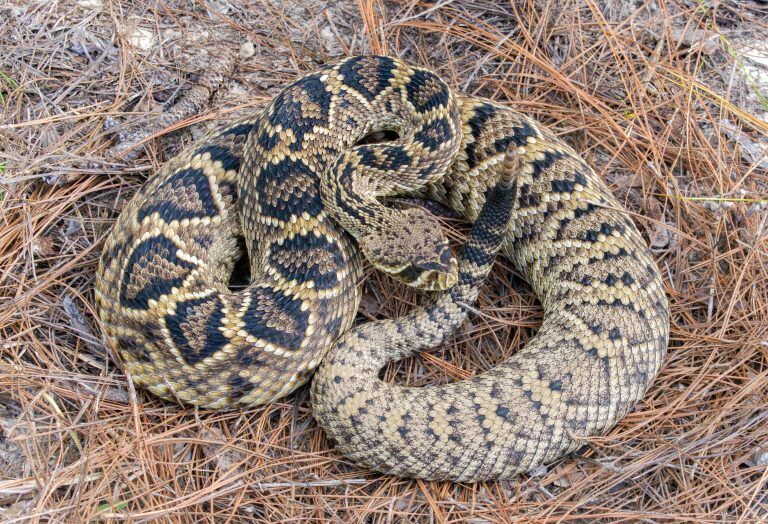
“We’ve got three species of rattlesnakes in Georgia, and all three can be found in southwest Georgia,” Daniel Sollenberger, senior wildlife biologist with the Georgia DNR, said. “You have the pygmy rattlesnake, which is the smallest, the timber rattler or canebrake, and then there’s the Eastern Diamondback.
“Historically, they were collected around this time of year in the winter when they’re spending a lot of time in holes, particularly Gopher tortoise burrows.”
The snake hunters would run a cut-off length of garden hose down a hole, pour a small amount of gasoline into the hose and blow the fumes into the depths of the hole. The resulting gas fumes acted as an irritant, forcing the inhabitant to the surface to be collected by hunters.
Unfortunately, rattlesnakes aren’t the only inhabitants of these holes, and a wide variety of hibernating reptiles, amphibians, small rodents, and other species calling the holes home were either driven out or killed by the fumes. This frequently included the Gopher Tortoise who had created the hole and was already considered to be a rare and endangered species before this practice started. For this reason, gassing tortoise holes is no longer legal in Georgia.
Noting the loss of rattlers in the region, Sollenberger said, “A great deal of that came from habitat loss. The snakes are historically associated with the longleaf pine ecosystem that existed throughout south Georgia and has mostly been eliminated at this point. All that’s left now in most areas of the region is a handful of small patches of pine forest and the field edges. But the kind of sunny, grassy habitats the snakes need are mostly gone.”
Although there was still a primal appeal for many to see these long-vilified reptiles in captivity, with little concern how they got there or what their future was following the roundup, other visitors were not as captivated, (pun intended) by the thought of the eventual extermination of the snakes. It was becoming apparent that something needed to change.
For members of the Whigham Community Club, discontinuing a festival that had contributed so much to the community for so many years was not a viable option. For decades, revenue from the roundup funded community projects, organizations and disaster relief efforts among other things. But what were the club’s options for continuing an event founded around an action that not only was no longer required but was also accomplished by questionable environmental practices?
In an interesting twist of fate, Paul Mobley, the grandson of Roundup founder Clarence Mobley, would prove to be part of the solution, although he is quick to give credit for the transition to others.
“Jess McGuire with Quail Forever played a key role in moving us toward making the change from collecting to conserving,” Mobley said. “She helped pull together the exhibitors and organizations that are now core to the roundup.”
Changing the roundup to a “no-kill” event allowed leading environmental education organizations and experts in the field of herpetology to become involved. A partial list of those participating in this year’s Roundup is proof of the change’s success: Quail Forever, Chehaw Park & Zoo, Southeastern Reptile Rescue, The Rattlesnake Conservancy, SOWEGA Prescribed Burn Association, Gopher Tortoise Council, University of Georgia, Georgia Reptile Society and the Georgia Department of Natural Resources.
The change from a “kill ’em all and let God sort ’em out” philosophy to a more coexistent philosophy has not been embraced by 100% of those attending the roundup. However, according to McGuire, it has opened the door to a meaningful dialogue regarding the relative low threat venomous reptiles present to those enjoying outdoor activities.
This challenge comes from the fact that 50% of people are reported to have some level of anxiety relating to any snake, with 2% having Ophidiophobia, a life-altering fear of snakes. Unfortunately for snakes, this still equates to a lot of anxious people feeling, “The only good snake is a dead snake.” Which in turn relates to numerous life-altering experiences for a large number of snakes, whether they are venomous or not.
Your chances of being bitten by a snake you see is greatly reduced by calmly putting a safe distance between yourself and the snake. Any attempt to attack or dispatch a venomous snake actually greatly increases your chance of being bitten by the now agitated reptile. There are also legal considerations.
“There are a few different laws that apply to the killing of reptiles in Georgia,” Sollenberger said. “The first is a baseline that all non-game wildlife in Georgia is protected, and that includes non-venomous snakes. However, there’s another law that exempts certain species from that and we call it, ‘The Unlucky Fourteen List,’ which says you can take certain non-game species at any time of the year by any means.”
The list includes armadillo, coyotes, hogs, beaver and venomous snakes.
However, before killing a reptile in Georgia, you might want to get a basic education in snake identification because you could be charged with a misdemeanor for killing a non-venomous snake or be fined up to $1,000 and sentenced up to a year in jail.
“There are only 6 or 7 venomous snakes in Georgia: copperheads, pigmy rattlesnakes, timber rattlesnakes, Eastern diamondback rattlesnakes, Eastern coral snakes, and cottonmouths, which some people now believe are divided into 2 separate species. It is also worth mentioning that it is illegal to keep any non-venomous snakes as pets in the state without proper permits.
Time spent at the Roundup could prove to be an easy way to learn how to avoid reptilian problems and have a great time as well. Besides the educational presentations and exhibitors, an estimated 100 food and arts and craft vendors will be present.
Author

Related Articles

Wild Game Dinner marks 34 years as South Georgia Scouting reaches for next generation
More than a century after organized Scouting first took root in Southwest Georgia, local leaders say the program is working to preserve its traditional mission while adapting to a new generation of young people.
Dawson’s $10.2 million sewer project leaves major financial questions unresolved
As Dawson’s finance director resigns and operating pressures mount, records show $10.2 million in sewer funding, frozen loans, missing audits and gaps in the public accounting of project money.

Foreclosures jump 52.9% across the region as buyers regain negotiating power
In Dougherty County, the number of residential properties advertised for foreclosure has nearly doubled this year. In neighboring Lee County, developers are preparing to add hundreds of new houses and apartments, including homes aimed at buyers who have struggled to find newer housing at an attainable price.
