Gone are the days when learning how to balance a checkbook in home economics class was enough to prepare young people for financial responsibility—if there ever was a time when that was true. Financial literacy is an undeniably valuable tool for navigating an increasingly digital and data-driven world. Online banking and investing are ever more accessible, and dozens of financial apps can help users keep track of their credit scores, account balances, and budgets in real-time. But even with more tools available, income inequality continues to increase and student loan debt is valued at a record-shattering $1.7 trillion nationally.Citing data from the Council for Economic Education, GoHenry looked at six types of laws mandating personal finance education across the country and outlined where every state stands on each.Despite the fact that 83% of Americans believe parents are responsible for teaching their children about finances, very few actually talk to their kids about money, according to an April 2022 CNBC poll. In fact, 69% of parents report feeling reluctant to broach the topic of finances with their kids. Because of this discomfort around discussing money, many children and young adults only learn of these financial concepts for the first time in school. But the way schools cover personal finance varies depending on the state you live in, your school district, and how well-resourced your school is.According to the Council of Economic Education, which publishes national standards for teaching personal finance, important topics to include in financial literacy courses are earning income, spending, saving, investing, managing credit, and managing risk. But only around half of states require personal finance topics to be covered in schools.According to a 2021 Milken Institute report, the unevenness of the financial literacy landscape across the U.S. falls along racial, socioeconomic, and gender lines; populations historically excluded from financial stability and prosperity are also less likely to have access to personal finance education, perpetuating a cycle of disempowerment.Bolstering financial literacy in schools is becoming an increasingly large priority for states and school districts across the country, and it’s one step in helping an individual understand financial fundamentals. But it alone is not enough to change the financial destinies of many young people. Systemic inequalities, frequently along racial lines, are sustained through intergenerational wealth and poverty. Having access to knowledge about personal finance, in other words, is not the same thing as having money. Conversely, strong social assistance programs, particularly during the COVID-19 pandemic, were shown to dramatically decrease poverty rates.Read on to learn more about how financial literacy is taught in your state. Canva
looked at six types of laws mandating personal finance education across the country and outlined where every state stands on each.
CanvaGoHenry
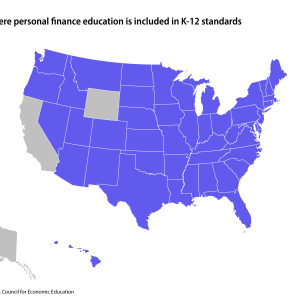
Most states offer standards for teaching personal finance in K-12 schools, and in most cases, these standards are reflective of the topics the CEE has laid out. This means if schools are mandated to abide by these standards, courses that include personal finance will cover similar topics across the nation.Only three states do not have any standards for personal finance education in K-12 schools: California, Alaska, and Wyoming. In California, for instance, high school students are required to take a half-credit economic education course to graduate, but teaching personal finance topics within that course is merely suggested. Without state standards dictating if and how personal finance is taught in schools, financial literacy education is left to the discretion of individual California school districts.This may not be the case for too much longer, however; in early 2022, a bill was proposed in California’s legislature that would solidify a state-standardized personal finance curriculum. In Alaska, meanwhile, no legislation is in the works to standardize its financial literacy education.
GoHenry
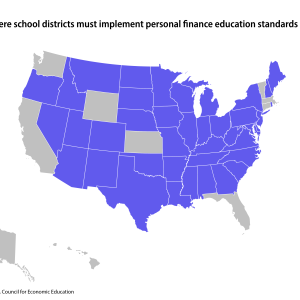
Though most states offer standards for how to teach personal finance, schools are not necessarily required to follow these standards. States like Washington, Florida, Massachusetts, and Kansas offer standards for financial literacy education but do not mandate that schools implement them—they exist as suggestions, rather than rules.In Massachusetts, which has standards for personal finance education but does not require that schools follow them, issues can arise around the logistics of teaching financial literacy. A 2021 report from the Massachusetts Financial Literacy Task Force found a lack of resources or training for teachers, as well as a shortage of class time, funding, and vetted curricula, were significant obstacles to teaching personal financial literacy.Pennsylvania’s standards for teaching personal finance are required to be implemented when courses are taught, but since no requirement exists for actually offering financial literacy courses, putting these standards into practice is still limited. The state’s legislature is currently developing a bill that would require students to take a financial literacy course for graduation.
GoHenry
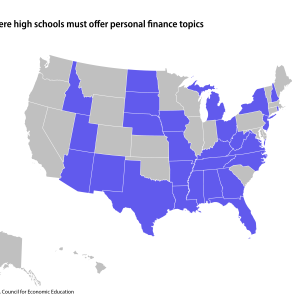
Roughly half of the U.S. requires financial literacy topics to be offered in schools, whether through a standalone course on the subject or combined with another course. While schools in these states must offer personal finance instruction to students, in theory, the consistency and accessibility of this type of education are hazy in practice.In states that do not offer standards for teaching personal finance—or do not require schools to implement those standards—questions of what is being taught, and how extensively, are left to individual teachers and districts.Additionally, some states call for financial literacy education to be integrated into existing courses. Personal finance topics are often tucked into subjects like math, civics, and social studies. But without designated curricula or designated teachers trained for financial literacy, these topics can seem like an afterthought.In New York state, students are required to take a half-credit economics course to graduate. While some of the topics covered in this course are related to personal finance, it does not put an emphasis on topics like budgeting or building credit. Instead, it focuses on economic concepts more broadly. Currently, there are legislative efforts to create a required standalone personal finance course.
GoHenry
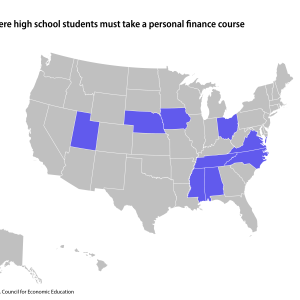
Despite being considered the “gold standard” of personal finance education, just nine states require students to take a standalone financial literacy course to graduate high school.In recent years, due in part to the financial hardship exacerbated by the pandemic, more states have been introducing legislation that would create a required standalone personal finance course. In the past few years alone, Nebraska, Ohio, Mississippi, and North Carolina have passed legislation making financial literacy courses a graduation requirement.While the length of the required course varies—some states require a full semester, while others mandate a half-semester—imposing a graduation requirement is one of the few ways experts say schools can ensure more equal access to financial literacy education. In states without a graduation requirement, socioeconomic inequities between districts can inhibit schools with fewer resources from teaching personal finance material.Though the number of states requiring a standalone financial literacy course for graduation is relatively small, more states have introduced or passed legislation requiring personal finance education, whether as part of another class or as a project, before graduating. In 2021, Rhode Island passed a law requiring students to take a personal finance course or complete a project in order to graduate.
GoHenry
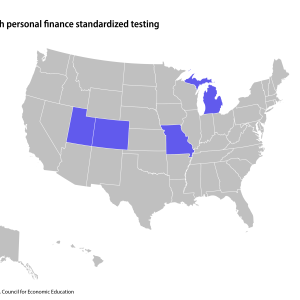
Only a handful of states have standardized tests for personal finance: Utah, Missouri, Colorado, and Michigan. The course material that’s tested varies between states but is consistent among school districts within each state.In Utah, personal finance assessments are administered after students complete a financial literacy course, which covers topics ranging from how cultural, social, and emotional influences can affect financial behavior to more technical subjects like filling out tax forms and creating budgets. In Missouri, passing a personal finance assessment is required in order to graduate, unless students are enrolled in a standalone financial literacy course. The test includes topics about investing and the stock market, savings, and inflation.