
Albany area farmers hit with triple whammy: high costs, depressed commodity prices, drought
“Land is a farmer’s equity. It’s gotten bad enough that every farmer I know has sold land. We’re losing our equity. Some people are even getting out of it. Corporations are going to own the land or we’re going to turn into sharecroppers if something doesn’t change quickly. It’s that bad.”
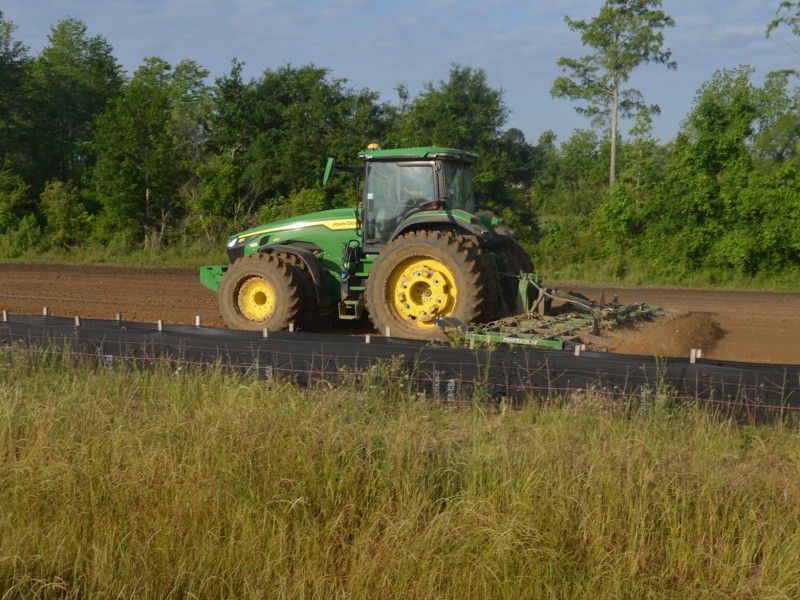
ALBANY – Southwest Georgia farmers have been sharpening a lot of pencils lately. Or perhaps more accurately they’ve been pounding their computer keyboards figuring and refiguring the numbers as the components that go into producing a crop keep spiking upward.
The price of fertilizers are one of those components, and in the last month and a half the nitrogen fertilizers used for the recently planted corn crop are up by double digits. That’s because a healthy chunk of the world’s supply comes from the Middle East, where the Strait of Hormuz remains choked up due to the conflict in Iran.
“Urea, nitrogen fertilizers have been surging tremendously over the past few weeks,” Guy Hancock, a data scientist for the University of Georgia’s Department of Applied Economics based in Tifton, said. “Urea is up from $560 to $570 a ton over last year and has surged to over $800 a ton. Anything that impacts shipping and supply will eventually have an impact.”
Diesel prices are up significantly as well, with Georgia’s average at $5.23 per gallon, compared to $3.52 at the same time last year, according to AAA. For farmers, who get a tax break on sales taxes, diesel started the year at less than $2.50 a gallon, and at its peak in 2026, it hit $4.50, Hancock said.
Nitrogen is key to producing a healthy corn crop, and growers use diesel for planting and applying chemicals. Plus, some use diesel irrigation units.
“Right now, fuel and nitrogen fertilizer are the ones that are really hitting farmers,” the farm economist said. “Corn is the big one right now. Corn is probably one of our most nitrogen-demanding row crops.”
Later in the year, growers will need nitrogen to boost cotton, and to a larger extent peanuts, he said.
Currently, prices for cotton grown in 2026 are hovering near 70 cents per pound, up from the mid-60s a few weeks ago, but much less than what farmers need to make a profit.
Similarly, corn is at about $4.50 a bushel, which also is a depressed price for growers.
To add another fly to the ointment, the region is now in the midst of a severe drought. A large portion of southwest and south-central Georgia are currently in the exceptional drought stage, the most severe, and the rest of those regions are in extreme drought.
If those conditions don’t change soon, corn growers will be forced to spend more money for the electricity or diesel used to run their irrigation systems,
“All of the costs of inputs have certainly increased with all these geopolitical issues in the Middle East,” Hancock said. “With inflation, all the costs are going up on everything.”
Typically, producers of products can spread increased costs on to their consumers. Bakers, for example, can charge more for a loaf of bread when wheat prices climb. Car manufacturers can increase prices when the price of steel increases.
For the area’s farmers, that is not an option. They take what buyers offer for their corn, cotton and peanuts.
“(We have) the most astronomical inputs we’ve ever seen,” Calhoun row crop and pecan farmer Adam McLendon said. “You’re selling cotton for prices my grandfather sold cotton for, and a cotton-harvesting machine costs $1.2 million. How do you sustain that?
“Weather is an issue we can deal with. It’s something we have faith we can get through. The larger problems are our input costs and our low commodity costs. We’re going through selling commodities at record low prices with inputs at record high costs.”
The triple whammy of high prices for supplies, low crop prices and a drought comes during a long stretch for farmers over the last several years, McLendon said. Farmers are mainly looking to tread water this year in the hopes of better conditions in 2027.
“If we could even break even, we’d keep doing it,” he said. “We’re trying to hold out for better times. We’re farming on faith that things will get better at some time.”
The biggest need for farmers now is congressional legislation that will allow them to continue farming, and some payments to help them weather the adverse conditions also would be helpful, the farmer said.
Otherwise, the prospects are bleak for many.
“Land is a farmer’s equity,” McLendon said. “It’s gotten bad enough that every farmer I know has sold land. We’re losing our equity. Some people are even getting out of it. Corporations are going to own the land, or we’re going to turn into sharecroppers if something doesn’t change quickly. It’s that bad.
“I love everything about farming. We do it because we have a love for what we do. None of us started farming because we want to be multimillionaires.”
The 2018 U.S. Farm Bill, which expired in 2023, has been extended twice to run through the end of September, but it does not cover farmers’ immediate needs.
At the Sunbelt Ag Expo in Moultrie, which operates a 540-acre research farming operation, Farm Manager Cody Mitchell is looking at taking measures to cut down on fertilizer use, a practice that many area farmers also are following.
On the 135 acres of corn on the farm, he is looking at reducing the usual 300 units of nitrogen applied to corn to 250 or 275 units and applying fertilizer stabilizer, with the hopes of achieving yields that are the same or close to the same.
“The idea is to not spend as much money on fertilizer,” Mitchell said. “We’re basically cutting back on the nitrogen. We’re not cutting it back so much we expect a significant yield loss.
“This isn’t new technology. It’s been around. We’re going to use the fertilizer stabilizers this year and see what we get out of this.”
Farmers also are doing less preparation work than usual, saving the cost of diesel, Mitchell said. Unfortunately, there are no workarounds for the lack of rainfall, with many farm ponds drying out before farmers even start planting the largest row crops of cotton and peanuts.
“They’re trying to maximize what they’ve got,” he said. “Farmers are worried if their wells are going to go dry and if their ponds are going to go empty.”
The Expo farm grows 90 acres of hay, and grass also needs fertilizer and water.
“Grass takes a lot of fertilizer,” Mitchell said. “People are cutting back on that as well. It’s bad times. It really is.”
Farmers will be making other decisions, like the mix of cotton and peanuts they plant, Colquitt County Agricultural Extension Agent Jeremy Kichler said. Last year growers planted more cotton than peanuts, which is a rarity, and he expects that will be the case this year as well.
The dry conditions are also on farmers’ minds, with a deficit of 38% from normal rainfall since the fall of last year.
“Irrigation isn’t a stand-alone,” he said. “It’s a supplement. We need to recharge wells and ponds. It’s fixing to get serious if it doesn’t rain. It already is.”
U.S. Rep. Sanford Bishop recently met with a group of farmers in the area, Calhoun County Agricultural Extension Agent Luke Crosson said, and there are hopes for bridge payments to help them with this crop year as well as action on a farm bill.
“Any help they could get would go a long way,” Bishop said. “They’re operating at a loss right now. We’ve never seen prices like this. It’s horrible. It’s a tough time out there. They’re cutting everything they can.”
Author

Related Articles

‘Flywheel’ comes home as Kendrick brothers bring Brazilian remake to Albany
Twenty-three years after a $20,000 movie made with church volunteers launched their filmmaking careers, Alex and Stephen Kendrick returned Thursday to the Albany theater where “Flywheel” first reached an audience — this time with a Brazilian cast telling the story.

Heated exchanges, lengthy delays precede Lee school board’s 17.96-mill vote
The Lee County Board of Education adopted a 17.96-mill operating tax rate Thursday after a crowded public hearing and a lengthy wait for a vote that left frustrated residents at the meeting until close to 9:30 p.m.

Turnout steady during first week of early voting in Dougherty County
Early voting started statewide on Tuesday, giving voters three weeks to cast ballots ahead of the Nov. 3 election.
