
Albany, Dougherty officials learned lessons from Flood of 1994
Grants have allowed for improved infrastructure for flood control since 1994
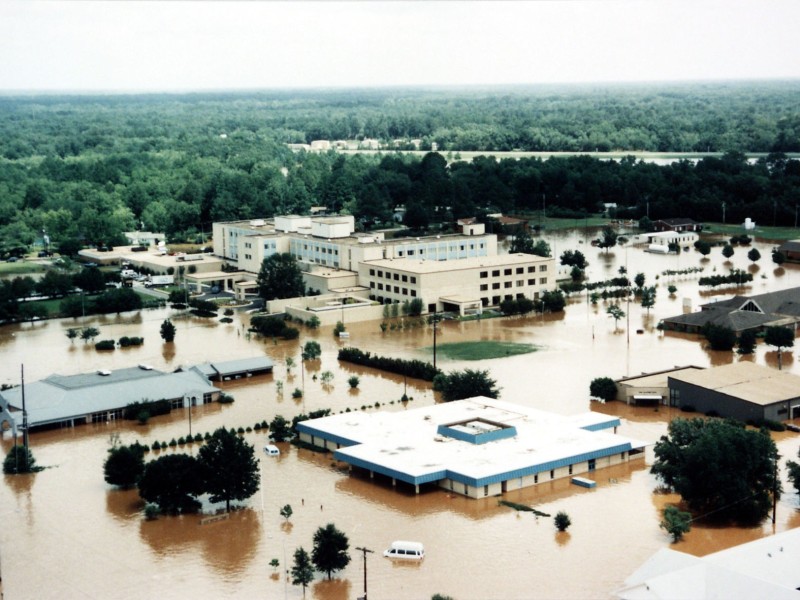
File Photo
By Jennifer Parks
[email protected]
ALBANY — A 43-foot crest of the Flint River on July 11, 1994, a byproduct of heavy rains attributed to Tropical Storm Alberto, was unprecedented in the Albany area. Once the river gets that high, only so much can be done to keep the water from inundating everything in its path.
Even so, some things have changed in 25 years that have made responding to such an incident less a monumental task.
Dougherty County Public Works Director Larry Cook had been with the county for two years, serving as the department’s assistant director at the time.
“It was a trying time with all the rain we had and keeping up with that,” Cook said. “We quickly learned it would be more than a normal storm.”
Cook said alerts came in as they usually would, and one of the immediate concerns was Albany State University. Then North Slappey Boulevard, Whispering Pines Road, the Palmyra Park area and bridges.
“Our facility was actually flooded too at Public Works,” he said. “We were dislodged from where we would be working.”
Emergency responders were on different frequencies, making physical communication necessary. The flood made Albany and Dougherty County officials aware of Federal Emergency Management Agency protocol, which has proved helpful since.
“We had to keep up with every small asset we had,” Cook said.
Cook said, overall, the county’s drainage system worked as it was supposed to. There were some lessons learned, specifically regarding the importance of early warning systems and debris clean-up.
“I think we are much better prepared now on how to deal with that,” he said.
Albany Assistant City Manager Phil Roberson, who at the time of the flood was the city’s street superintendent, said the worst flooding incident prior to the ’94 Flood was in 1925 when the Flint crested at 37.8 feet.
“The (’94) flood was 5 feet higher than anything on record,” Roberson said.
Alberto came up from the Gulf of Mexico and stalled south of Atlanta, dumping a substantial amount of rain that made its way southward via the Flint River a few days later.
Weather models in 1994 were not what they are now, and local officials the forecast constantly kept changing. Officials were initially told to expect a 35-foot crest, which they had charts for based on 1925 data. It was apparent drainage would be overtopped at that point, so gates were closed to keep the water from going the wrong way.
But predictions from meteorologists got steadily worse. Eventually, Albany learned the river was going to be above 42 feet.
“There was nothing Albany had at that time that would be able to handle that magnitude,” Roberson said.
As the ever-changing model started showing figures beyond what could be handled, the priority became getting people out of the water’s expected path. A dam in Cordele could not keep water out, while canals were being overwhelmed and water was coming into the Slappey Boulevard and Whispering Pines areas, as well as Dawson Road and Third Avenue.
As water collected in low-lying areas, bridges throughout the Albany area were closed.
“Then it became a life-safety issue,” Roberson said.
Among the closed bridges was the one on U.S. 19 near the Lee/Dougherty County line, as well as the ones on Oglethorpe Boulevard and Broad Avenue. People were forced to go around the water while heavy equipment and sandbags were being staged.
Palmyra Medical Center and nearby nursing homes became vulnerable. Some services had to be relocated.
The flood resulted in new models with a chart that now extends to 44 feet, and is divided into half-foot intervals. It guides the decisions officials make when a similar event takes place.
“We know what to do at each of those elevations,” Roberson said. “We know what actions to take when and what happens to infrastructure.”
Grant funding afterward allowed for better protection at pumping stations and gates at major canals. Officials hold planning sessions once or twice a year, while consistently looking at what is going on north of Albany.
The biggest change since 1994, though, has nothing to do with the flood at all.
“Technology is the biggest thing,” Roberson said. “There were no cellphones. Communication became an issue. Now there is instantaneous information, with social media. It has improved what we can do with information.”
The circumstances of the 1994 flood were tragic, but in its aftermath the data from the 1925 flood were updated, giving officials a fresh start as they prepared for future weather events.
“The unfortunate data from that time helps us (to respond better),” Roberson said.
Bruce Maples, the city’s managing director of Engineering and Planning, was coming back to Albany from a vacation as the rain was starting. He had a two-week-old baby at home, and his boss — the city engineer — had just retired, allowing him to go from assistant city engineer to interim engineer.
He said he came back to work, and the Public Works director briefed him on the predicted crest from the first wave of Alberto, which eventually turned south and dropped 24 inches of rain. The ground was getting saturated, and protective dams were reaching their limit.
“All the predictions were off,” Maples said.
He found some old friends at a seafood restaurant near the Kinchafoonee Creek as he was taking a ride out. Maples said he urged them to pack their things and leave, but he had a hard time convincing them of the pending danger. Many citizens, he said, refused to leave because they were convinced they were safe. It did not seem conceivable that areas like Palmyra and Dawson roads could be impacted.
“Nobody had seen anything like this,” Maples said. “It was hard to get them to understand that this was something we had never seen.
“We were trying to fight it as we could.”
The changing forecasts resulted in a map depicting a 500-year flood. The first crest came July 7-8 for the Muckalee and Kinchafoonee creeks as well as the Flint. The crest coming from the upper regions of the Flint came July 10-11.
“It drug out for seven to eight days because there was so much water,” Maples said.
Maples said the levees around Albany State University were not maintained well, and they were extended to at least give protection up to a 37-foot level. When the dam eventually breached, there was not a significant difference in elevation on either side, so it did not create a terrible problem.
At Palmyra Medical Center, Maples spent a great deal of time helping to save generators. At the back of the hospital, there was a water pump on the dock. Sandbags and another pump were en route.
“They asked me, ‘Can you save this hospital?’” he said. “There were seven people on life support, and they couldn’t get helicopters in.”
The lives of these people depended on the generator, and rising water was making the possibility of generator failure very real. Water was flowing on the dock, and pressure on the pumps diminished greatly. The generator was nearly gone, and Maples was chest-deep in water.
Then a double miracle occurred.
“The sandbags showed up, and at the same time, the Marines showed up,” he said.
The Marines moved a fire truck at the scene to prevent it from being lost, and sandbags were put around the loading dock.
“We were able to save the generator,” Maples said.
Maples said deciding when to close floodgates can be a balancing act, and there have been cases since 1994 when those calls have had to be made.
“We are always constantly fighting,” he said. “We learned a lot and got the money to build gates and pumps we didn’t have before.”
Advancements in technology mean officials can rely on maps on the National Oceanic and Atmospheric Administration website for river levels rather than on the paper maps used 25 years ago. The response is much smoother now, and contact is constant, not just among emergency management officials but also with entities such as Georgia Power when a dam needs to be adjusted.
“It’s an automatic thing when we get major rainfall,” Maples said. “Whether it is 20 feet or 32 feet, we always start going into action.”
What has not changed is difficulty getting through to the people who refuse to leave when told to evacuate, the city’s chief engineer said. But it is easier to communicate with them now.
“Always one of our challenges is how to convey to people,” Maples said.
He added that it is always useful to remember the flood, and to realize water is more dangerous than it looks. Soil collapses, and cars float away.
“I hate to think we’ll have another Flood of 1994, but it is always a possibility we could exceed it,” Maples said.
Related Articles

Three summertime fun nights planned for young people at Albany Civic Center
“I think any time you invest in children and youth, you’re always making a great investment. I think it should be a good experience.”
Albany Herald – June 13, 2026
ATC student earns bronze medal at National SkillsUSA competition… Albany Commission eyes another draft at downtown brewery… PUBLIC OPPOSITION SINKS PROPOSED LEE COUNTY SOLAR FARM…

Classifieds – June 13, 2026
Moving Sale: Sat June 13th, 8am-12pm. 265 Brenda Lane, Albany. Large Variety of Items.

