
BABS J. HALL: A mental health crisis has no schedule
Babs J. Hall
EDITOR’S NOTE: This is the fourth in a series of columns focusing on mental health. This week is Mental Illness Awareness Week.
A crisis has no schedule. Preparing for a mental health crisis is much like preparing for other types of emergencies. It is important to be aware of your available resources and to develop a plan of action before the crisis occurs.
The Georgia Crisis & Access Line (GCAL) is a one-stop resource for mental health, addiction, developmental disabilities, and behavioral healthcare crisis services by calling 1 (800) 715-4225. Funded by the Department of Behavioral Health and Development Disabilities (DBHDD), GCAL was established to provide a single point of access to care. GCAL is staffed with professional counselors 24/7 to assist those with urgent and emergency needs. Callers requesting routine services are directly connected with the agency of their choice and given a scheduled appointment that best meets their needs.
According to www.mygcal.com, GCAL receives more than 1,000 calls per days. Nearly 60 percent are individuals calling for themselves, while approximately 18 percent are calling for their friends or family, and 23 percent are professionals seeking support. Professionals call from emergency rooms, community mental health centers, private physician offices, DFCS, courts, schools, law enforcement, probation and parole, juvenile justice, etc.
Based upon the clinician’s assessment of the call to GCAL, Mobile Crisis Response Services are available 24/7 to provide immediate, on-site crisis management through assessment, de-escalation, consultation and referral with post crisis follow up to assure linkage with recommended services.
For individuals who require a higher level of care, services are available through local Behavioral Health Crisis Centers (BHCCs). These facilities triage individuals based on the level of care required to meet the individual’s immediate needs. BHCCs may operate a Crisis Stabilization Unit (CSU), Crisis Service Center and/or a Temporary Observation Unit as an integral part of its operations.
CSUs are short-term, residential programs that act as emergency receiving/evaluation facilities to provide psychiatric stabilization and detoxification services. CSUs are designed for individuals who are experiencing a psychiatric and/or addiction crisis posing a potential risk of harm to self or others. Crisis Service Centers are 24/7 walk-in centers which provide short-term behavioral health crisis intervention that is designed to be time-limited, generally addressing a single, non-overnight episode that stabilizes and enables an individual to return home. A Temporary Observation Unit is a facility-based program that provides a physically secure and clinically staffed environment during which an individual in crisis is further assessed, stabilized and referred to the next appropriate level of care.
There are three BHCCs located in the 24-county service area that is designated as DBHDD Region Four. These centers are located in Albany, Thomasville, and Valdosta.
Another alternative to inpatient treatment is a Peer Support, Wellness, and Respite Center (PSWRC). Established by the Georgia Mental Health Consumer Network, these centers are peer-run alternatives to traditional mental health day programs and psychiatric hospitalization. Centers are equipped with three respite beds that can be occupied by an individual who needs support for up to 24 hours a day and prefers not to be in a hospital setting. A person can use a respite bed for up to seven nights. Participants must self-identify as a person who is a consumer of mental health services.
For more information, please visit the PSWRC located at 417 2nd St. SE, Moultrie, or call its 24/7 warm peer-support line at (229) 873-9737.
In addition to GCAL and services available from the PSWRC, the National Suicide Prevention Helpline is available 24/7 by calling 1 (800) 273-TALK (8255). Callers are connected to a licensed counselor in their area who is available to listen and share information regarding available mental health services. Calls are confidential and free of charge.
For individuals who have lost someone to suicide, the Southwest Georgia Suicide Prevention Coalition hosts a support group on the second Thursday of each month for anyone that has been impacted by a suicide. This confidential peer-led group provides survivors an opportunity to gather together for mutual support, to share common experiences, and to receive non-judgmental encouragement and practical guidance from each other on coping with grief and loss.
For information on the Southwest Georgia Suicide Prevention Coalition or the Suicide Loss Support Group, please contact Babs Hall at (229) 234-7954.
Recent events have demonstrated that no one is exempt from a crisis situation, and people everywhere need to be prepared. The actions taken in the initial minutes of an emergency are critical. Having a plan for yourself and your loved one, along with vital information on available resources, is the key to minimizing the impact of the crisis on everyone involved.
Babs J. Hall is co-chair of the Southwest Georgia Suicide Prevention Coalition and a member of the Board of Directors of NAMI Georgia.
Related Articles
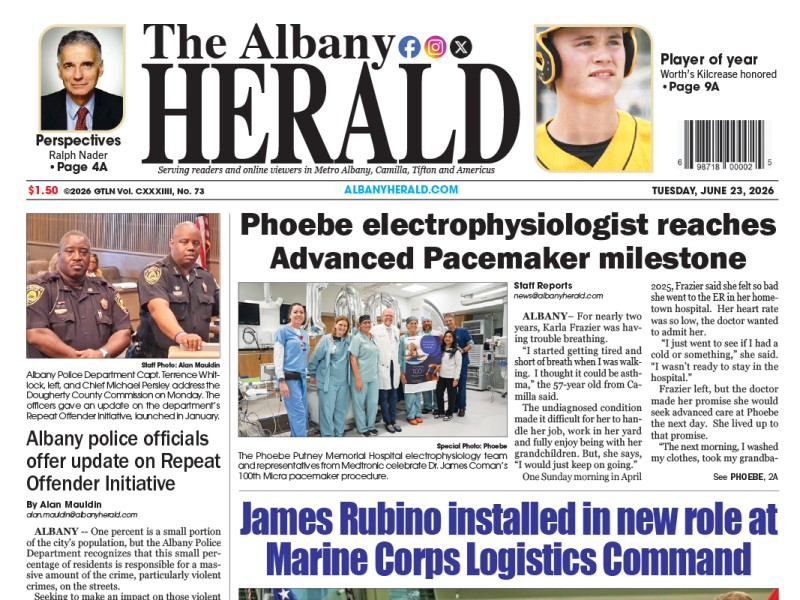
Albany Herald – June 23, 2026
Phoebe electrophysiologist reaches Advanced… Albany police officials offer update… James Rubino installed in new role at…

Classifieds – June 23, 2026
ALBANY HERALD CLASSIFIEDS JUNE 23 2026
Albany police investigate suspicious Sunday death
A 21-year-old Turner Job Corps student who was found unresponsive on Sunday evening was later pronounced dead at Phoebe Putney Memorial Hospital. The death is under investigation.
