
Georgia loses third of cotton crop to Hurricane Helene
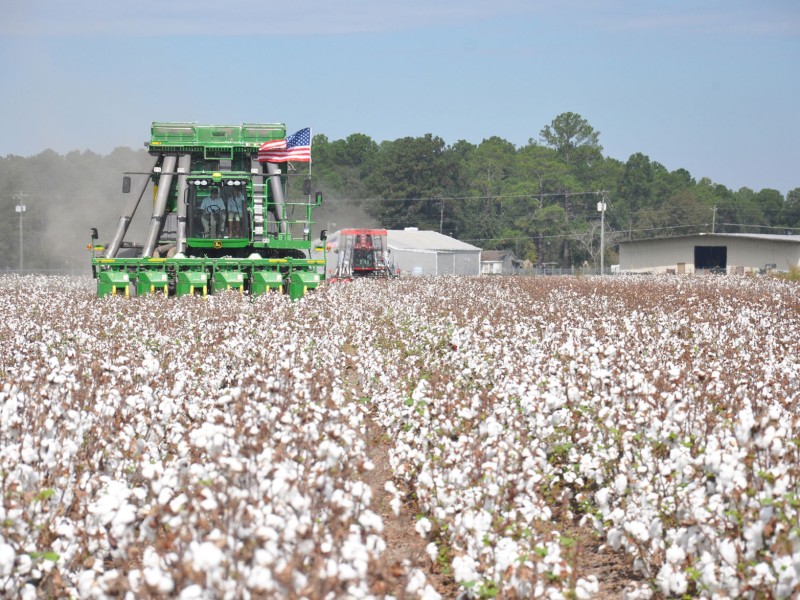
Early reports indicate Georgia cotton farmers lost as much as a third of their crop due to Hurricane Helene.
File PhotoStaff Reports
[email protected]
PERRY — Hurricane Helene made landfall in the Big Bend of Florida on Sept. 26 as a Category 4 hurricane. It was one of the largest and fastest storms to ever make landfall in the continental United States, measuring around 350 to 420 miles wide, and moving up to 30 miles per hour over land.
These factors are part of what made this storm so devastating for the Southeastern U.S. The USDA Crop Progress report the week prior to Hurricane Helene showed that 68% of Georgia’s cotton crop had open bolls, with only 1% harvested. This made the majority of our state’s cotton crop susceptible to direct yield losses from this particular storm.
In the week leading up to Hurricane Helene’s landfall, the Georgia Cotton Commission and the UGA Cotton Team were in close contact and formulated a plan to determine yield losses. UGA County Extension agents were asked to find defoliated fields in their counties and hand harvest 10 row feet from these fields to determine yield potential prior to Hurricane Helene.
After the storm passed through and it was safe to get out, agents returned to the same fields from which “pre-storm” samples were collected and harvested 10 row feet in the same area of the same field to determine yield losses as well. Although many fields were ready to defoliate, very few had actually been defoliated prior to Hurricane Helene. Therefore, yield losses were quantified in an additional way.
After the storm, agents were asked to sample fields in their counties to determine actual yield losses on cotton that had yet to be defoliated. This was done by collecting cotton that was no longer harvestable (i.e. had fallen on the ground) in a 30-square-foot area in grower fields. This cotton also was ginned to determine lint yield losses in these fields. To determine a percent loss, growers were asked about historic yields in these fields and what the anticipated yield for 2024 was. A total of 100 samples were collected from 34 counties, including pre/post samples and samples off the ground.
Averaged across all samples received (from areas severely impacted and other areas that weren’t), the state of Georgia lost 32.6% of it’s cotton crop in response to Hurricane Helene. Losses ranged from 0 to 90% statewide, dependent upon location within the state and stage of the crop at the time Hurricane Helene passed through Georgia. In areas east of Interstate 75, losses were more likely to be severe than in other parts of the state.
USDA projected that Georgia was going to produce approximately 2.1 million bales prior to Hurricane Helene, and this number would suggest farmers lost 684,600 bales. An additional form of income for cotton growers is cottonseed, which in many cases helps pay for ginning costs, and in good years growers will get a rebate from the gin. Based on this data and assuming 50% of the crop is cotton seed, the state lost 205,200 tons of cotton seed.
Additionally, previous work has demonstrated that a quality loss of 10 cents per pound can be assumed following a hurricane. Quality data from growers following Hurricane Helene has confirmed this, with reductions in color grade, increases in trash, higher leaf grades, and increased likelihood of extraneous matter issues noted. Below is a table highlighting the aforementioned losses.
Table 1. Cotton loss estimates in Georgia due to Hurricane Helene.
Lint Yield 684,000 bales $0.72/lb. — $236,390,400
Seed Yield 205,200 tons $226/ton — $46,375,200
Fiber quality 1,416,000 bales $0.10/lb. — $67,968,000
TOTAL $350,733,600
Experts do not yet know the full extent of what was lost due to Hurricane Helene. These are direct yield and quality losses due to the hurricane in the fields sampled by UGA County Extension agents, and many assumptions have been made. Many fields had more severe losses than those mentioned here, and there were some that weren’t as severe. Additionally, approximately 30% of the state’s cotton crop was planted in the month of June, and much of that cotton was not as susceptible to direct losses from Helene. However, there will be indirect losses associated with lodged cotton, boll rot, hard lock, and additional quality losses as well.
Author

Related Articles
Dawson proposes borrowing up to $420,000 to stay afloat as finances unravel
Documents obtained by The Dawson News show city officials are proposing to balance the budget through a transfer from the Public Utilities Fund while simultaneously seeking authority to borrow as much as $420,000 from a private financial institution to continue meeting payroll and other operating expenses as Dawson works to complete financial audits that have remained unfinished since 2023.

Regional catering business finds new home at Warrior Creek Mercantile
For months, Marchbanks said she had been asking God for an opportunity to serve others. “I just kept praying, ‘God, use me as a servant,'” she recalled. “I didn’t care what it was. I just wanted to be used to help people.”

Leesburg business reflects growing trend toward multi-use downtown spaces
Beyond the pristinely curated lunch spot, owner Sheri Smith has created a small hub of health and wellness services, retail and local partnerships — an example of the type of multi-use business model many small communities are increasingly embracing as they reinvest in historic downtown properties.
