
New ‘Tif3D’ turfgrass promises superior putting-green performance
Special Photo: UGA/CAES
By Emily Cabrera
turf.caes.uga.edu
TIFTON — After nearly a decade of research trials, University of Georgia College of Agricultural and Environmental Sciences turfgrass breeder Brian Schwartz and a dedicated team of colleagues and industry partners released a cutting-edge bermudagrass variety called “Tif3D” earlier this year.
“Tif3D” is a specialty grass developed specifically for putting greens and boasts the unparalleled performance and playability putting greens require, said Schwartz, a professor in the CAES Department of Crop and Soil Sciences. The turf’s name is derived from its development on the UGA Tifton campus and the variety’s unique dark, dense and durable characteristics.
The meticulous maintenance of a putting green is a key part of a golf course superintendent’s role. Because grasses on putting greens are trimmed daily to less than an eighth of an inch, these varieties are carefully bred and selected over years of development for specific qualities, added Schwartz, a member of UGA’s Institute of Plant Breeding, Genetics and Genomics. The new variety is a hybrid bermudagrass that descends from “TifGreen,” one of the first hybrid bermudagrasses released from CAES in the 1950s by world-renowned research geneticist and plant breeder Glenn Burton.
With its dense, fine-textured canopy, great uniformity, and superior resistance to stressors including drought and scalping, Schwartz said “Tif3D” is the latest attempt to meet the critical aesthetic demands of the golf industry. With a total economic impact of $5.3 billion, direct economic activity from golf facilities and golf-related businesses amounts to $3.4 billion per year, according to the Georgia State Golf Association 2024 economic impact summary.
Because golf course superintendents often wait to see how a turf variety performs before making a new investment, establishing “Tif3D” in the marketplace will take time as courses upgrade their greens.
“They prefer to see results with their own eyes rather than rely solely on research findings,” Schwartz explained. “It’s a huge financial commitment for a course manager to renovate their greens, so the process of building trust and demonstrating the long-term performance of new grass varieties takes years, even decades.”
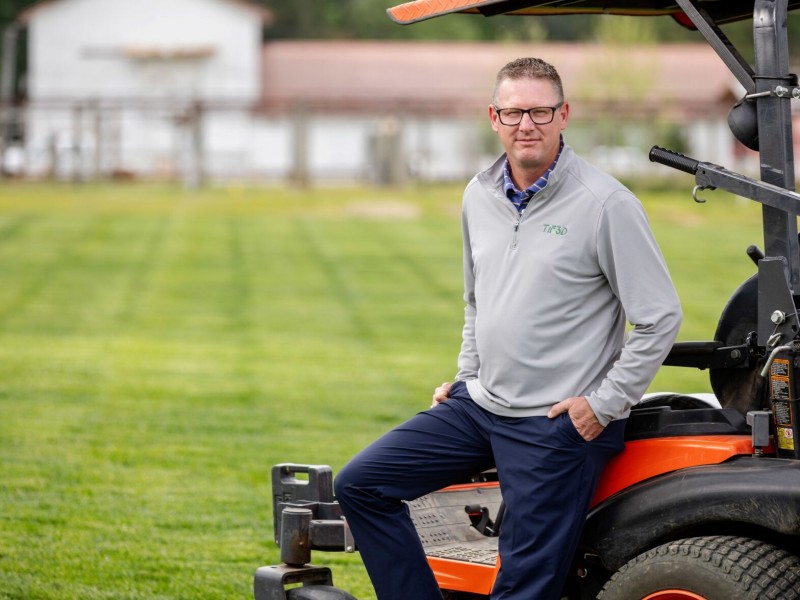
Jonathon Fox, a research professional for the UGA turfgrass breeding program, works with Schwartz to manage turfgrass research plots with a keen eye for the intricacies golf courses require.
Schwartz and Fox conduct trials at golf courses and research facilities across Georgia, Florida, Louisiana, Arkansas, Tennessee and Texas so superintendents can see various grass varieties first-hand and evaluate how they respond to their specific management techniques and microclimates.
“Our relationships with superintendents are built on trust,” Fox said. “That means we communicate the things that work and the things that don’t. Trust is paramount in this industry. When we introduce a promising variety like ‘Tif3D’, it’s backed by years of rigorous testing and ongoing trials and on open lines of communication.”
Rows of containers are lined up in a greenhouse where turfgrass varieties are being grown for research.
Because turfgrass is a perennial crop grown in a variety of locations, with countless differences in site management, drainage, sunlight, pests and diseases, it can take decades to complete research programs before a variety is released to the public.
Schwartz collaborated with the Georgia Golf Environmental Foundation and the U.S. Golf Association to grow enough ‘Tif3D’ bermudagrass to install trials at 23 golf courses in the Southeast to demonstrate the new cultivar’s superior performance before it officially became available.
Tyler DaSilva, an assistant superintendent at Kinderlou Forest Golf Club in Valdosta, worked with Schwartz as an undergraduate at neighboring Abraham Baldwin Agricultural College in Tifton. He said his experience working in the breeding program and establishing turfgrass trials on golf courses in Georgia and Florida has been one of the biggest assets to his career.
DaSilva agreed that the practical application of new varieties takes time.
“Because the sport of golf depends on precision and consistency, making management decisions is like walking a tightrope,” DaSilva said.
You don’t want to roll the dice when you’re working with a long-term investment that is the playing field for high-stakes tournaments. Knowing the varieties coming out of UGA are backed by reputable science is a great resource to the industry in Georgia.
Much of the work Schwartz and other turfgrass breeders do is centered on developing cultivars with the effects of climate change in mind. Schwartz said because “Tif3D” has shown superior resistance to drought and other stressors, it is well-suited to areas where water conservation is a priority. He added that the secret to the success of many CAES-bred turfgrasses is the location where they are bred.
“I always say that because the geographic location of Tifton is so bad, it’s perfect,” he mused. “We have drought, rainy seasons, countless plant diseases, nematodes, and funny spring and fall weather anomalies that all serve to kill plants. We put our grasses through some of the hardest conditions here to find the toughest individuals that will perform the best. If it survives Tifton, you have a great chance of growing it elsewhere. It’s so bad, it’s good.”
Schwartz credits much of his success and that of the turfgrass breeding program to the foundational work and valuable lessons he learned from his predecessor and mentor, Wayne Hanna, an esteemed turfgrass breeder in Georgia for more than 40 years. “TifTuf,” which the two developed and co-released in 2014, became one of the fastest-adopted bermudagrass varieties worldwide for its superior drought- and stress-tolerance.
Because it takes years to bring new turf cultivars to market, Schwartz said the unique relationships the turfgrass breeding program has with the Georgia Crop Improvement Association, Georgia Seed Development, and sod growers help ensure long-term support and mutually beneficial results.
Due to the similarities between “Tif3D” and the lab’s previous gold-standard varieties, like “TifEagle,” Schwartz said he is confident that UGA’s state-of-the-art research facilities and dedicated team of experts will continue to keep the industry at the forefront of sustainability and performance.
“These strong ties have created a long-term, cyclical pipeline for developing and maintaining a strong turfgrass industry in Georgia,” he said.
Learn more about the UGA Turf Team, a multidisciplinary team of scientists addressing all parts of the turf industry, at turf.caes.uga.edu.
Author

Related Articles
Dawson proposes borrowing up to $420,000 to stay afloat as finances unravel
Documents obtained by The Dawson News show city officials are proposing to balance the budget through a transfer from the Public Utilities Fund while simultaneously seeking authority to borrow as much as $420,000 from a private financial institution to continue meeting payroll and other operating expenses as Dawson works to complete financial audits that have remained unfinished since 2023.

Regional catering business finds new home at Warrior Creek Mercantile
For months, Marchbanks said she had been asking God for an opportunity to serve others. “I just kept praying, ‘God, use me as a servant,'” she recalled. “I didn’t care what it was. I just wanted to be used to help people.”

Leesburg business reflects growing trend toward multi-use downtown spaces
Beyond the pristinely curated lunch spot, owner Sheri Smith has created a small hub of health and wellness services, retail and local partnerships — an example of the type of multi-use business model many small communities are increasingly embracing as they reinvest in historic downtown properties.
