
City, county face budget challenges
Carlton Fletcher
ALBANY, Ga. — There’s a general feeling among officials whose offices take up the fifth floor of the downtown Government Center that this year’s budget process may be the most closely scrutinized of their tenure.
As Dougherty County Administrator Richard Crowdis notes, the “low-hanging fruit” of budget cuts has been picked. Now county and city of Albany leaders have to make some hard decisions that will not only impact the services provided citizens in the community, they could impact employees’ jobs.
“We’re already closely scrutinizing our personnel,” City Manager James Taylor said. “We’ve started by not rehiring to fill nonessential vacancies, but I don’t know at this point if that will be enough. We hate to use those ugly words (job cuts), but we might have to.”
The combined city and county budgets account for a little less than $200 million in taxpayer money used for such services as garbage collection, road repairs, police and fire protection, EMS services and planning. But with a crippling recession lingering in the region, the taxpayers who are footing the bill are demanding wiser use of the funding.
“People say ‘You have to cut back like we do,'” Crowdis said. “What they don’t seem to consider is that demand (for services) does not go down in a recession. We don’t have less people coming to the tax office, to the courts, getting birth certificates and marriage licenses. The miles of pavement and the drainage ditches in the county haven’t shrunk.
“If we cut back on personnel and suddenly the lines of people waiting for services are out the door, the citizens want to know why. That doesn’t mean we can’t scale back, but we have to do it cautiously.”
WAKEUP CALL FOR CITY
City officials got a sobering shot of reality during a pre-briefing before their Tuesday business meeting. Meredith Lipson with the Mauldin & Jenkins CPA firm told city officials that while their finances had a “clean” finding in the firm’s audit for Fiscal Year 2012, the city had more total expenditures ($58 million) than revenue it had generated ($57 million).
“I’m hoping that’s a wakeup call,” Taylor said of the audit. “I’m hoping that information did not get lost on our commissioners. I continue to restate to them what should be obvious: You can’t continue to spend more than you take in and expect not to go broke.”
Taylor said he’s early in the process of putting together the city’s Fiscal Year 2014 budget plan, but he says he has a four-tiered approach that he hopes will stop the flow of red ink. That plan:
- Paint a definite picture of the fiscal challenges the city has.
- Present areas that have an opportunity to generate additional revenue short of raising property taxes.
- Present ways to save money.
- Come up with a list of possible money-saving ideas, determine which ones the majority of the commission will support and go after them.
“As you could see this year, if the majority of the commission is not willing to support these ideas, it’s useless to pursue them,” said Taylor, who in the last four months offered ways to cut some $3 million from the city’s budget, only to have the commission vote against the measures.
The city manager said he’s tasking staff with finding creative and outside-the-box ways to cut costs, mentioning such ideas as closing or reducing use of the Albany Civic Center, closing certain gyms and community centers in the city or arranging schedules so that less staff can manage them, closing seldom-used community policing centers, selling or even giving city parks to adjacent property owners, privatizing or dramatically changing management of the city cemetery.
“You go by those community policing centers at any random time, and there’s a good chance nobody is there,” Taylor said. “And they’re located on potentially highly commercial plots. Why couldn’t we put them on the market and have a more mobile policing center?
“And at the cemetery, citizens are getting perpetual care for a very low cost. If everyone took care of their plot, that would be one thing. But they don’t, and that’s a lot of grass to cut. If we don’t get out of the cemetery business, we might look at taking the grass out and putting down gravel to cut maintenance costs.”
Taylor said the seven-person City Commission is going to have to make some decisions that may not be popular with some of their constituents.
“I can show (commissioners) the benefits, and I can show them what might happen in the future if they don’t (follow through on recommendations),” the city manager said. “But I don’t get a vote. I don’t believe we’re going to see a return anytime soon to those days when the city was flush with funding, so we’re going to have to get creative and make some bold moves.
“I keep pointing out that we have sources of income right now — the MEAG credits, a decent-sized fund balance and an enterprise fund — that are bringing in between $5 million and $6 million that we won’t have in three or four years. And the other night I had an epiphany: Not only will the city no longer get MEAG credits, Water, Gas & Light won’t either. We have to start preparing now.”
COUNTY’S TOUGH LESSONS
Forced to raise taxes in the county’s special unincorporated district for the first time in a decade, Dougherty County commissioners have taken a proactive approach in buiulding toward their FY 2014 budget. Under orders from Commission Chairman Jeff Sinyard and under the guidance of Crowdis, the county’s Finance Committee has met with department managers and elected department heads on an almost weekly basis to get a better grasp of budgetary needs.
“We’re different from the city because 53 percent of our budget goes to elected offices,” Crowdis said. “Counties are like subcultures of the state, and with elected offices there are specific mandated expenditures that we must make. There are certain things the clerks and judges and health department and the sheriff’s office are mandated to have, and those fall under our budget.”
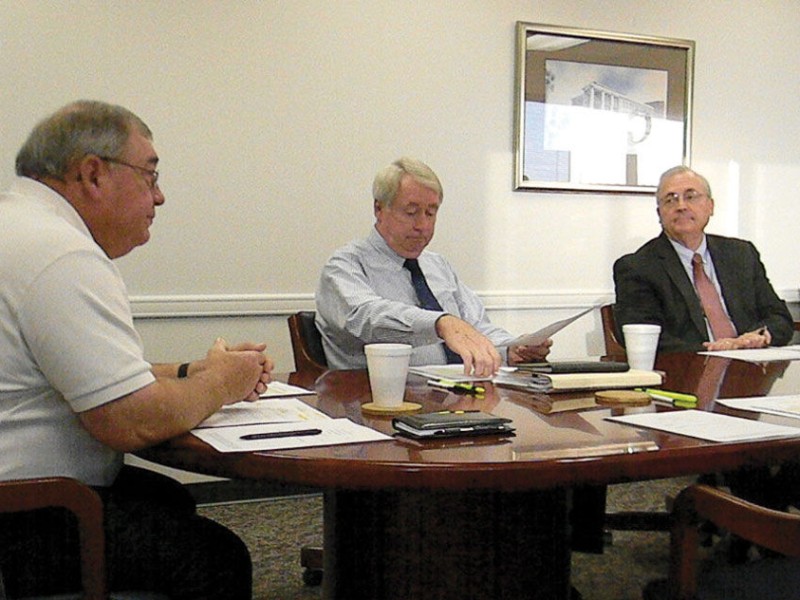
The Finance Committee — Commissioners Lamar Hudgins, John Hayes and Ewell Lyle — have been meeting with department managers to discuss their specific budget needs, a process that Sinyard said should prove beneficial.
“The purpose of these meetings is for our folks to hear and understand the specific needs of each (department’s) individual budgets,” the commission chairman said. “With no apparent significant increase in revenue projected, we’re going to have to spend the money we have wisely and fund the right things.
“We took a beating during last year’s budget process, so we’ve made looking at ways to tighten our budget our primary focus this year. The economic climate is difficult right now, so we’re going to analyze every dollar we spend to make sure we have a balanced budget and no new taxes.”
Crowdis distributed budget forms to department managers Jan. 17, and each will submit budget requests to Finance Director Martha Hendley by March 4. Those managers, and elected officials who are heads of various departments, will meet with Crowdis on an individual basis, and he will present an initial budget to the Finance Committee May 6.
That committee will fine-tune the budget and present it to the entire commission June 3. Once final tweaks are made, the budget will be adopted at a called meeting June 24.
“I think these meetings we’re having allow us to make this process even more fluid,” Hudgins, the Finance Committee’s chairman, said. “And where we get a clearer understanding of each department head’s needs, I think they also get a better picture of what we’re working under.
“I think we’ll get a clearer understanding of where we are once we get our audit report. We’re hoping that increased revenues will mean a positive audit.”
Crowdis said preliminary figures indicate the county will have to transfer considerably less than the $1.99 million from reserves it had drawn into the budget to take care of projected shortfalls.
“I feel like we’re going to come out much better in the audit than we had projected,” the county administrator said. “But we always try to project revenue and expenditures conservatively. Still, we know that the economy ebbs and flows in cycles, that while we may have some good years, there is going to be a recession down the road.
“That ‘do more with less’ thing is easy to say but a lot more difficult to do. We have to be able to balance the level of services we provide with the mandated costs of the elected offices we finance. Our departments have to get used to the fact that there is only so much money to go around.”
Related Articles
Small actions can help save big on utility bills
The high temperatures of July and August can bring scorching utility bills as air conditioners hum to keep houses cool. Albany Utilities Residential Conservation Auditor Willie Jackson offered some tips on making summer cooling bills more manageable.
Bigger budget will mean improvements at Dougherty County’s landfill
“It’s certainly an opportunity where we can grow and make this very beneficial for years to the community. It’s a service that we provide for the community and I want to prolong that resource for the community. It’s not just fill it up and close it.”
Putting on the Ritz: The rise, fall and renewal of Albany’s Harlem District
On July 7, the Albany City Commission unanimously approved final construction drawings for a comprehensive restoration of the Ritz Theatre and Cultural Center, clearing the way for the project to move into competitive bidding after years of planning and preservation efforts. The decision marks the latest chapter in a decades-long effort to preserve one of Southwest Georgia’s most significant African American landmarks.
