
City of Albany proposes $128 million FY 2015 budget
Carlton Fletcher
ALBANY — City Manager James Taylor gave the Albany City Commission and other department heads a first look at the city’s Fiscal Year 2015 budget at a called commission meeting Wednesday morning.
Taylor told city officials he and staff would be working in the coming weeks to fine tune a $128,130,143 proposed budget that includes a 2 percent cost of living adjustment for all employees, fully funded workers’ compensation, group insurance rate increases and no funding for downtown attractions.
Taylor said after the session he doesn’t expect a lot of changes to the budget package, which includes an $82,607,605 balanced general/special funds budget and a $45,522,493 enterprise fund budget. The city manager noted, though, that a budget for the city’s Water, Gas, Light & Telecommunications department was not part of Wednesday’s presentation.
“My core budget team has been working long and hard with me to prepare this budget,” Taylor said. “If any of them falls over while I’m talking, it’s not that they’re bored. They’re exhausted.
“But we’re now moving into a time crunch. We still have work to do and not much time to do it.”
As promised, the proposed FY 2015 budget includes a cost-of-living increase for the city’s 917 full-time employees that will add some $848,000 to the budget. Another factor that plays into the $1.9 million general/special funds increase over the $80,651,427 FY 2014 budget is $1,030,659 in additional insurance funds. Meanwhile, equipment depreciation of $7.5 million, $3.4 million in new stormwater costs and $3.1 million in transit fees pushed the enterprise fund budget up by $13.7 million over 2014.
Finance Director JoEllen Brophy explained that that while depreciation has always been a part of the city’s financial planning procedure, it is listed on the budget for the first time this year as required by state law.
Noting the costs associated with the city’s Transit Authority, Ward V Commissioner Bob Langstaff asked if purchasing would investigate the possibility of buying vehicles that use compressed natural gas as a possible cost-cutting measure. CNG costs are currently about half that of gasoline and diesel fuel.
Told that Transit expects to purchase 11 new buses, Langstaff said, “I know it’s a complicated analysis, but I can’t imagine we’d let 11 new buses go through without analyzing (possible cost savings by purchasing CNG-ready vehicles). How long do these buses last?” When Transit Director David Hamilton responded, “Ten years,” Langstaff said, “If we don’t look into this now, it will be that much longer before we can act.”
Taylor said he’d looked into the conversion of city vehicles from gas/diesel to CNG and found the process to be too costly. “And keep in mind,” Central Services Director Stephen Collier added, “we can’t work on CNG vehicles in our shop.”
Taylor noted that the balanced budget would require a $1,979,545 transfer from the city’s fund balance, primarily to subsidize enterprise fund entities such as the Albany Civic Center.
“The Civic Center costs us about a half-million dollars more than it takes in,” the city manager said. “And that’s with an additional $1 million in hotel/motel tax money. It’s really closer to a million and a half dollars. That’s why I think we have to take a close look at outsourcing management. I think we need to look at contract services for areas like HR and IT as well.”
Taylor said the city would need to address budget issues through a five-year plan that would include taking a closer look at reduction of operating costs, improving fuel consumption, sale of surplus property, take-home vehicles, consideration of a fire fee that would require tax-exempt entities to pay for the service, weening the city off Municipal Electric Authority of Georgia credits (which end in 2018) and making enterprise funds self-sustaining.
“I would strongly recommend that you (city commissioners) take a close look at the fire fee,” Taylor said. “The folks who don’t pay property taxes in the community are getting a free ride.”
Taylor also mentioned other issues on the horizon that will impact the city’s long- and short-term bottom line.
“I think it’s important that you keep in mind that there is $4.4 million in accumulated sick and vacation leave on the books,” he said. “I don’t want anyone to be surprised. And House Bill 60 scares the bejesus out of me. That’s the new gun bill, and it could force us to put out a considerable amount of money for armed security at city functions.”
The board also asked City Clerk Sonja Tolbert to advertise an opening on the city’s Water, Gas & Light Commission board to replace Rashad Flournoy, who recently resigned from the board. Ward III Commissioner B.J. Fletcher told Tolbert that applicants should be informed of the requirements and meeting schedule of the board so that issues such as Flournoy’s inability to attend meetings during work hours could possibly be avoided.
Related Articles
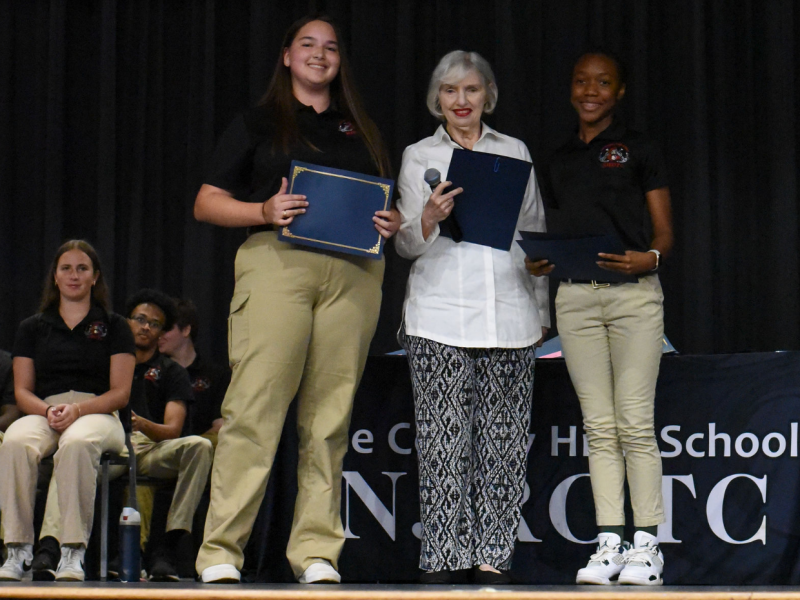
Lee County JROTC cadets honored by DAR for citizenship and leadership
Several Terrell County High School JROTC cadets were recognized for outstanding citizenship, leadership and service during the school’s recent JROTC Honors Night, receiving awards from the Old Herod Chapter of the National Society Daughters of the American Revolution.

Dawson police arrest wanted suspect after Flock Safety camera alert
According to police, May drove into the yard of a nearby residence instead of complying with officers’ commands. He then exited the vehicle and ran into the home on foot.
USDA expands drought assistance as Terrell County farmers continue recovery from dry conditions
As Southwest Georgia farmers continue to recover from prolonged drought conditions that affected planting and crop production this year, the U.S. Department of Agriculture is reminding producers that a range of federal disaster assistance programs remain available while also expanding relief payments through its Supplemental Disaster Relief Program.
