
County approves 198-foot Gillionville Road cell tower; no speakers at public hearing
Dougherty County commissioners unanimously approved a 198-foot cell tower behind a church on Gillionville Road, with no one speaking for or against it at the public hearing.
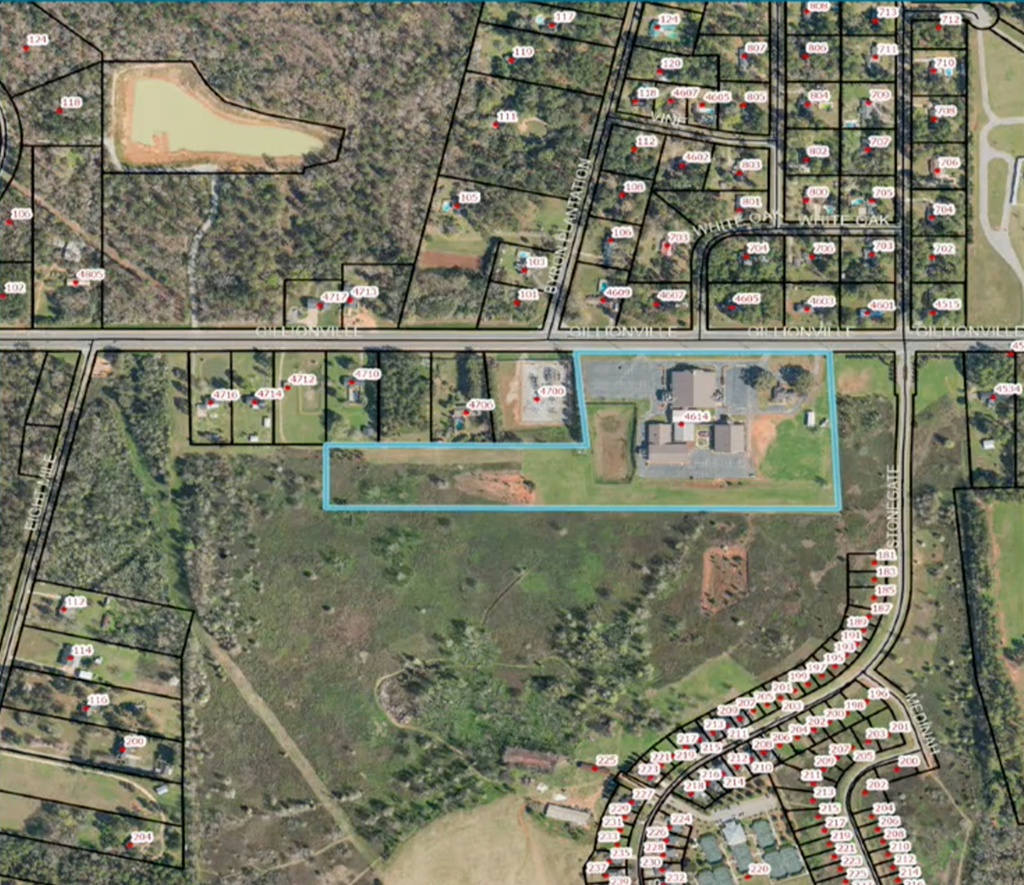
ALBANY — Dougherty County commissioners unanimously approved a 198-foot cell tower behind a church on Gillionville Road, with no one speaking for or against it at a public hearing.
Commissioners raised no questions about radio frequency emissions. The applicant’s site plan places the nearest home about 426 feet from the proposed tower.
At their Sept. 21 meeting, commissioners rezoned about a quarter-acre at 4614 Gillionville Road to C-3c, commercial conditional, limiting its use to a telecommunications facility. They also granted special approval for the tower. The county’s published zoning ordinance requires that special approval be granted for towers taller than 150 feet in specified districts, including C-3.
Gillionville Forest Baptist Church owns the 21.39-acre property. Diamond Communications is the applicant.
Commission Vice Chairman Ed Newsome presided in the absence of Chairman Lorenzo Heard.
Johnthan Yates of Diamond told commissioners the tower would address gaps in Verizon coverage along Gillionville Road, Eight Mile Road and Byron Plantation Road and in the Stonegate neighborhood.
“And most importantly, Live Oak Elementary,” Yates said. “We have to improve the coverage in Live Oak Elementary.”
He called the site “the perfect location” because it sits directly behind a Georgia Power substation at 4700 Gillionville Road. He described the pairing of wireless and power infrastructure as “utility with utility.”
District 6 Commissioner Anthony Jones asked Yates to relay concerns about poor coverage on Fleming Road, County Line Road and elsewhere in east Dougherty County.
Newsome then told Yates, “If there’s any interest in a location for a site, I may have something. I would like to talk to you.”
Angel Gray, the county’s deputy planning director, said the tower would improve signal strength without adding meaningful traffic. She said it would be unlit, surrounded by a fence at least 6 feet tall, and buffered by trees and existing vegetation.
Gray said the facility would stand 500 feet from the nearest edge of the public right-of-way.
She acknowledged that the rezoning conflicts with the county’s future land use map, which designates the parcel for low-density residential use.
“However, the installation of a cell tower, while not residential, is not a use type that increases traffic or noise,” she said.
District 3 Commissioner Clinton Johnson asked whether the tower site would be separated from the church property for taxation. Gray said it would become a separate, landlocked parcel “so that the parcel itself can be taxed.”
Johnson also questioned a site-plan label identifying the tower area as M-1c, an industrial district. Gray said the label likely came from a preliminary application and that C-3c was the actual request.
The Albany-Dougherty Planning Commission recommended approval 5-0 on Sept. 3.
The church property is L-shaped. The tower site lies in a narrow strip extending west behind the substation and a row of homes on the south side of Gillionville Road.
The plans show a 100-by-100-foot rezoning area, about 0.23 acres, containing a 50-by-50-foot equipment compound. A 30-foot access and utility easement would serve the facility.
The nearest home is farther from the tower than the tower’s height and outside the applicant’s labeled 70-foot engineered “fall radius.” That label describes the proposed failure design; it does not, by itself, establish that all debris would remain within that area.
Staff’s presentation identified the adjacent land use as residential and stated that “setback requirements will keep any impacts on-site.” The site plan shows a property line behind the homes 209 feet from the tower and another line 75 feet to the south.
The published ordinance provides a twice-height setback standard when a tower site abuts residential districts, public property or a public street. For a 198-foot tower, that distance is 396 feet. It also requires stealth construction within 500 feet of residentially zoned property unless commissioners approve otherwise. The drawings depict a gray, galvanized-steel monopole. Neither provision was discussed during the hearing.
The tower drawing places Verizon antennas at 190 feet and shows three additional mounts for future antennas. Adding carriers could increase RF emissions, though the drawings alone do not establish future exposure levels.
The published ordinance requires a building permit application to include an environmental impact statement addressing surrounding residences and “the radiological impact on human health,” along with a structural report from a Georgia-licensed engineer.
Federal law limits local authority over RF concerns. Under the Telecommunications Act of 1996, local governments cannot regulate wireless facility placement based on the environmental effects of RF emissions when the facility complies with Federal Communications Commission rules.
FCC public exposure limits apply to people of all ages and are intended to accommodate continuous exposure. Compliance at this location would require an assessment of the proposed equipment and operating conditions.
A World Health Organization backgrounder published in 2006 concluded that available research did not provide convincing evidence of adverse health effects from the weak RF signals typical near base stations. That general assessment does not establish the exposure level at this proposed site.
Related Articles

An insider’s (semi-fictionalized) look at Cruising Albany’s Slappey Boulevard
Graylon Brunson has written and published a pair of books about Cruising Slappey Boulevard as a teenager.
Who’s not paying?
Nearly 1 of every 5 dollars of property value in Dougherty County pays no property tax at all.
With new assessment notices hitting hard after Dougherty’s first full revaluation since 2007, and many residents are facing sharply higher values, the question of who carries the tax base is no longer abstract.

‘We train leaders’: Albany’s Marl McCracken honored for 70 years of combined service
McCracken’s path to service began even before his military career. Growing up in western New York, he spent two years in Civil Air Patrol before enlisting in the Air Force at 17 in September 1955.
