
Who’s not paying?
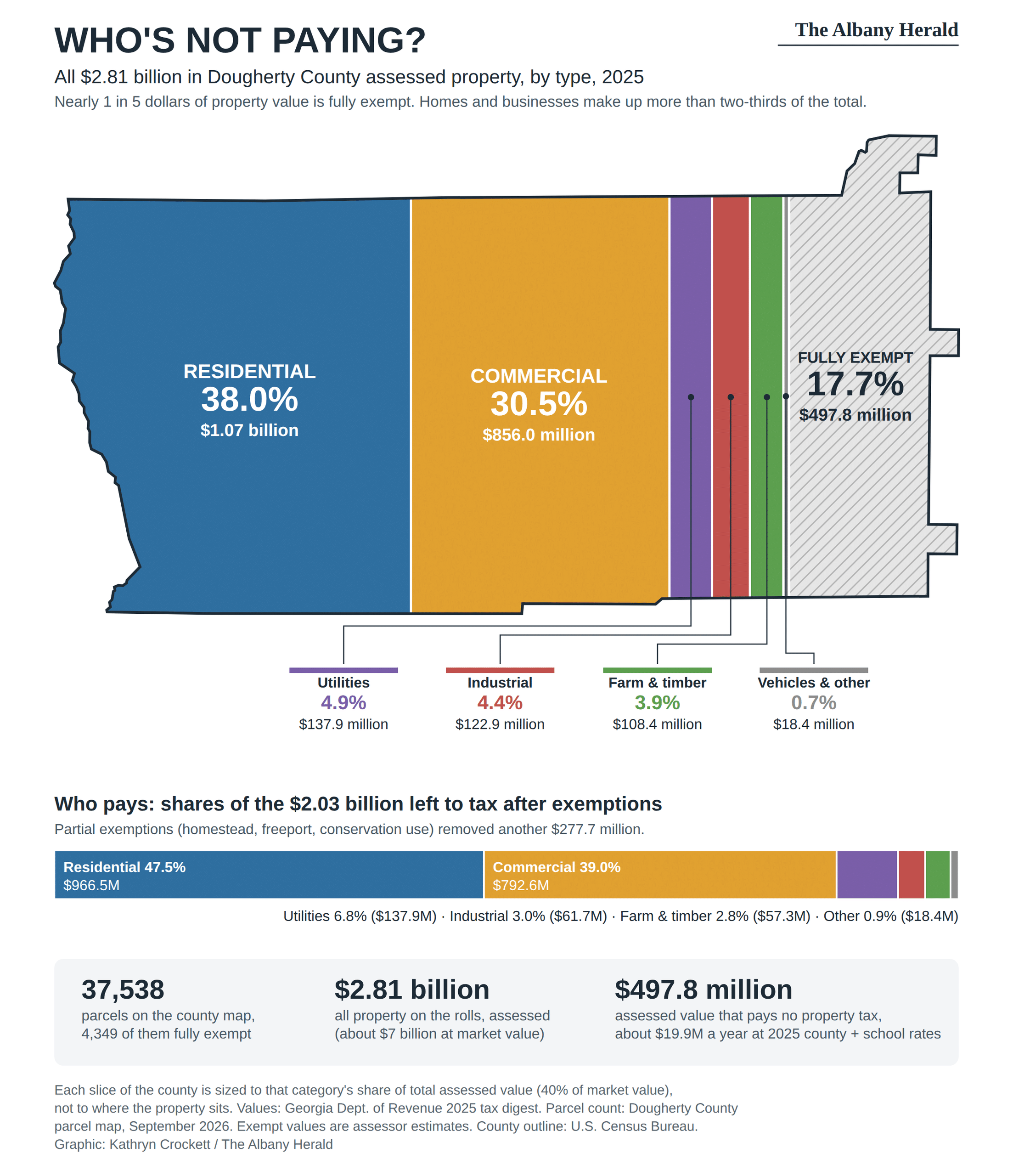
Nearly 1 of every 5 dollars of property value in Dougherty County pays no property tax at all.
With new assessment notices hitting hard after Dougherty’s first full revaluation since 2007, and many residents are facing sharply higher values, the question of who carries the tax base is no longer abstract.
More than $1 billion in Dougherty County property is exempt from property tax. Here’s who holds it, and what it means for everyone else.
ALBANY — Nearly 1 of every 5 dollars of property value in Dougherty County pays no property tax at all.
Government buildings, hospital campuses, churches, charities and two of the county’s largest factory sites sit outside the tax base. Together they hold $497.8 million in assessed value, about $1.24 billion at market value, according to the 2025 state tax digest. That equates to 17.7% of all property on the county’s rolls.
The rest of the county pays for everything that property doesn’t. With new assessment notices hitting hard after Dougherty’s first full revaluation since 2007, and many residents facing sharply higher values, the question of who carries the tax burden is no longer abstract. Here’s how the bill is being split.
How the base breaks down
Property taxes start with what a property is worth. In Georgia. Only 40% of that value is used to calculate the tax bill. For a home worth $100,000, that means taxes are calculated on $40,000. That $40,000 is called a property’s assessed value.
Add those assessed values together across Dougherty County, and the 2025 total was about $2.31 billion, representing 40% of property worth roughly $5.78 billion. That list of property and values is called the county’s tax digest. Tax breaks, called exemptions, further reduce how much of that value can be taxed, and local tax rates determine how much owners pay.
Before tax breaks, homes and rental housing accounted for 45.6% of the county’s assessed property value. Commercial property — including business buildings, equipment and inventory — accounted for 37%; utilities, 6%; and industrial property, 5.3%.
Tax breaks reduced the amount available to tax for schools by $277.7 million, leaving about $2.03 billion. These breaks include homestead exemptions for people who own and live in their homes, reduced taxable values for qualifying farmland, and the Freeport exemption, which removes the full value of qualifying business inventory from taxation.
Those breaks also change how the tax base is divided. After exemptions, homes and rental housing accounted for about 47.5% of the value subject to school taxes, and commercial property about 39%. Industry’s share fell to 3%, largely because qualifying inventory was no longer counted. These percentages describe taxable property value, not the number of properties or owners.
Put simply, if some owners get a tax break and the community’s bills stay the same, everyone else has to make up the difference. But some properties get more than a break. They pay no property taxes at all.
Who isn’t paying
Fully exempt property pays no property tax. Its value remains on the county’s records but is left out when calculating taxes. In 2025, Dougherty County listed $497.8 million in fully exempt assessed value. That figure measures property value, not unpaid taxes. The chart below shows how it breaks down:
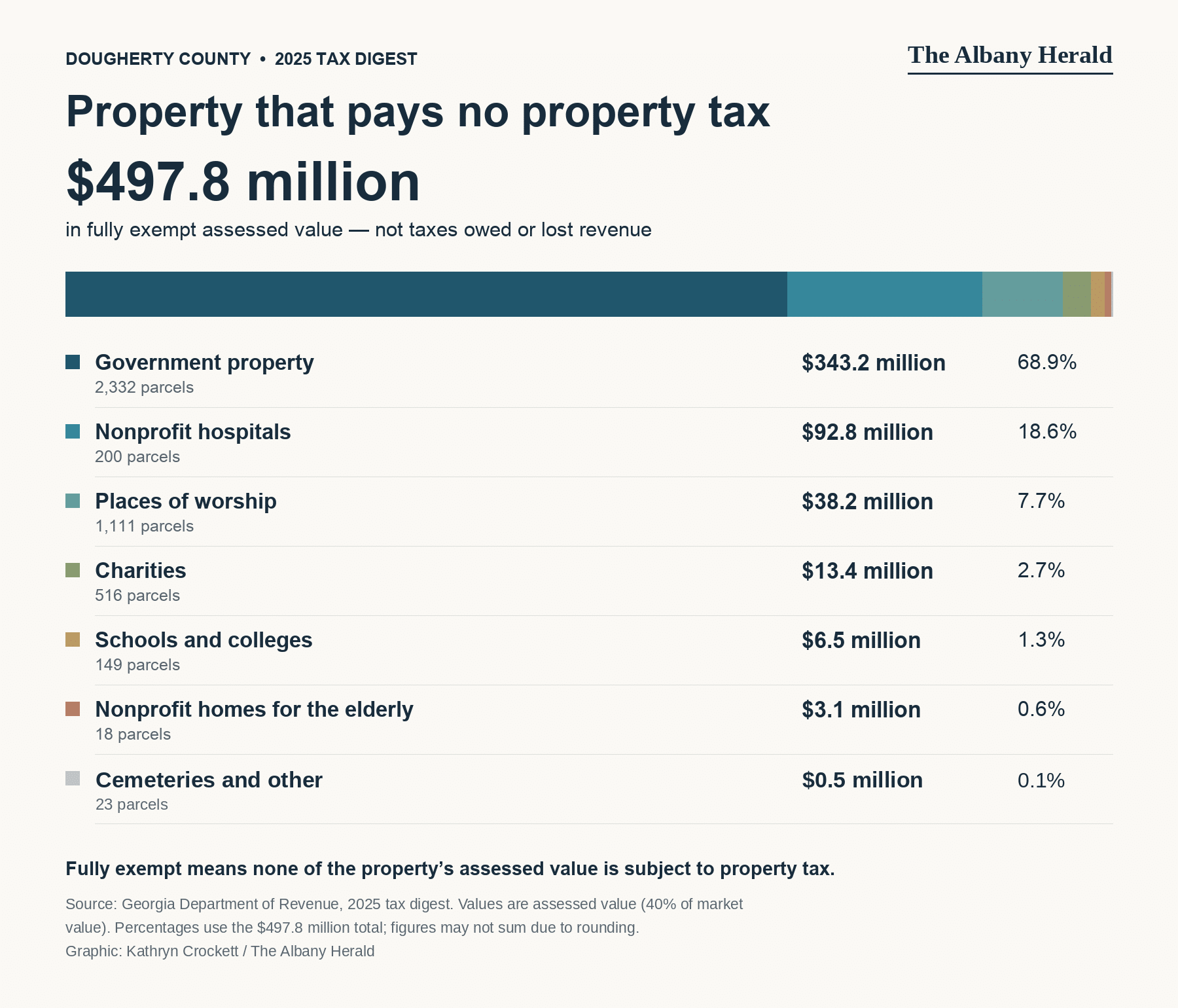
County parcel records, which carry market values from a 2020 appraisal, the most recent available online, show who holds the most.
- The Albany-Dougherty Payroll Development Authority, about $207 million. It is the single largest holder of exempt property in the county. County records list the authority as owner of the Procter & Gamble paper plant on Liberty Expressway, valued at $80.8 million, and the Molson Coors brewery on Cordele Road, valued at $30 million, among other industrial sites.
Georgia counties often use this arrangement to recruit industry: a development authority owns the property, leases it to the company, and the company typically makes negotiated payments in lieu of taxes rather than paying full property tax. Those payment amounts are set in lease agreements that are not published with the tax digest.
- The Hospital Authority of Albany-Dougherty County, about $166 million, mostly Phoebe Putney Memorial Hospital’s main campus on Third Avenue and Phoebe North. The property is owned by the Hospital Authority and operated by Phoebe. Phoebe’s own nonprofit entities hold another $70 million in exempt property and pay tax on about $24 million more.
- Dougherty County government, about $135 million, and the city of Albany, about $93 million. Together they hold more than 1,300 parcels, many of them vacant or acquired lots.
- Churches. The largest single church holding is First Freewill Baptist Church, valued at about $5.3 million. About 260 other church owners hold $67 million combined.
- The federal government. The Marine Corps Logistics Base, the area’s largest employer according to the city of Albany’s financial report, is carried on the rolls at no value. Federal property cannot be taxed by local governments.
What if exempt properties paid taxes?
At 2025 county and school tax rates, last years’ $497.8 million in exempt assessed value would generate about $19.9 million a year.
Put another way: If that property were taxable and local governments lowered rates to collect the same total, everyone else would pay about 80 cents for every dollar they pay now.
That scenario has limits. Most exempt value belongs to governments, and taxing public buildings would largely move money from one public account to another. Hospitals and churches are exempt under Georgia law for reasons lawmakers have long defended.
Still, with residents facing potentially higher bills, the $497.8 million in exempt value raises fair questions: what each property is used for, who benefits and what justifies keeping it off the tax rolls.
Homeowners are claiming less
Homeowners have their own partial break. The homestead exemption shields part of the value of a home the owner lives in. Rentals and second homes do not qualify.
Fewer residents are claiming it. The 2025 digest listed 10,802 homesteads, down 2,206, or 17%, from 13,008 in 2015. Regular homestead exemptions, the kind most owners under 65 receive, fell 40%.
The Census Bureau counts about 13,600 owner-occupied homes in the county. That gap suggests some owners are paying more than they need to. The decline also may reflect fewer homes being lived in by their owners: Renters now make up 58% of the county’s households.
County parcel records show only about 37% of residentially zoned parcels carry a homestead exemption. Limited liability companies and corporations own 14% of them, and 150 owners hold at least 10 residential parcels each.
The value that was never counted
Exempt property isn’t the only value missing from the tax base. Taxable property has been undercounted, too.
The state checks each county’s assessments every year against actual sales. By that measure, Dougherty assessments ran at about 31% of market value in 2024, well below the 40% Georgia law requires and outside the 36% to 44% range the state accepts. State auditors estimated the county’s true school tax base that year at $7.29 billion, about $2.1 billion more in market value than the county’s own digest reflected.
County officials have said the state’s findings prompted the countywide revaluation now underway. But the revaluation raises another question: Are exempt properties also worth more than county records show? Those records suggest some values are outdated, meaning the total value of property kept off the tax rolls could be significantly higher than reported.
What comes next
Appeals of 2026 assessments are due by Oct. 5. Higher values don’t automatically mean higher bills. Each government can lower its tax rate to offset the growth, and Dougherty County School System Superintendent Ken Dyer has said the school system expects a significant cut, which is consistent with previous years.
Higher assessments will not affect everyone equally. Homestead protections cushion some homeowners against increases in county and city taxes, while landlords, businesses and owners without an exemption lack that protection. Fully exempt properties will still pay no property tax, regardless of how much their values rise.
Homeowners who live in their home on Jan. 1 can apply for a homestead exemption at the Dougherty County Tax Assessors’ Office, 240 Pine Ave., by April 1. Exemption status for any parcel can be checked at qpublic.schneidercorp.com.
The Albany Herald will continue examining Dougherty County’s reassessment and tax-exempt property: who owns it, why it qualifies and how it serves the public. The newspaper’s aim is to help residents understand local government, ask informed questions and take part in decisions that affect them.
Have another question you’d like explained in local terms? Send it to [email protected].
Related Articles

Voters will decide on Dougherty County Commision District 4 in Nov. 3 election
Only one competitive Dougherty County Commission race remains to be decided on Nov. 3. Democratic challenger Anthony Patterson is the challenger for incumbent Republican Russell Gray in District 4.
Lee commissioners adopt 29.71-mill tax levy, including school bond payments
Lee County commissioners adopted a combined county and school property tax rate of 29.71 mills Monday, formalizing a levy that includes 17.96 mills for school operations and a separate 0.58-mill charge to repay school bonds.

PHOTOS: Albany State and Phoebe Ceremony
Click the arrow to scroll through the images.
