
Dougherty commissioners get feedback on tax increase from residents
“Everything is going up, This is not the time to do this to everybody.”
By Alan Mauldin

Blake Rainey addresses Dougherty County Commissioners during a Tuesday public hearing held to give the public the chance to offer input on a proposed property tax increase.
ALBANY – Dougherty County commissioners heard from taxpayers concerned about a proposed property tax increase on Tuesday during the first of three public hearings scheduled on the topic.
During the session, residents voiced their concerns about the county’s shrinking population that is increasing the tax burden on those who remain, a lack of industries and businesses to boost the tax base, and how an increase in taxes will impact them.
“With a limited income, now, having to pay an additional $15% is hard,” Jackie Johnson said. “Retirees are getting hit hard from everywhere.”
The commission is considering increasing the tax millage rate for property owners by 16% for 2025 bills that are expected to be mailed out in late December. That increase would mean an overall increase in county property taxes on a house valued at $125,000 of $146 for individuals who have a homestead exemption and $152 for taxpayers who do not.
Johnson asked the commission to consider delaying an increase in taxes at a time when many people are struggling.
“Everything is going up,” she said. “This is not the time to do this to everybody.”
Retired Albany and Dougherty County employee Blake Rainey told commissioners that the county’s racial divide is hindering growth. The cost of living is also affecting people like himself, he said.
“I’ve paid taxes all my life here,” he said. “They did nothing but go up. Services come down. It’s a crying shame. I’ve got to live with what I got.
“Now our industries are leaving, yet we want to go up 16% on our taxes. Where does it stop?”
The retiree also questioned $592,982 in funding for a Westtown Library renovation project and about $700,000 approved for employee bonuses.
“I’m sitting over here wondering if my utilities are going to go up, and here’s (this) $700,000,” Rainey said. “When I started working with the city I was making $1.05 an hour. We didn’t get bonuses.”
Commission Chairman Lorenzo Heard responded that the library project is being funded through the special-purpose local-option sales tax dollars, not property taxes.
The one-time lump-sum distribution, as the end-of-year bonuses are called, of $1,000 for full-time employees and $500 for part-time workers, has not been approved as part of the county’s annual budgets in the past, the chairman said. So the end-of-year decision to approve the payments to employees is the normal procedure.
Dougherty County has had racial disharmony for decades, Rainey said, and it is making it difficult to attract growth and leading to residents moving away.
“This is the most racially divided town in the state of Georgia,” he said “I think I have never seen anything like it. That’s one reason we don’t have industry. That’s a major reason we don’t have industry.
“Albany used to be a great place. If this wasn’t my home, I’d leave. You’re trying to make this a better place, but it isn’t working. People are still leaving.”
For the majority of county residents who rent, the property tax increase will be felt along with the landlords, Julie MIchas, one of those landlords, told commissioners.
“You’re talking about people who rent these properties … their rent is going to go up,” she said. “How is that going to benefit 50% of the people in Dougherty County? How does that benefit them?”
Prior to comments from residents, Dougherty County tax officials said that the county is facing a double whammy due to state legislation. House Bill 581 established a floating homestead exemption limiting the annual increase in property value increases for governments that opted into the program, as did Dougherty County and the city of Albany, to the amount of inflation or less.
Another law, House Bill 808, increased property owners’ tax exemption from $7,500 to $20,000, Chief Tax Appraiser Adam Bridges said.
In all, the impact of those two pieces of legislation mean a reduction in revenue of several million dollars, he said.
In addition, the county was hit by the unexpected expense this year of a steep increase in health care costs for jail inmates, Heard told the audience. When the Phoebe Putney Health System declined to continue providing the service, which came at a cost of $1.3 million, the least expensive price the county got for inmate care was $7.6 million, he said.
“Since the sheriff is a constitutional office, we have to pay the cost,” Heard said. “We just did not see that coming, just the $6.3 million increase.”
One issue mentioned by several of the half-dozen residents who addressed the commission was a proposed $1.1 million contract with Albany Community Together for a revolving loan fund for small businesses.
Commissioners tabled a motion for the contract several weeks ago, and it apparently will not be coming back to the table for a vote.
“It’s dead,” Commissioner Clinton Johnson, who chairs the commission’s Finance Committee, told a Herald reporter after the meeting. Heard also said during the hearing that the proposal would not be resuscitated.
Public hearings were held at 10 a.m. and 6 p.m. on Tuesday. The third required hearing is scheduled for 10 a.m. Dec. 23 at the Albany-Dougherty Government Center.
Author

Related Articles
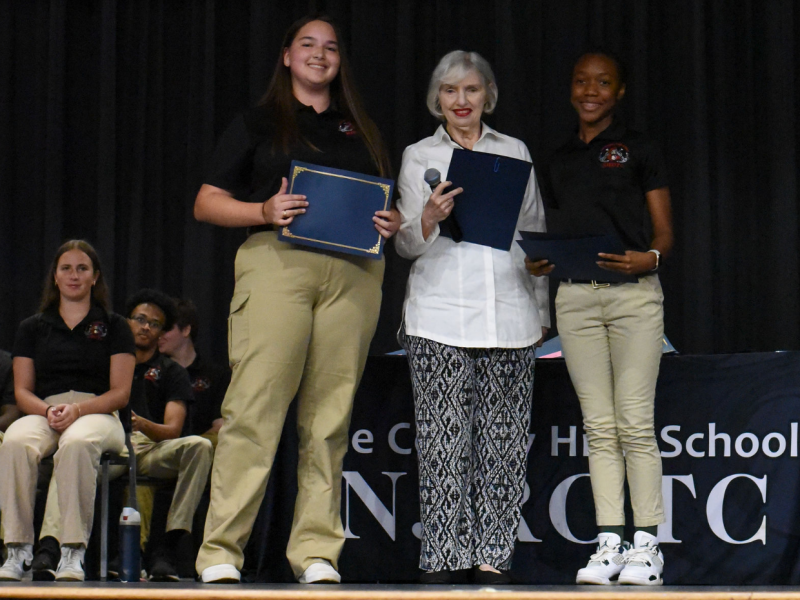
Lee County JROTC cadets honored by DAR for citizenship and leadership
Several Terrell County High School JROTC cadets were recognized for outstanding citizenship, leadership and service during the school’s recent JROTC Honors Night, receiving awards from the Old Herod Chapter of the National Society Daughters of the American Revolution.

Dawson police arrest wanted suspect after Flock Safety camera alert
According to police, May drove into the yard of a nearby residence instead of complying with officers’ commands. He then exited the vehicle and ran into the home on foot.
USDA expands drought assistance as Terrell County farmers continue recovery from dry conditions
As Southwest Georgia farmers continue to recover from prolonged drought conditions that affected planting and crop production this year, the U.S. Department of Agriculture is reminding producers that a range of federal disaster assistance programs remain available while also expanding relief payments through its Supplemental Disaster Relief Program.
