
Dougherty County Commissioner Clinton Johnson selected to address White House staff on COVID relief programs
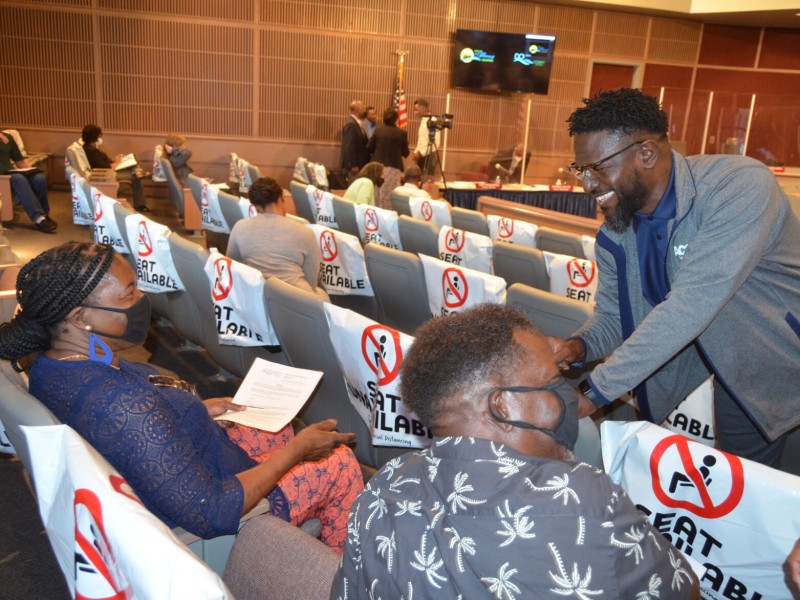
Staff Photo: Alan Mauldin
By Alan Mauldin
[email protected]
ALBANY — Premium pay for first responders who worked through the pandemic and mass vaccination clinics were among the major projects funded by Dougherty County using COVID-relief funding provided by the federal American Rescue Plan Act.
Now policymakers in Washington, D.C., are looking to discuss how that money assisted local communities as the Inflation Reduction Act is unrolled, and Dougherty County Commissioner Clinton Johnson is among those who will weigh in.
The District 3 commissioner is one of five county commissioners from the state selected by the National Association of Counties and the Association County Commissioners of Georgia.
“There are things this administration has enacted to help local counties,” Johnson, who will take part in a conference with White House staff on Oct. 19, said. “They wanted to see how local communities have benefited.
“We were a very hard-hit community, but I also think there are things in the Inflation Reduction Act that are going to break off to help with hospitals and mental health.”
Johnson’s presentation will include respective usage of ARPA funds and planned or anticipated usage of funds available through the Bipartisan Infrastructure Law and the Inflation Reduction Act. Dougherty County’s vaccination clinics, held in fall of 2020, provided vaccines to nearly 5,000 area residents. Additionally, the county has earmarked funds for the city of Albany to assist with their sewer upgrade.
Among the goals of the legislation is boosting green energy production, and the commissioner said he thinks that is another issue from which the area could benefit. The county has previously been contacted by a company interested in pursuing a wind turbine project.
Other legislation of interest to the area includes the Medicaid Restoration Act, which allows Medicaid payment for medical services provided to jail and prison inmates during the 30-day period preceding the inmate’s release.
Inmates lose federal services in jail, and in some instances that means the person can go without medication for a mental health issue after release and then end up in jail again a short time later, Johnson said.
“We’re trying to get a wrap-around program for inmates when they get out,” he said.
Author

Related Articles
Small actions can help save big on utility bills
The high temperatures of July and August can bring scorching utility bills as air conditioners hum to keep houses cool. Albany Utilities Residential Conservation Auditor Willie Jackson offered some tips on making summer cooling bills more manageable.

Bigger budget will mean improvements at Dougherty County’s landfill
“It’s certainly an opportunity where we can grow and make this very beneficial for years to the community. It’s a service that we provide for the community and I want to prolong that resource for the community. It’s not just fill it up and close it.”

Putting on the Ritz: The rise, fall and renewal of Albany’s Harlem District
On July 7, the Albany City Commission unanimously approved final construction drawings for a comprehensive restoration of the Ritz Theatre and Cultural Center, clearing the way for the project to move into competitive bidding after years of planning and preservation efforts. The decision marks the latest chapter in a decades-long effort to preserve one of Southwest Georgia’s most significant African American landmarks.
