
Dougherty County coroner, EMS director note downward trend in opioid overdoses
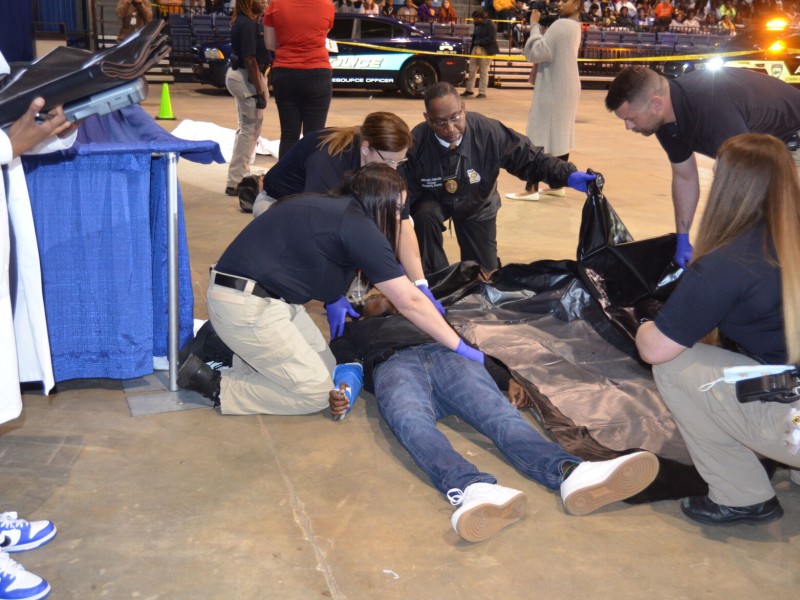
Programs like this opioid overdose drama conducted at the Albany Civic Center held in March 2023 brought in high school students in order to show them the dangers of drugs.
File Photo: Alan [email protected]://secure.gravatar.com/avatar/f714026fc83d6150ab9a4350b4169940?s=100&d=mm&r=gFile Photo: Alan [email protected]://secure.gravatar.com/avatar/f714026fc83d6150ab9a4350b4169940?s=100&d=mm&r=gBy Alan Mauldin
[email protected]
ALBANY – After the number of drug overdose deaths spiked at nearly 40 in Dougherty County in 2021, the numbers have shown a gradual decline, and with one month left in 2024 the number of potential overdose deaths are at about half that number.
Dougherty County Coroner Michael Fowler and Emergency Medical Services Director Sam Allen started seeing an upward trend in opioid deaths in 2017, but it was during the height of the COVID-19 pandemic that numbers soared.
After that, though, numbers started declining.
In 2022 there were 34 overdose deaths, Fowler said, and last year there were 32.
“This year we’ve got, so far, 10 confirmed and 10 waiting for the (toxicology) to confirm,” the coroner said. “So we’ve got 20 if those are confirmed.”
After noticing the increase in overdoses in 2017, Fowler and Allen became proactive in trying to prevent deaths. One of those efforts was a dramatic program presented in the Albany Civic Center, complete with ambulances and police cars entering to respond to the overdose scene aimed at young people.
“I think that kind of helped by people being aware of what’s going on,” Fowler said.
The coroner said he doesn’t know of any direct correlation between the pandemic and drug overdoses, but “it makes sense” that people who were confined for a long period of time were reacting to the situation.
“I can’t really answer that directly, but I think so,” he said. “I believe so.”
One game-changer was Narcan, the brand name for the drug naloxone. As that drug has become more available, it has helped reduce the number of overdose deaths. Now health departments provide the drug at no cost, which means that more people have it around.
“It’s a lot more available now,” Fowler said.
Allen seconded Fowler’s assessment of the effectiveness of naloxone and its role in helping decrease the number of overdose cases.
In 2020 EMS personnel used the drug in 182 instances for patients who were suspected overdose cases, a number that declined to 136 last year. As of Nov. 1 this year, EMS personnel had used the drug on 90 calls.
Prior to around 2016, EMS personnel might have administered naloxone one time over the course of a year, but out of nowhere it exploded in the county and caught the attention of health officials.
“Up until that point, (for) heroin, it seemed nobody was using opioids,” Allen said. “It was meth or cocaine. It’s like a trend. This has by far been the deadliest trend.”
At one time during the worst of the overdose crisis, Allen reported eight overdose cases during one 12-hour shift.
“We’ve had three cases so far for November through the 22nd,” the EMS director said. “Something’s getting better.”
And, in some cases, someone at the scene has administered naloxone to the patient before paramedics have arrived, something that greatly increases chances of survival, Allen said.
“We have seen somewhat of an increase where people have Narcan available to them,” he said. “It’s out in the community more than ever.”
Sadly, in some instances deceased patients have the drug on hand, but there was no one at the scene to administer it to them.
The majority of overdoses involve individuals in their 30s to 50s, Allen said. Opioid use is not limited by race or socioeconomic status.
“It’s open to everybody,” Allen said. “I’ve gone from homeless to the most affluent houses in the county, and it does not matter to any race or ethnic background. It just consumes people.”
When the victim is young, that represents a tragedy of losing someone whose whole life was ahead of them, he said.
When an EMS call involves a patient who has overdosed, personnel notify the patient at the hospital about resources available to deal with drug addiction, Allen said. The same is true for patients who refuse transport to the hospital.
Author

Related Articles
Albany Rescue Mission in recovery but still can use some help
“We can’t do this without the community. We are so grateful for the willing vessels. We just can’t thank them enough. We also appreciate the other ministries that have sown seeds into our ministry.”

Plenty of oil, not enough diesel — and southwest Georgia farmers are paying for it
Sedrick Rowe doesn’t spray herbicides on his 10 acres of organic peanuts. He fights weeds with his tractor instead, which means he runs it more often than most farmers — and burns at least 30 gallons of diesel on a typical day. This harvest season, every one of those gallons costs more than it has at any point on record.

Dougherty schools plan task force as SNAP changes raise concern over free meals
The Dougherty County School System plans to create a task force to help families retain food assistance and navigate new reporting requirements as district officials warn that declining SNAP participation could eventually affect the federal provision that allows every student to eat free at school.
