
Dougherty County legislative delegation gets leaders’ ‘wish lists’
Carlton Fletcher
ALBANY — The presidents of Albany State University and Darton State College said they were open to a discussion of expanding their institutions’ footprints into the community during a meeting with the area’s legislative delegation Monday morning.
In response to a question from House District 152 Rep. Ed Rynders, ASU President Art Dunning said that while the proposed $19 million multipurpose academic building for which the university is seeking funding is not a candidate for off-campus location, Albany State is open to the possibility of expanding its presence into the community.
“This building has to be on campus,” Dunning said. “I look at what’s been done in Atlanta and Columbus, though, and I really like the synergy they’ve developed with their collaborative projects. I think that shows one of many positive impacts a post-secondary institution can have in a community.
“Such a collaborative project could be an economic driver here. This is a conversation that needs to be held, and I think all of us need to be at that table.”
The ASU president’s comments came during the legislative delegation’s annual meeting with city and county agencies, whose representatives presented their “wish-list” agendas. State Sen. Freddie Powell Sims; Reps. Rynders, Winfred Dukes and Gerald Greene, and Rep.-elect Darrel Ealum met with members of the Dougherty County Commission; the Dougherty School Board; the heads of Albany State, Darton and Albany Technical College; leaders of the Albany Area Chamber of Commerce and Albany-Dougherty Economic Development Commission, and the Albany City Commission.
Albany Tech President Anthony Parker was unable to attend the session and was represented by Vice President of Institutional Effectiveness Kim Lee.
Paul Jones, president of Darton State, said he, too, believes the city’s institutions of higher education can expand outside campus boundaries and suggested a collaborative project that would be utilized by all three institutions might best serve the community and the institutions’ student populations.
“I think that kind of opportunity exists here,” Jones said.
Jones’ expressed a desire to “get out of you guys’ hair this year” when noting that Darton’s primary funding request is for some $1.7 million to finish its student center was typical of the education leaders’ requests Monday. Dunning’s focus remained on the long-delayed academic building, while Lee said Albany Tech’s primary need is for funding of Phase II construction planned at its Carlton Construction Academy.
When Ealum started to ask a question as to what ASU could do with the original $30 million that was allocated for its new academic building, Dunning interrupted.
“I respect this process,” he said. “Our proposal will meet our academic needs and get our students out of the flood plain, will be made available to the entire community, will have a positive economic impact on the region, and will provide a significant return on investment.
“My job is to make the most compelling case for why we need this project. We will take what we are given and utilize it to meet the requirements of our core mission. I don’t want to discuss what might have been before I got here. I’d just like for this funding (to go through the process) untouched.”
Ealum, who, according to event moderator Dukes was allowed to “wear two hats at the table” because he is still a member of the School Board, asked the delegation to reconsider local legislation that would raise School Board members’ salary from $250 a month to $1,000. That proposal was approved 4-3 by the board, but did not have the support to get through local legislation at the Legislative level.
“Our School Board hasn’t had an increase (in compensation) in more than 50 years,” Ealum said. “It’s not about the money; no one is going to be adequately compensated for the work they do on these boards. It’s a point of fairness.”
Greene had a quick response.
“I have an opinion that as long as teachers are taking furloughs, I have a problem with (raising board pay),” the Republican legislator said.
Dukes, a Democrat, called the $250 stipend “insulting for Dougherty County” and said he would try again to push the matter through local legislation at the Capitol if he gets enough support to move it through the Legislature.
School Board CFO Ken Dyer asked the lawmakers for input on sustainability of FTE (full-time equivalency) credit if the board follows through with its intent to change to a charter system.
“The question is whether that funding will be sustained or discontinued after we make the initial move,” Dyer said. “Should we plan for an increase in funding or plan more conservatively?”
Superintendent Butch Mosely stressed the importance of lowering the student/teacher ratio across the state, especially in the formative K-3 years.
“I’ve been in this business almost 50 years, and I’ve seen a little of everything and then some,” Mosely said. “I worked in a system with rural, mostly impoverished students with a 15-1 student/teacher ratio, and 93 percent of them could read when they got to the third grade. If anything can improve education in this state, it’s a lower student/teacher ratio.
“With 25 to 30 kids in a classroom, you’re little better than a babysitting service.”
Rynders, a Republican who primarily represents Lee County, and Sims, a Democrat whose vast region includes some of the poorer regions of the state, had a heated discussion over Dougherty Library officials’ request for $2 million to complete work on the county’s Northwest Library branch during the legislators’ meeting with the County Commission.
“The competition is so tough for the funding,” Sims said. “Dougherty County has met the criteria of self-investment that will qualify the county for state grants, but they’re competing against just about every other community in the state.
“I certainly think this request is worthwhile, especially for children’s programs, but the fight for funding is going to be fierce.”
When County Attorney Spencer Lee responded to Dukes’ question whether recent developments with the Sabal Trail pipeline would “help our case,” Lee asked the representative whose case he was referring to.
“There are two cases,” Lee said.
When Dukes said officials with Sabal Trail were “them,” Lee said, “I’m not an economic developer, so this issue depends on whether the city of Albany needs more natural gas.”
Ealum asked for the county’s position on the pipeline and said, “In light of the county attorney’s position on this matter, we are they.”
Lee responded, “I have no position.”
During a discussion of the city’s Deal-Closing Fund with chamber and EDC officials, EDC President Justin Strickland told the legislators he expects “from four to six other businesses” to apply for the funding set aside by the Albany City Commission to stimulate business growth in the community.
Strickland said the current threshold of funding allows funding up to $6 million.
Greene was particularly interested in the City Commission’s recent agreement with the South Georgia Regional Information Technology Authority that could bring expanded telecommunications opportunities into seven rural communities in the region. Greene said he’s been trying to get expanded service in the region for years.
“This is needed in that area,” he said. “And I appreciate the City Commission stepping up to the plate to help out.”
In a discussion about private enterprise and utilities services in that region, Ward V City Commissioner Bob Langstaff said, “The private sector may get there eventually, but it’s not financially feasible for them to be there now. We’re offering an opportunity to give the people in the area a leg up.”
Ward III Commissioner B.J. Fletcher asked if the state officials could help come up with minimum requirements for absentee and disinterested landlords that she said have slowed progress in redeveloping the inner city. Rynders suggested using city funds to develop a “revenue stream” to help bring dilapidated properties up to code.
“I think there’s a different way to skin this cat,” he said.
When Ward IV Commissioner Roger Marietta brought up the question of a second vote on T-SPLOST (a regional special-purpose local-option sales tax dedicated to funding transportation projects), the final meeting of the afternoon devolved into a friendly disagreement between Dukes — who opposed T-SPLOST — and Mayor Dorothy Hubbard, who said city officials weren’t given ample information about the failed vote that would have provided funding for regional transportation projects.
Related Articles

Seventh annual Recovery in the Streets brings Saturday celebration
“We know that recovery is for the entire community,” Burgman said. “It affects us all, so we want to come together and celebrate.”
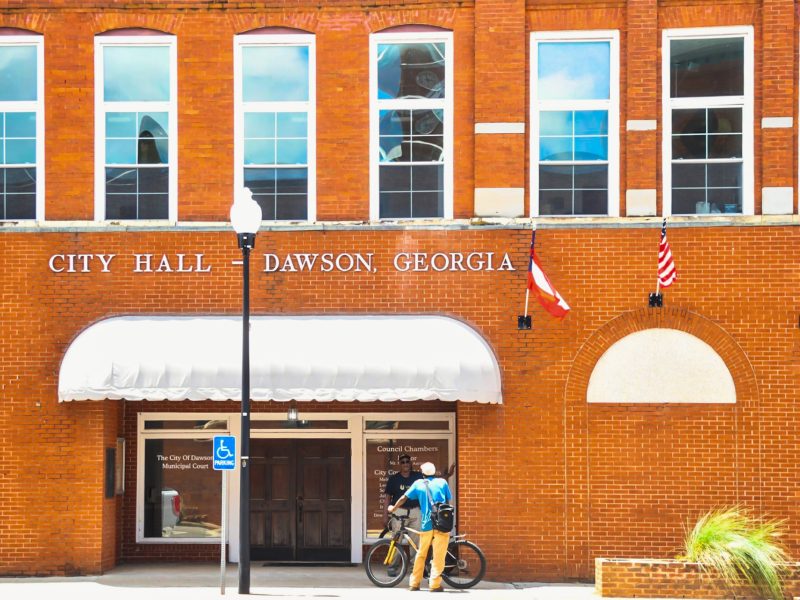
Dawson’s budget hearing: What the law requires and residents should ask
Dawson residents will have an opportunity Sept. 24 to question the city’s proposed budget before the City Council decides how to fund police, fire protection, streets and other services for the fiscal year already underway. But the documents available for review leave a basic question unanswered: How much does the city plan to spend, and what money will pay for it?

Dawson approves K-9 program, wastewater purchases amid audit delays
Questions about unfinished audits, restricted state funding and an unbalanced budget dominated a Dawson City Council meeting that also included decisions on wastewater equipment, employee benefits, a police K-9 program and the city’s dormant downtown development board.
