
Dougherty educational collaborative, community receive findings of educational survey
Terry Lewis
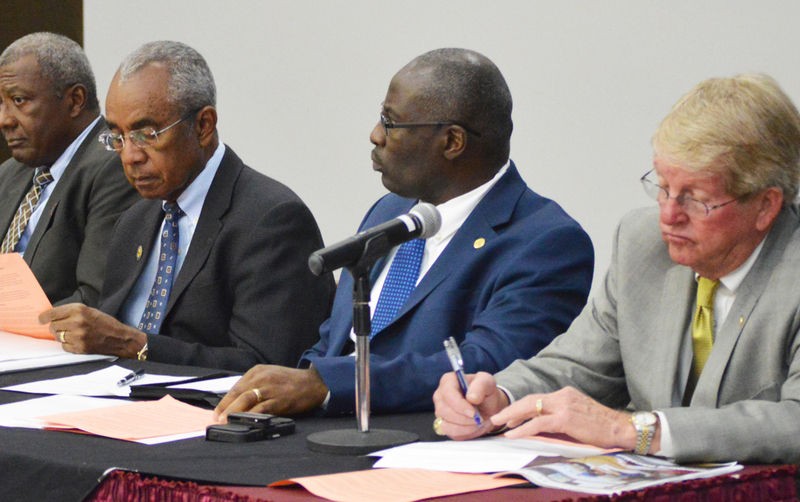
ALBANY — In July, four Dougherty County educational leaders — Albany State Interim President Art Dunning; Darton State College Interim President Paul Jones, Albany Technical College President Anthony Parker and Dougherty County School Superintendent Butch Mosely — formed a collaborative to address issues, attitudes and perceptions of PK-16 of the county’s educational systems.
They reached out to the University of Georgia’s J.W. Fanning Institute and the Carl Vinson Institute to facilitate conversations with educators, parents, students, citizens and other stake holders to explore local educational issues.
The UGA groups interviewed more than 400 residents, discussing real-life stories, experiences, insights and suggestions as to how to improve and advance the community’s commitment to education.
Thursday evening at Albany Tech’s Kirkland Center, they delivered their final report.
“The data we collected matched the answers to what we found in the community,” said the Fanning Institute’s Maritza Keen. “We complied and read more than 2,000 comments from a broad cross-section of the community. The commonality was that across all groups they said that education is the key to change in Dougherty County.”
The report’s findings focused on seven major areas including:
— Residents welcomed renewed commitment to education by the school system and the community
— Community members noted that for sustained change to occur, social and environmental factors have to be accounted for and addressed.
— The community called for increased investment in the PK-12 system.
— Participants want to strengthen the support environment for students to to ensure their success.
— An educated workforce benefits everyone.
— Positive media coverage matters.
— Coordination and partnerships matter.
“We looked at a lot of data and sometimes facts can be troubling,” Dunning said. “We also looked at these four (educational) entities and how can we work together. How can we get rid of the old ‘mill town mindset?’ Our only agenda is how to strengthen this economy.
“Butch Mosely is going to have to provide the seed corn, because if we can’t get people into our schools, then why are we here?”
At the moment, Mosely is leading a nearly 16,000 student school system with a graduation rate hovering just above 60 percent. By comparison, the state’s graduation rate is 70 percent and nationwide its 80 percent for all students.
“We have to get beyond what we read in the media,” Mosely said. “I have worked in the poorest and wealthiest counties in the state. (Dougherty County) is not poverty stricken, we are somewhere in between. We will continue to work together because the problems in Dougherty County are not insurmountable. Our main job is to provide (the county’s three post-secondary institutions) with better students.”
The Fanning group offered seven specific short term strategies that the county could look at over the next several months including:
_ Work with school personnel and area nonprofits to establish a process for early identification of PK-12 student and teacher needs that is aligned and shared with the Albany Area Chamber of Commerce, businesses, and the three institutes of higher education.
_ Invest in school district and post secondary marketing strategies that illustrate different pathways to a post secondary education and a four-year degree.
_ Through existing school system avenues, provide leadership skills training to parents, guardians and community members who can provide input for system improvement.
_ Explore the feasibility of creating a 9th grade academy to help with middle school to high school transition.
_ Meet with area business and education leaders to explore how to increase high school to college options and high school-to-work readiness. Explore the option of a College and Career academy.
_ Bring together faculty from the three higher education institutes to discuss how their institutions can jointly contribute to the economic vitality of the community. Issues to consider: how to align educational standards, map coursework and work with school system teachers and staff for increased student academic preparation.
_ Explore ways to create or reinstate early identification programs to help students enter school prepared to learn, and in later grades provide accessible points of contact of school re-entry for those who interrupted their schooling due to academic or personal issues.
“We are not interested in quick fixes, they rarely last” Jones said. “This isn’t about us, but really about all of us leveraging the resources we have in this community. It’s going to take all of us to move this community, to really move the needle.”
Parker said the last six months were a new experience for him.
“I have really enjoyed the experience and have learned a lot,” Parker said. “It’s also important to remember that improvement will not happen overnight. We are building something for those that come after us, they will have to pick up the mantle and move forward.”
Related Articles
Albany Herald – June 23, 2026
Phoebe electrophysiologist reaches Advanced… Albany police officials offer update… James Rubino installed in new role at…

Classifieds – June 23, 2026
ALBANY HERALD CLASSIFIEDS JUNE 23 2026
Albany police investigate suspicious Sunday death
A 21-year-old Turner Job Corps student who was found unresponsive on Sunday evening was later pronounced dead at Phoebe Putney Memorial Hospital. The death is under investigation.
