
Famed Albany architect remembered for his groundbreaking work
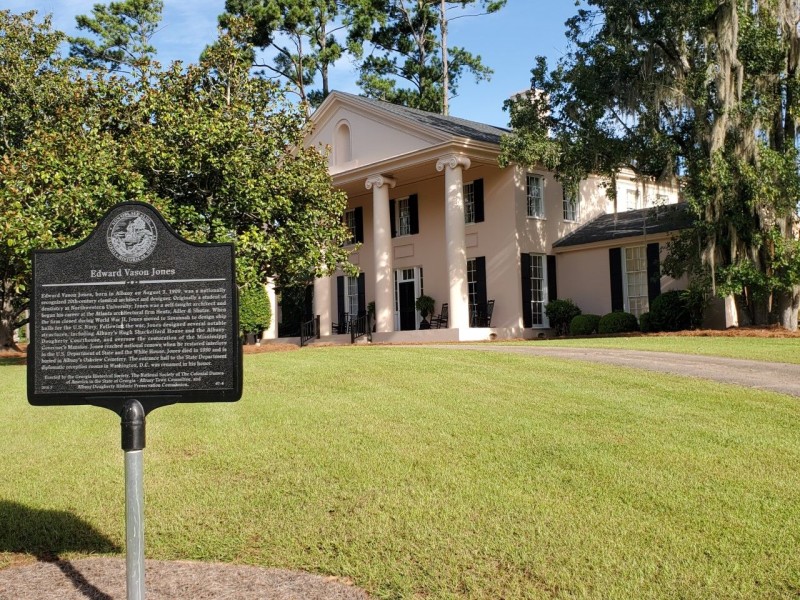
Staff Photo: Tom Seegmueller
By Tom Seegmueller
[email protected]
Editor’s Note: Part of an ongoing series about historic people, places and monuments in southwest Georgia.
ALBANY — Edward Vason Jones, born in Albany on Aug. 3, 1909, was a nationally recognized 20th-century classical architect and designer. His work, which included interior restoration design on the White House during three presidential administrations, is lauded nationally.
Originally a student of dentistry at Northwestern University, Jones was a self-taught architect and began his career at the Atlanta architectural firm Hentz, Adler & Shutze. When the firm closed during World War II, Jones moved to Savannah to design ship hulls for the U.S. Navy. Following the war, Jones designed several notable structures, including Albany’s Hugh Shackelford House and the Albany-Dougherty Courthouse, and oversaw the restoration of the Mississippi Governor’s Mansion. Jones reached national renown when he restored interiors in the U.S. Department of State and the White House.
The famed architect died in 1980 and is buried in Albany’s Oakview Cemetery. The entrance hall to the State Department diplomatic reception rooms in Washington, D.C., was renamed in his honor.
A short paragraph in the 1952 edition of “White Columns in Georgia” may lend insight into Jones’ decision to leave the study of dentistry and instead pursue a career in architecture.
“Architect Edward Vason lives in his grandfather’s ante-bellum town house, planned by a New Orleans architect who gave it pleasing ironwork trimmings.” Jones noted: “Grandfather built it because he was tired of living in town, but the town long ago caught up with the house.”
In Jones’ youth, Albany was filled with a number of notable antebellum homes, which influenced his designs. The crown jewel of the day was recognized as “Iris Court.” The home was located on Pine Avenue across from the State Theatre with its back facing the post office. Ironically, it was being torn down when, in 1965, Jones bought it from the Durrett Wrecking Company. He dismantled the home and moved it to Moultrie, where it was reassembled and stands today.
Jones’ initial foray into architecture was notable when, in 1936, he designed and oversaw construction of the main house on Gillionville Plantation outside Albany. The house still stands today and was so impressive that it led Hal Hentz of Hentz, Adler & Shutze to hire him, even though he had no formal training in the field of architecture.
Hertz studied at the Echole des Beaux Arts in Paris in 1908 and received a B.S. in architecture from Columbia University in 1909. Obviously, he saw something special in Jones. The firm would go on to be recognized as the founders of what is recognized today as the Georgia school of classicism.
At the outbreak of World War II, Jones would take a sabbatical from his architectural work to design the hulls of battleships for the United States Navy. In 1948 he would establish his own firm in Albany, where he would continue creating his designs until his death in 1980.
During this period, Jones would not only leave his mark on his hometown but the nation as well. Locally his inspiration is visible on the Albany-Dougherty Courthouse, the Albany High School Building on North Jefferson Street and numerous private residences, the most notable being the Shackelford House, where the marker in his recognition is placed. That marker reads, in part: Erected by the Georgia Historical Society, The National Society of The Colonial Dames of America in the state of Georgia – Albany Town Committee, and the Albany-Dougherty Historic Preservation Commission. Year Erected: 2018
Jones was not the only Albanian to leave his mark in the world of architecture. Early in his career, while planning the Shackelford House, he discovered a talented pair of brothers, Odolph and Ben Blaylock. Ben Blaylock would become his go-to general contractor with Odolph taking on the role of foreman and head carpenter. Odolph’s skills as a finish carpenter would lead him to become Jones’ assistant, directing other artisans who worked to panel, carve and plaster Jones’ designs.
Jones and the Blaylocks would combine their talents, transforming the U.S. State Department Reception Rooms and numerous renovations on the White House during the administrations of Richard Nixon, Gerald Ford and Jimmy Carter.
Related Articles

The boy who drove the bus and helped build a school system
As Lee County grapples with questions of trust, leadership and the future of public education, the life of Dr. Robert Clay offers a reminder of the community values that helped build one of Georgia’s most respected school systems.
Powerful performances drive Theatre Albany’s ‘The Color Purple’
From the street, strands of purple ribbon wind around the white columns of the historic theater, hinting at the story waiting beyond its doors. Inside the foyer, a carefully curated slideshow flickers across a large screen, cycling through the faces of the cast. Some are seasoned performers. Others are stepping onto a stage for the very first time. Teachers stand alongside former students. Parents perform beside their children. People who worship in different churches, work different jobs and come from different corners of Southwest Georgia gather beneath the same lights to tell the same story.

CWC Alliance brings substance-abuse training to southwest Georgia
“We train youth and young adults across the state on substance-use prevention. It’s been incredible to partner with NAMI Albany. Through this training they will become youth prevention mentors.”

