
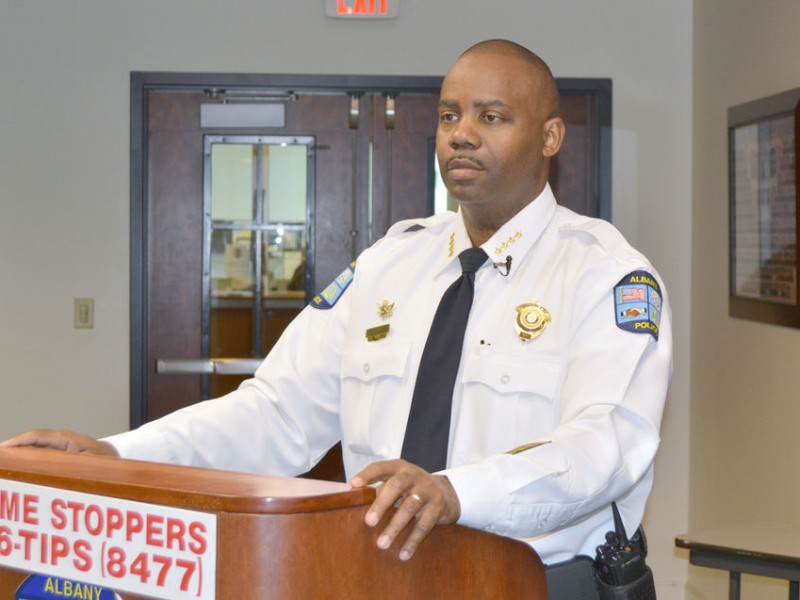
Albany Police Chief Persley discusses crime in Albany
Albany crime stats show mixed results
By Jon Gosa
ALBANY — The city of Albany contributes nearly 1.9 percent of total crime in Georgia, according to the Georgia Bureau of Investigation’s Crime Statistics Summary,
On the Georgia Crime Index, Albany ranks No. 307 out of 336, with 1 being the best and 336 the worst. Crimes such as murders, rapes, robberies, assaults, burglaries, thefts, vehicle thefts and arson are averaged to determine a city’s ranking. Albany averages 3,535 of these crimes per year, which is significantly higher than the state average of 1,911 and more than double the national average of 1,669.
“You have to look at demographics,” Albany Police Department Chief Michael Persley said. “I will tell anybody, if you find another city with a comparable population to Albany and you say crime is worse in Albany, you have to look at demographics. You have to look at the economic impact of it. You can have a city that has a flourishing economic situation or you look at a city like Albany, and we have lost some major businesses around here in the past several years. That has an impact.”
The overall economy of Albany plays an important role in the city’s crime rate, according to Persley.
“When you look at the local economy,” Persley said, “our manufacturing jobs have decreased. We had a Cooper Tire plant, Merck Chemical, Bobs Candies — we had a lot of manufacturing-type businesses close. Now, I am not saying that all people are going to sit around and commit crime (if they don’t have a job). But some people will move away, and then there will be some that are left behind that are kind of like, ‘I have to make a living, but what can I do?’ If you have drug addicts, there’s always going to be a drug dealer.”
According to Persley, many factors affect the crime rate in Albany.
“If our graduation rates keep going up, I guarantee you our crime rate will go down,” the APD chief said. “There are a lot of social issues that affect our crime rate. Now, what can the police do? We try to do as many proactive programs (as we can), but I am not one to just do something to do something. I want to do an initiative or some type of act that focuses on a problem, such as these Part II crimes. As long as we can deal effectively with Part II crimes, then I believe we can address the Part I crimes and work through that.”
Part II crimes, according to the Albany Police Department 2016 Crime Data Report, are crimes such as forgery, fraud, stolen property, vandalism, prostitution, drug abuse violations, disorderly conduct, DUI, vagrancy, sex offenses, gambling, etc., typically less violent crimes. Part I crimes are offenses such as murder, rape, robbery, aggravated assault, burglary, larceny, auto theft and arson.
“Once again, there are a lot of factors involved in the demographics of an area,” Persley said. “And education is a key factor in reducing crime.
“Our educational institutions here offer people an opportunity to go out in the work force and do great things. Our technical college here has a 94-plus percent placement rate. Our university here has exceptional programs, and there are plenty of students who went to Albany State that were able to move into other programs across the United States. At Darton, one of the bright spots was the nursing program. Well, people have to be able to get in those programs, and if they don’t get a high school education first, graduate and then move on to those areas, then that is one of the places you stop.”
Albany has made progress over the past several years in raising high school graduation rates. According to Dougherty County Schools Superintendent Butch Mosely, four years ago two of the high schools here, Dougherty and Monroe, were graduating only about 46 percent of their students. Those numbers have risen to 70 and 78 percent, respectively.
“Many of the crimes in Albany are crimes of opportunity,” Persley said. “For example, entering autos. This is a crime of opportunity. Criminals are going along and pulling on car doors until they find one open. They don’t steal your phone out of your car because they want to use your phone. They are stealing it because it was left in the car, and they are going to take it and sell it.”
Removing the opportunity can reduce these types of crimes tremendously, officials say.
“Sometimes situations may move a person toward criminal activity. I don’t think anybody is born bad, but if people lack hope and they think there is no other way, that’s the way people will go,” Persley said. “However, you can’t blame everything on your environment either, for crime. There are plenty of examples of people who grew up in some of the more challenging places here in Albany and they didn’t resort to a life of crime.
“Whether it was family, whether it was friends or outside influences, something pushed them. They didn’t want to go the crime route. However, there are those that, because of family, friends or outside influences, feel like there is no other way but crime.”
Some outside influences that Persley said negatively affect people and contribute to criminal activity are violent movies, television shows and, in particular, video games.
“When you look at video games that are the most popular, like Grand Theft Auto, somebody is getting killed,” said Persley, “There is a lack of respect for human life. There are a lot of children, teens and adults who are desensitized by this. Many people don’t know how to do conflict resolution if your way of handling a situation is picking up a gun. Too often, the thinking is, ‘I know how to solve this, I’m going to get my gun and shoot you.’
“I believe when it is not re-enforced at home, you have to be careful because there are a lot of outside influences. You have shows like ‘The Walking Dead,’ a show about killing the walking dead. Parents have to fight against that. When you let a person just soak up a certain amount (of violence, you get crime). Also, with the media, when you are looking at what is happening in the United States and around the world, every day in some part of the U.S. or some part of the world there is going to be a report about death and how others have devalued life. A lot of what is done for entertainment or what’s done for just public knowledge does have an affect on how people are treating others.”
So far in 2016, 1,825 Part I crimes have been committed in Albany, including six murders, 10 rapes, 75 robberies, 245 aggravated assaults, 391 burglaries, 1,026 cases of larceny, 63 auto thefts and nine cases of arson.
Related Articles

New commander takes helm as Marine Corps logistics adapts to evolving battlefield
Brig. Gen. Kevin G. Collins assumed command of Marine Corps Logistics Command during a change of command ceremony at Marine Corps Logistics Base Albany, succeeding Maj. Gen. Keith D. Reventlow after four years leading the organization responsible for sustaining Marine forces around the globe.
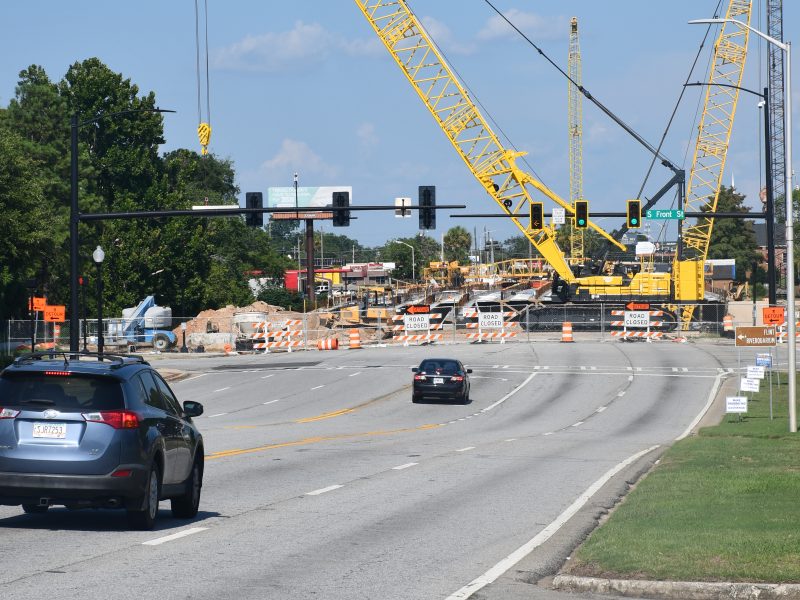
DOT says delay in Oglethorpe Bridge opening should be brief
“We know it’s not going to be July 22. We don’t think it’s going to be much later than that.”

City of Albany has big July 4 celebration planned for Saturday
“It’s going to be a lot of moving and shooting them off in a short time. It’s going to be a big show.”
