
Average gas prices decline for third straight week
Weak demand, low crude prices, uneventful refinery switches adding up to pump savings
By Jim Hendricks
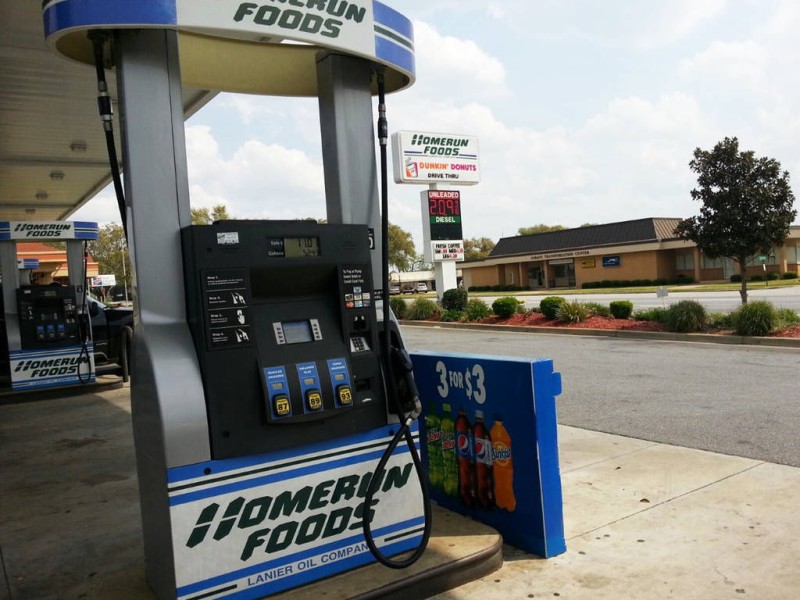
ALBANY — Temperatures are higher but gas demand is unseasonably cool, which has led to a third straight Monday of declining week-to-week prices that includes a late-March average under the traditional mid-February low, something that last happened in 2009.
Still, market experts expect the average to be around $2.70 per gallon when summer driving season gets into full swing.
Both GasBuddy.com’s Fuel Insights and AAA Auto Club’s Daily Fuel Gauge Report had the morning benchmark national average for gas at $2.285, down at least seven-tenths of a cent from last week and nearly flat compared to a month ago.
In Georgia, the surveys were a penny apart, with GasBuddy’s lower at $2.147. Depending on the survey, the week-to-week decline was a penny to 1.4 cents, while the decline from a month ago was 5.2-6.4 cents.
“Remarkably, for a third straight week, average gasoline prices have declined,” Patrick DeHaan, the senior petroleum analyst for GasBuddy.com, said. “In fact, for just the first time since 2009, average gasoline prices today stand cheaper than on Feb. 15th — traditionally the day of the lowest gasoline prices of the season.”
DeHaan said there were three reasons the anticipated “spring sting” hasn’t been felt so far by motorists.
“First,” he said, “weak gasoline demand, which has kept inventories of winter gasoline far more than adequate. Second, there have been few large-scale unexpected refinery outages; and third, crude oil inventories and rising U.S. production have kept oil prices under pressure over the last month.
“All three of these factors are actively at play and will continue to keep pressure on prices from spiking.”
Within Georgia, according to the Daily Fuel Gauge Report, metro Albany ranked third-lowest Monday among the state’s eight largest metro areas. Albany drivers were paying an average $2.108, down less than a half-cent from the previous Monday, but 3.3 cents below last month.
The lowest average in Georgia was in metro Augusta, $2.064, followed by Macon at $2.102. Savannah had the highest average among the metro areas at $2.192.
The decline hasn’t been shared everywhere, with demand playing a big role. Mark Jenkins, a spokesman for AAA, noted that in the Southeast, Georgia saw the price decline while Tennessee held flat and Florida saw an uptick at the pump. Those headed south for spring break this week and next likely will notice.
“This is the type of volatility we expect to see at the pump this time of year, as supply and demand patterns shift,” Jenkins said. “Falling oil prices have helped offset inventory declines in most states, keeping gas prices low. Also, demand has been off to a slow start this year throughout most of the U.S. However, it is beginning to ramp up in Florida.
“We also saw a decline in gasoline inventories last week, which normally triggers rising prices at the pump. Gasoline demand in Florida surges in March, because there are more drivers visiting for spring break and spring training, combined with ‘winter residents’ who came to the sunshine state for a break from the cold.”
Crude oil has declined for five consecutive weeks to fall in a price area last seen around Thanksgiving. Citing Energy Information Administration figures, Jenkins noted that U.S. crude inventories had increased 5 percent to reach 533.1 million barrels, the upper limit of the average range for this time of year, and that domestic crude production had increased 0.22 percent to 9.13 million barrels, the highest daily production rate since February 2016.
Gasoline inventories, however, decreased nationwide by 2.8 million barrels last week, Jenkins said, which could be an indicator of rising prices in the future.
AAA market experts think gas will top out this summer around $2.70 a gallon nationally.
“During the month of April, drivers across the country will see gas prices begin to climb as the industry completes spring maintenance and the switch-over to summer-blend gasoline,” Jenkins said. “AAA projects the national average for a gallon of gasoline will increase 40 cents this summer, peaking near $2.70, which is 70 cents higher than it was last summer.
“Whether gas prices reach that peak will depend on the direction of oil prices, which have slipped lower in recent weeks.”
The national average on March 27, 2016, was around $2.04, with Georgia’s just under the $1.99 mark. Metro Albany’s average also was at $1.99 a year ago.
Related Articles

James Rubino installed in new role at Marine Corps Logistics Command in Albany
James L. Rubino recently assumed the role as executive deputy of Marine Corps Logistics Command in Albany. In his new role he will oversee integrated logistics support.

Rain depresses voter turnout in Dougherty County
“A lot of people don’t vote when it’s raining. People don’t do a lot of things when it’s raining.”
City of Albany faces shortfall for police, fire salaries
“We can’t tell staff to hire more police officers and then complain at what it costs.”
