
BARRY LEVINE: Band names prove truth stranger than fiction
THE OLD ROCKER: Artists came up with names in unusual ways
By Barry Levine
This will prove the adage that truth is stranger than fiction.
Did you ever wonder how some musicians acquired their names? Some are so unusual that it’s hard to believe. Here are just some of the strange ways people in the music industry got their names.
Cascades – The pop group from San Diego had only one Top 100 hit as “Rhythm of the Rain” climbed to No. 7 in 1963. The group took its name from the dishwasher detergent Cascade.
Village People — Because all of the group members had been recruited from Greenwich Village in New York, Jacques Morali, their manager, decided to call them Village People. The group had two smash hits: “YMCA,” which reached No. 2 on the pop charts in 1978, and “In the Navy,” which got to No. 3 in 1979.
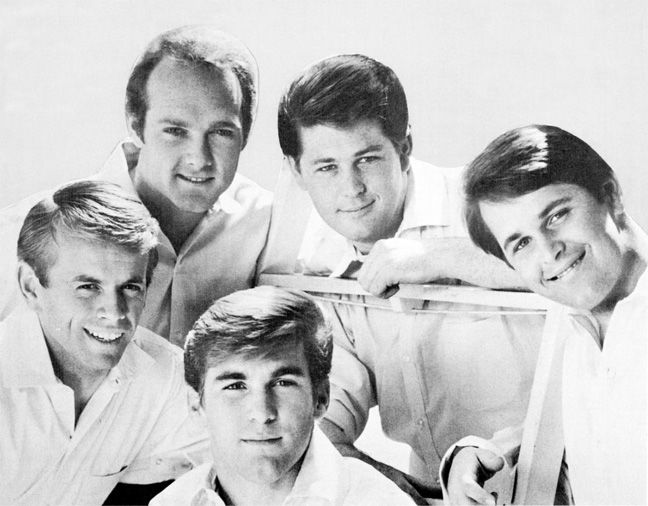
Beach Boys — A California band called The Pendletones recorded a song for Candix Records called “Surfin’” in 1961. After the records were pressed, it was discovered that a young promotions worker had changed the band’s name to more tie the group to other surf bands. Although the group was furious, the limited budget meant the labels could not be reprinted and the name, Beach Boys, stuck. One of the most successful groups in rock history, the Beach Boys had 22 Top 20 hits, four of which reached No. 1: “I Get Around” in 1964, “Help Me, Rhonda,” in 1965, “Good Vibrations” in 1966 and “Kokomo” in 1988.
The Big Bopper – Texas DJ J.P. Richardson took the name “The Big Bopper” in reference to his 240-pound frame. During the 1950s, a bopper was someone who was a real rock ‘n’ roll fanatic. Killed in the airplane crash with Buddy Holly and Ritchie Valens in February 1959, the Big Bopper is remembered for his only Top 20 hit, “Chantilly Lace,” which rose to No. 6 in 1958.
Chubby Checker — During a recording session, Barbara Clark, the wife of “American Bandstand” host Dick Clark, asked Ernest Evans what his name was. “My friends call me Chubby,” he responded after just completing a Fats Domino impression for his 1959 record “The Class.” She smiled and said, “As in Checker?” That little play on words got an instant laugh and from that point, Ernest Evans would be known as “Chubby Checker.” He gained fame nearly six decades ago when he had the whole world doing “The Twist.”
Creedence Clearwater Revival — Originally called The Golliwogs, the band concocted its new name from Norvel Creedence, a friend of band leader John Fogerty. John’s favorite beer was called Clearwater, which, after it disappeared from the market, was re-introduced by another brewery. The result: Creedence Clearwater Revival. CCR had 12 Top 20 hits from 1968 until 1972 when the band split.
The Belmonts — Dion DiMucci and his friends, Carlo Mastrangelo, Fred Milano and Angelo D’Aleo, named their group The Belmonts after a street in their Bronx, N.Y., neighborhood, where they would sing street corner harmonies. The group had five Top 20 hits during the late 1950s. Dion started a solo career in 1960 and had 14 Top 20 hits, including his No. 1 smash “Runaround Sue” in 1961.
The Duprees – The New Jersey quintet had a No. 7 hit in 1962 with “You Belong To Me.” They reportedly got their name when they hollered from their car window to ask a man standing on a street corner if he knew where they could find any singers in the neighborhood. They were directed to a local barber shop and a group member said, “Hey, man, thanks a lot. What’s your name?” The man said, “Dupree, baby, what’s yours?” It was later decided that The Duprees would be a good name for a group. “You Belong to Me” was the Duprees’ only Top 20 hit.
The Fleetwoods — The trio topped the charts in April, 1959 with “Come Softly To Me.” They got their name because all three members of the group had the same telephone exchange, Fleetwood. The group totaled three Top 20 hits, including No. 1 smash “Mr. Blue” later in 1959.
Englebert Humperdinck — Manager and promoter Gordon Mills felt a performer had to call attention to himself any way possible. His idea for singer Gerry Dorsey was to change his name to something that people would remember. He convinced him that an audience would never forget the name Englebert Humperdinck, the name of the Austrian composer who wrote “Hansel and Gretel.”
Guy Mitchell — When Albert George Cernik was signed by Columbia records, Mitch Miller, his boss, supposedly told him “my name is ‘Mitchell’ and you seem like a nice ‘guy,’ so we’ll call you Guy Mitchell.” The young singer sold more than 44 million records and had a pair of No. 1 hits: “Singing the Blues” in 1956 and “Heartaches By the Number” in 1959.
Col. Tom Parker — Andreas Cornelius van Kujik changed his name to Thomas Andrew Parker after he came to the United States from Holland in 1927. During the late 1940s, he began a successful career as a music promoter and manager and persuaded an aide to Louisiana Gov. Jimmie Davis to have him made an honorary Louisiana colonel. He served as Elvis Presley’s manager from 1956 until 1973.
Sam the Sham & The Pharaohs — In the early ’60s, Domingo Samudio was playing in a band called “Andy And The Night Riders.” When Andy Anderson left the group, Domingo took control of the band and decided to rename it. By that time, everyone was calling him “Sam,” short for Samudio. Samudio was as real clown, and cutting up was called “shamming.” They got the rest of the name from the movie “The Ten Commandments.” The band felt Old Ramses, the King of Egypt, looked good, so they decided to become The Pharaohs.” Their only Top 20 hits peaked at No. 2: “Wooly Bully” in 1965 and “L’il Red Riding Hood” in 1966.
This week in rock history: Alan Freed premiered his last rock ‘n’ roll movie, “Go Johnny Go,” starring Chuck Berry, Jackie Wilson, Ritchie Valens, Eddie Cochran and The Flamingos on April 22, 1959. … After eight weeks as the top-selling song, “Theme From A Summer Place” by Percy Faith & His Orchestra was replaced at No. 1 by Elvis Presley’s “Stuck On You” on April 23, 1960. … On April 24, 1963, Georgia’s Brenda Lee, 18, married Ronnie Shacklett, 19, six months after spotting him in a crowd at a Jackie Wilson concert. The couple celebrated their 50th wedding anniversary in 2013. … Funeral services were held for Eddie Cochran in Cypress, Calif., on April 25, 1960. He was killed in an auto accident in London. … Janis Ian, 16, performed “Society’s Child” on the CBS-TV show, “Inside Pop — The Rock Revolution” on April 26, 1967. A year before, the song was banned by many radio stations because of its interracial love affair theme. Following her TV appearance, the record jumped into the Top 20. … At 15 years, 1 month and 13 days old, Little Peggy March became the youngest female singer to have a No. 1 record when “I Will Follow Him” reached the top of the charts on April 27, 1963. … David Seville’s novelty tune, “Witch Doctor” reached at No. 1 on April 28, 1958, and became the fourth-best-selling song of the year.
Barry “The Old Rocker” Levine is an entertainment writer for The Albany Herald. He can be reached at [email protected].
Related Articles
Putting on the Ritz: The rise, fall and renewal of Albany’s Harlem District
On July 7, the Albany City Commission unanimously approved final construction drawings for a comprehensive restoration of the Ritz Theatre and Cultural Center, clearing the way for the project to move into competitive bidding after years of planning and preservation efforts. The decision marks the latest chapter in a decades-long effort to preserve one of Southwest Georgia’s most significant African American landmarks.

Albany City Commission set to vote on skate park funding
“There have been other sites discussed. Based on information (from) the community, we decided on the current site. That’s the only site we’re looking at right now.”

Food, mini menagerie provide inspiration for Mitchell County’s Lydia Griffin
“I would like to open, like, a Caribbean/tropical buffet where everybody can eat anything and everything. If I can’t do that, I would start small with a coffee shop (and) deli and keep going.”
