Albany, Dougherty County officials present wish lists to state lawmakers
Policy issues dominated the all-day sessions
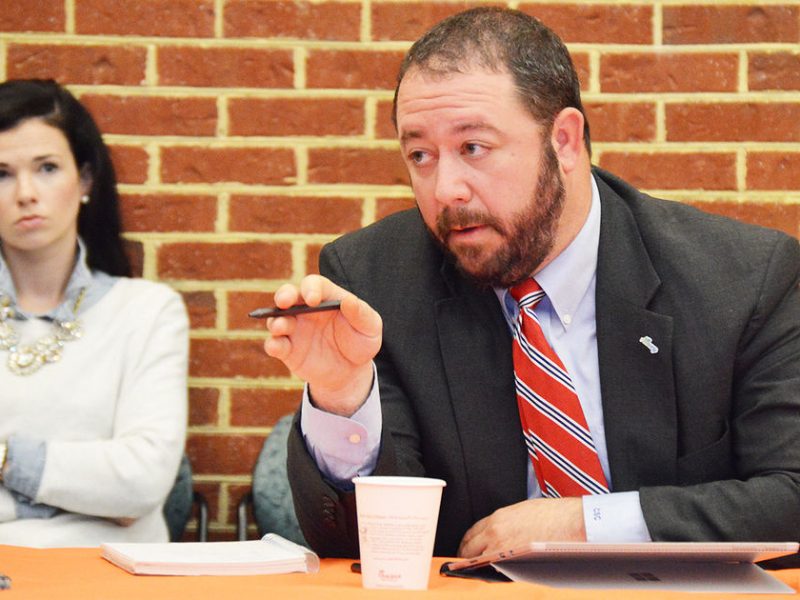
Dougherty County Commission Chairman Chris Cohilas makes a point during a meeting with Metro Albany lawmakers who heard the county’s agenda for the upcoming legislative session of the General Assembly. (Staff Photo: Terry Lewis)
By Terry Lewis
ALBANY — Four members of the Albany area legislative delegation met Monday with city, county, education and business leaders in separate sessions to hear the issues they’d like to see discussed during General Assembly session that begins next month in Atlanta.
State Reps. Winfred Dukes, D-Albany; Darrel Ealum, D-Albany; Ed Rynders, R-Leesburg, and state Sen. Freddie Powell Sims, D-Dawson, met with Dougherty County and Albany officials, public safety heads, Dougherty County School System representatives, Albany Technical College President Anthony Parker, and Albany-Dougherty Economic Development Commission and Albany Area Chamber of Chamber officials in one-hour sessions.
Each group had its own legislative agenda, but there was some overlap.
The county’s priority was T-SPLOST — a special-purpose local-option sales tax devoted to transportation in regions — that voters defeated two years ago.
“I would hope that T-SPLOST would be revisited, but in a different iteration from last time.” Commission Chair Chris Cohilas said.
The last time Dougherty County voted on T-SPLOST, it was grouped into a district. Cohilas would like to see the county vote as a separate unit.
Dougherty County has seen other counties in regions that passed the tax benefit from a 1 percent T-SPLOST.
“We’d also like for our delegation to look at helping fund the Flint River Trail System,” Cohilas said. “We think it could potentially benefit the community and the entire state.
The county also brought up the thorny issue of Medicaid expansion, saying lack of expansion has hurt the county. Cohilas, however, acknowledged no one really knows what President-elect Donald Trump and Congress will do regarding the Affordable Care Act.
Rynders said the House could not make a recommendation without knowing how much it was going to cost.
The DCSS had a light wish list.
“We have nothing to ask for beyond reason, we are in good shape financially,” DCSS Superintendent Butch Mosley said.
The school district did ask the delegation to look into consistency in testing programs and the receiving of testing results in a timely manner.
A good deal of the public safety session was spent discussing the Campus Carry Act, which Gov. Nathan Deal vetoed last session.
“I’m worried the bill could create a wild, wild west scenario on our campuses,” Albany State University Police Chief John Fields said.
“If you asked me right now if I thought the (Campus Carry) bill is coming back, well, if I were a betting man, I’d say, ‘Yes,’” Rynders said.
Albany Technical College President Anthony Parker had the big request of the day, asking the delegation’s help with securing $4.9 million from the state for Phase II work on the Carlton Construction Academy. Parker pointed out that Albany Tech paid $7 million in non-state money for Phase I and that the Phase II request would be just the third state-funded project at ATC in the last 22 years.
Albany Chamber officials, focusing on workforce development, urged the delegation to support Parker’s request. In addition, the chamber asked the lawmakers to support funding for the Southwest Georgia Medical Housing Complex for third- and fourth-year medical students students from the Medical College of Georgia and pharmacy students from the University of Georgia, as well as residents in the Southwest Georgia Family Medicine Residency program.
This housing facility is currently under construction near Phoebe Putney Memorial Hospital.
The city of Albany asked for help in the form of a bill that would allow the city to create a Downtown Development Authority (DDA) Board separate from ADICA, which would have its powers revised put it on par with public facilities authorities in the state. The DDA and ADICA currently have the same members on their respective boards.
City Manager Sharon Subadan said having two entities with similar powers that share the same board has made it a challenge to distinguish between the two and to make decisions on which board should be used for various projects.
After the meetings were over, Dukes said it was different from previous ones because local officials “didn’t have as many financial asks as in the past.”
Rynders, who said he attended a similar session last week in Sumter County, agreed.
“What we got today was more policy-driven that financially driven,” he said. “I like to meet with a variety of regional entities and what I look at is how does the state impact your community.”
Ealum was happy with the way the day went.
“Today was an excellent opportunity for our delegation to hear from the key elements of our elected bodies,” he said. “The main takeaway I took from our meetings today was our need to fight hard to get the $4.9 million for Phase II of our Carlton Construction Academy.
“Dr. Parker has proven that money invested for student growth at Albany Tech turns into jobs. Ninety-five percent of our graduates find jobs and 75 percent of those find jobs within 30 or so miles from Albany.”
Related Articles
Regional catering business finds new home at Warrior Creek Mercantile
For months, Marchbanks said she had been asking God for an opportunity to serve others. “I just kept praying, ‘God, use me as a servant,'” she recalled. “I didn’t care what it was. I just wanted to be used to help people.”