
City of Albany hosts Georgia Department of Transportation forum
GDOT forum to discuss House Bill 170
By Brad McEwen
ALBANY — Albany area business owners and city officials gathered with representatives from the Georgia Department of Transportation (GDOT) Thursday to learn more about how small businesses can get involved in transportation-related construction contracts as part of House Bill 170, which was passed by the Georgia General Assembly last year.
The forum was designed to help local contractors position themselves to receive a portion of the $1 billion in funding provided by HB 170, or the transportation bill, as it’s commonly known.
Chad Hartley, GDOT district engineer in District 4 which is based in Tifton and includes Dougherty and 30 other counties, began his presentation by giving some background on the types of projects GDOT has prioritized since the bill was passed.
Hartley said that the bulk of the funds will ultimately be used for maintenance projects that have accumulated over the past several years as GDOT funding and staff size has diminished.
“In the past, we were staffed 20, 30 years ago at 10,000 employees,” said Hartley. “We have less than 5,000 employees. It’s actually less than that and you’re going to see more contracted work. That’s why we’re reaching out to the community with this house bill and asking for contractors to bid. You can see the needs are there, the money’s there, our force has decreased and we’re relying on contractors to help us out.”
Harley said the state is hoping to use contractors, with a targeted 10 percent of those being Disadvantaged Business Enterprises (DBEs), to help with such maintenance projects as fence repair and replacement, road resurfacing, road striping, mowing, landscaping and more.
“There’s 88 things that we classify as maintenance activities,” said Hartley. “If you want to know the truth I think everybody that’s a registered contractor and wants the work is going to find it.”
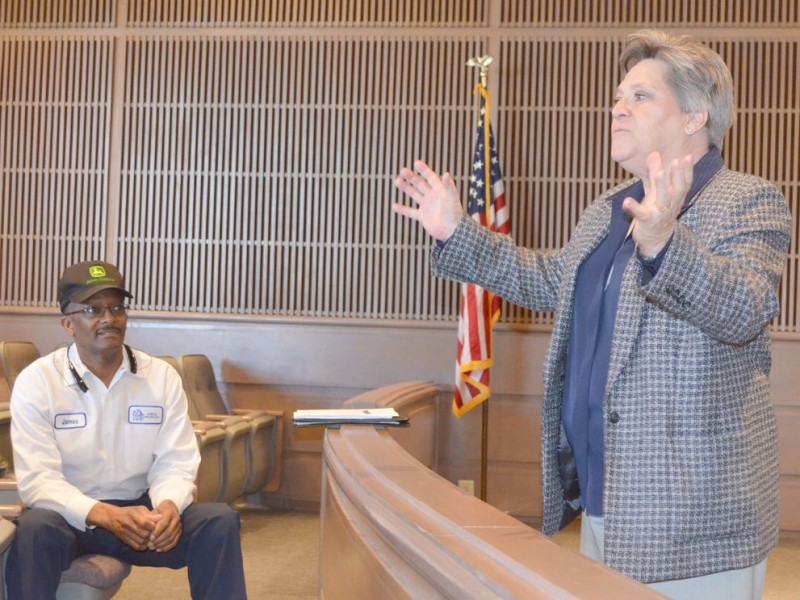
Although the forum was open to anyone there were several small business owners and local officials in the audience including Albany City Commissioner Harry James, who did raise some concerns he and several local business-owners had about the process for DBEs to be considered for the work.
James said the process seemed involved as interested businesses must submit qualifications to do the work before getting approval to submit bids for specific jobs.
“You’re sending out a request for qualifications,” said James. “You’re not sending out a notice to bid, you’re sending out a notice to qualify. But when you’re already qualified in your marketplace as a vendor, why do you have to qualify again just to get a bid number? That’s the frustration part for most of our businesses, because they don’t that have that sit in front of the computer time to do that because it intensifies the paperwork side of it.”
Mary Zirock, GDOT Operational Procurement Administrator who was on hand to show local business owners how to qualify as state vendors, responded to James’ questions, saying that it was a two-step process.
Zirock explained that when preparing to bid out a contract the procurement office first sends out an RFQC (request for qualified contractors). After receiving responses to those RFQCs, the department then sends out an ITB (invitation to bid), allowing qualified contractors to submit formal bids outlining their cost estimates for doing the work. The state then awards those contracts to the lowest bidder.
“Here’s what I’m talking about with these qualifications,” said Zirock. “I’m not talking about some monumental task that’s going to take you a week. Some of these RFQCs are very, very simplistic in the services. So, I’m talking about putting a fence up. When we say qualification, I’m talking about very simple, what kind of fences do you put up? Because there’s different kinds of fences. So, we need to know, what kind of fence can you put up? How many people do you have? That’s the first step in the qualification.”
Additionally Zirock explained that once it came to the second step, the state would provide project-specific information and allow interested contractors to visit the site and meet with GDOT officials to be certain that the full scope of the project was known before a bid was submitted.
“With those two things now you can go ahead and put together a bid price that is going to be advantageous to you and to the state,” said Zirock. “It’s a two-step process.”
“This way, with the state money, I’m offering you all the opportunity to be your own boss. You know why? I’ve got little jobs, I’ve got medium sized jobs and I’ve got big jobs. You can go ahead, once I’ve got you qualified, you can go ahead and bid on all seven districts.”
Zirock then walked interested audience members through the process of accessing the state procurement system and answering specific questions.
Hartley said GDOT would schedule another public session to explain the process through which a business becomes certified as a DBE.

Related Articles
Dawson’s $10.2 million sewer project leaves major financial questions unresolved
As Dawson’s finance director resigns and operating pressures mount, records show $10.2 million in sewer funding, frozen loans, missing audits and gaps in the public accounting of project money.
Jail HVAC work divides Dougherty County Commission
Dougherty County commissioners deadlocked in two 3-3 votes, with one commissioner abstaining in each, related to work on the heating, ventilation and air-conditioning system at the Dougherty County Jail on Monday. The issue has divided commissioners for months.

Dougherty tax assessor charged in criminal case will remain in position
“I’m not aware of any rule that requires them to take action. It’s up to their discretion.”
