
At 76, Rutha Harris is still singing
Freedom Singer spoke to Albany State University students about the importance of music to the civil rights movement
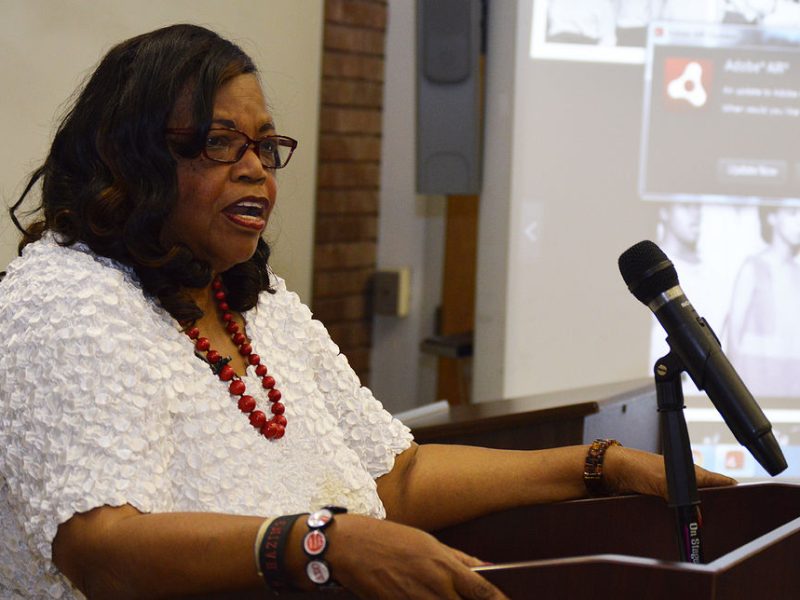
Original Freedom Singer Rutha Harris lectures Albany State University students Friday about the importance of music to the civil rights movement of the 1960s. (Staff Photo: Terry Lewis
By Terry Lewis
ALBANY — Even at 76, original Freedom Singer Rutha Harris still possesses a strong voice that needs no microphone and amplification. When she stepped up to the lectern at Albany State University’s Simmons Hall last Friday, everyone anticipated the first words out of her mouth would be in the form of lyrics of a song.
She did not disappoint, belting out the civil rights classic “Freedom Is a Constant Struggle.” The song recounts constant struggles, crying, sorrows, moaning and dying before making a final plea: “Oh Lord, we’ve died so long. We must be free, we must be free.”
Friday afternoon, Albany State’s Center of Excellence for Community Engagement hosted a “Conversation with Rutha Harris” to discuss the origin and meaning of Freedom Music. The music, an integral part of the Civil Rights Movement, contributed to the progress made during the civil rights era and includes the popular songs “We Shall Overcome” and “Go Tell It on the Mountain.”
The Albany native is one of the original Freedom Singers, along with Bernice Johnson Reagon, Cordell Reagon and Charles Nesbett. The group formed the Student Nonviolent Coordinating Committee (SNCC) Freedom Singers in 1962. She later joined Reagon as part of the Grammy award-winning a capella ensemble, Sweet Honey in the Rock. Harris and the Freedom Singers have performed at the March on Washington, the Newport Folk Festival and at the White House.
“In the summer of 1962, after completing one year at Florida A&M University, I came home for the summer and the Albany Movement was going on. I pondered in my mind if I wanted to continue my education or if I wanted to join the movement,” Harris said. “It took me about six weeks before I decided to join the movement.
“The reason I joined is because I thought I was free and the reason I thought I was free is because my mother and father had sheltered us (she and her seven siblings) from all of that stuff. So I thought we were free, but we were not free.”
A chance meeting between Harris and SNCC’s Charles Sherrod and Charles Jones during the summer of 1962 drove that point home.
“I was walking down the street headed to the SNCC office when one of them stopped me and asked me if I was free,” recalled Harris. “I said, ‘Yeah, I’m free.’ And I thought I was free until I joined the movement.”
Harris became involved in voter registration drives, participated in marches, mass meetings, was arrested three times and spent 14 days in jail. And she began singing with the Freedom Singers.
“Believe it or not, we had a wonderful time in jail. We’d pray and sing ‘Come By Here, My Lord,’” Harris said. “After getting out of jail, we’d march again, knowing we were going to be arrested and we’d go back to jail.”
But through it all Harris and the other Freedom Singers kept singing.
It has been noted that music played an important role in keeping the movement alive. In historian Lee Formwalt’s book “Looking Back Moving Forward” he wrote: “Music and song played a powerful role in the southwest Georgia Freedom struggle. At the time SNCC leader Charles Jones remarked ‘there could have been no Albany Movement without music.’ Later SNCC worker Peter de Lissovoy recalled ‘there is something almost indescribable to me about the music and singing … the music was almost like the ground beneath our feet.’”
“The songs of the Movement were taken from gospel, spirituals, rhythm and blues and many other genres like congregational singing,” Harris said. “We used spirituals and congregational singing because the audience knew those songs. We didn’t have to teach the songs, we only had to teach the lyrics.”
When asked how she related the music of the ’60s to today’s songs, Harris replied, “There is no relationship because each movement has its own music. Black Lives Matter didn’t have music, that’s why it was unsuccessful. Music plays a very important role. Music keeps you from being afraid.
“All of us had the Lord on our backs. We kept pushing because we wasn’t gonna let nobody turn us around. I ain’t even gonna let Donald Trump turn me around, and I ain’t scared. Things are going to be all right. Whatever’s troubling you, write a song. Sing it and it will make you feel better. That’s why I’m still singing because freedom ain’t free.”
Related Articles

Albany teen, 16, makes bodybuilding debut at Atlanta OCB Pro/Am
Crockett, an Albany resident and student at Albany Technical College Academy, placed second in the teen bikini division this weekend at the OCB Immortal Muscle Pro/Am Bodybuilding Competition in Atlanta, becoming the youngest competitor across all categories at the event.
Albany Technical College celebrates award winners
ALBANY – Albany Technical College has announced the names of students and educators representing our college at upcoming state-level competitions in 2025.
Georgia Southwestern earns SACSCOC reaffirmation accreditation
Georgia Southwestern State University received recognition of a 10-year reaffirmation of accreditation from the Southern …
