
Disaster funding inaction impacting Georgia cotton
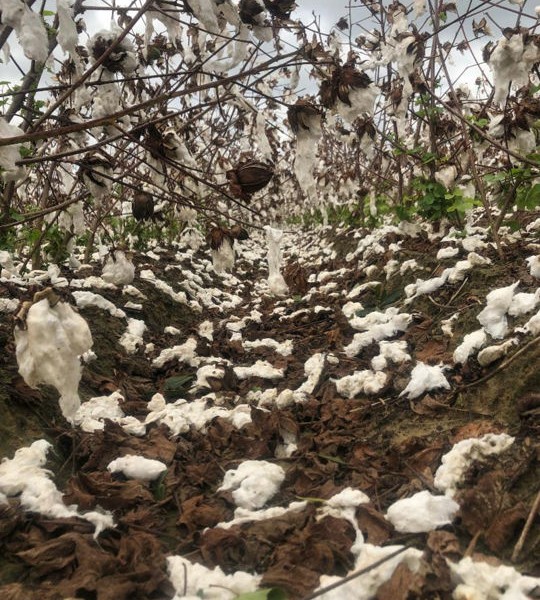
Special Photo
From Staff Reports
ALBANY — Georgia cotton producers are among those who are disappointed with the federal government’s lack of response to the impact Hurricane Michael has had on the state.
Leaders in the state’s $1 billion cotton industry say they’ve been left with more questions than answers. With Georgia cotton planting season quickly approaching, farm leaders say, lenders will be reluctant to provide production loans without a promise of disaster assistance.
“It’s frustrating to meet with our leaders face to face and be promised assistance and nothing come in return,” said Bart Davis, a cotton farmer from Colquitt County who chairs the Georgia Cotton Commission.
That concern was shared by U.S. Rep. Austin Scott, R-Tifton, in an email statement to constituents on Sunday.
“For months, I have worked tirelessly with my colleagues in the House for timely disaster relief for farmers and communities impacted by Hurricane Michael and the other natural disasters of 2018,” Scott said. “When the most recent spending package was released this past Thursday without disaster assistance, I was disappointed and frustrated that the assurances we have heard for months that relief would be included in spending measures to reopen the government were empty promises.”
Scott cited that lack of disaster action and lack of funding to secure the U.S. Southern border as reasons he voted against the spending package.
Rep. Sanford Bishop, D-Albany, who chairs of the House Appropriations Subcommittee on Agriculture, Rural Development, Food and Drug Administration, and Related Agencies, supported the measure to continue funding through the end of the federal fiscal year on Sept. 30.
“I want to thank the bipartisan and bicameral conferees for working so persistently to get something done for the American people,” Bishop said in a statement shortly after Thursday’s vote on the House/Senate conference report for HB 31. “Although both sides did not get everything they wanted, we cannot allow the perfect to be the enemy of the good.
“I also strongly regret, however, that we are not able to consider the disaster supplemental in this appropriations bill.”
Bishop noted the House and Senate each passed bills a month ago that would have provided desperately needed relief to farmers, ranchers and communities that were devastated by disasters, but Congress will have to reconcile those bills for them to head to the president’s desk.
“I look forward to working with my colleagues in the House and the Senate to get this disaster bill passed as fast as we can so the people affected by these natural disasters can get the relief they desperately need,” he said.
The reconciled funding bill passed the House 300-128 on Thursday, with 213 Democrats and 87 Republicans supporting it. The Senate passed the conference report 83-16, with both Georgia senators, Republicans Johnny Isakson and David Perdue, supporting it.
Davis said the inaction on disaster funding in Washington will adversely affect local economies.
“Our small towns will continue to suffer if something doesn’t change,” he said. “The business that farmers provide communities by buying equipment, seed and chemicals, as well as paying employees, are what send economic ripples through rural communities that everyone feels, and all of that is in danger.
“The simple fact of the matter is that current safety net procedures and crop insurance are not designed for severe losses such as the over $600 million that Hurricane Michael took from the 2018 Georgia cotton crop.”
Related Articles
Turnout steady during first week of early voting in Dougherty County
Early voting started statewide on Tuesday, giving voters three weeks to cast ballots ahead of the Nov. 3 election.
Albany considers battery storage system to address electricity surplus
“For me, this is all about ratepayers. Will this keep our rates low? That’s my biggest concern on a project like this.”
48th Sunbelt Farm Expo set to kick off next week in Moultrie
“It’s like down home week, coming to see all the friends, and that’s very reassuring to see. We look forward to welcoming 40,000 or 50,000 of our closest friends to the Sunbelt Expo.”
