
Dougherty County child abuse registry case to go before Georgia Supreme Court
Georgia DHS appeals a Dougherty County court ruling declaring the state’s Child Abuse Registry unconstitutional

A Columbus resident with a violent criminal history was convicted by a federal jury on charges related to armed methamphetamine trafficking.
File Photo
From Staff Reports
ATLANTA — Among the cases on the Georgia Supreme Court docket for Wednesday is a case in which the Georgia Department of Human Services is appealing a Dougherty County court ruling declaring the state’s Child Abuse Registry unconstitutional.
The appeal in this case stems from a lawsuit brought by five Dougherty County teachers and school administrators, including Loy Addison. The five worked in the special education program at Albany High School called Oak Tree Psychoeducational Program. State officials said following a series of incidents in which several students allegedly groped other students, a child abuse investigator for the Dougherty County Division of Family and Children Services substantiated reports of child abuse on the basis that the five teachers and school administrators were inadequately supervising the students.
All five were placed on the Child Abuse Registry. Teachers and school administrators said that in April 2017 Addison received information about “a possible sexual battery or inappropriate physical contact” of one student by one or more other students, wherein a group of students aged 14 to 19 were fondling each other.” Someone reported to Addison that maybe four or five high school students were playing spin the bottle in the school cafeteria during lunch when one of the female students was inappropriately touched by one or more students.
According to the brief filed by attorneys for the teachers and administrators, the following day Addison informed law enforcement about the reported sexual battery or inappropriate physical contact, and the Dougherty County School System Police Department, the Albany Police Department and Tammy Frazier, a child abuse investigator for the Dougherty County Division of Family and Children Services, began investigating. Following her investigation, Frazier concluded that each allegation of child abuse due to inadequate supervision had been substantiated.
A “substantiated case” means child abuse has been confirmed based upon a “preponderance of the evidence.” All five school officers received “Notices of Inclusion,” notifying each that he or she had been placed on the registry. Georgia law requires the name, age, sex, race, Social Security number, birthdate and a summary of the case be included on the registry. Access to the information on the registry is available only to child abuse investigators, their designees, law enforcement and any state agency that licenses entities related to child care services.
An individual placed on the list has 10 days after receiving notice to file a written request for a hearing before an administrative law judge. An adverse ruling by the administrative law judge may be appealed to Superior Court and then to Georgia’s appellate courts.
After receiving the notices, Addison and the others requested a hearing before the administrative law judge to appeal Frazier’s determinations. Prior to the administrative hearing, the five also filed a lawsuit in Dougherty County Superior Court against the state and three of its officers in their official and individual capacities, challenging the constitutionality of the registry. In their petition, they sought a “declaratory judgment” from the court, asking the court to “declare” the registry unconstitutional, and injunctive relief, asking the court to command or prevent certain actions.
Following a hearing, the trial court ruled in their favor, declaring Georgia Code § 49-5-180 through § 49-5-187, as well as the rules and regulations governing the Child Protective Services Information System, unconstitutional. The trial court prohibited DHS from including any of the five teachers and administrators as a substantiated child abuser on the computerized Child Abuse Registry and from disclosing any of the information.
DHS argues the state’s Supreme Court should reverse the Superior Court’s order. Firstly, the agency contends the claims by Addison and the others against the state and the named defendants in their official capacities are barred by sovereign immunity – the legal doctrine that protects the government or its departments from being sued without consent.
“Absent a legislative waiver, sovereign immunity bars suits for injunctive and declaratory relief against the state, its departments and agencies, and its officers and employees sued in their official capacities – even when the relief sought pertains to the constitutionality of a state statute,” the state argues in briefs.
Second, the state is arguing that the court should have dismissed the lawsuit for failure to exhaust administrative remedies.
“By ruling on Appellees’ [i.e. Addison et al.] petition for declaratory judgment and injunctive relief before that hearing took place, the Superior Court violated the well-established rule that courts may not interrupt administrative proceedings in process or grant declaratory relief concerning a constitutional question that could have been raised on appeal from the administrative decision,” the state argues.
Third, DHS is claiming the trial court erroneously invalidated the registry on various constitutional grounds. Specifically, it claims it erred in holding that the registry statute violated due process and equal protection, and by holding that the actions of the child abuse investigator violated separation of powers under the Georgia Constitution.
“The investigator was not acting in a combined executive and judicial capacity in substantiating claims of abuse against Appellees because, among other things, her substantiations were subject to review by an Administrative Law Judge …,” the state’s attorneys argue.
Attorneys for Addison and the other school officials argue the trial court correctly ruled that Georgia Code § 49-5-180 through § 49-5-187, and the rules and regulations governing the Child Abuse Registry, are unconstitutional. They allow the Division of Family and Children Services to investigate an allegation of child abuse, and then “unilaterally” place an individual on the registry prior to affording the individual any due process rights, including the right to notice and an opportunity for a hearing.
A person placed on the registry, “is immediately deprived of one’s reputation and the fundamental rights to family privacy and autonomy, employment and freedom from police surveillance,” the attorneys argue in briefs. Furthermore, the child abuse investigator “is given unconstitutional statutory authority to be the investigator of the facts of an alleged act of child abuse and at the same time given judicial authority to rule on the sufficiency of the evidence” to place an individual on the registry in violation of separation of powers.
They also claim Frazier conducted a “cursory, careless and haphazard investigation” into the allegations, concluding they were “substantiated” without “weighing the evidence” available to her and without knowing the definition of “preponderance of the evidence.”
Although an individual placed on the registry may appeal to an administrative law judge, such a judge “has no authority to rule on a challenge to the constitutionality of any statute or rule,” the attorneys contend.
The school officers’ attorneys also argue that sovereign immunity does not bar their claims. They crafted their petition to be consistent with the Georgia Supreme Court’s 2017 decision in Lathrop v. Deal, which stated that state officials may be sued in their individual capacities to prevent them from attempting to enforce an unconstitutional statute.
Related Articles
Albany/Dougherty County among local governments looking at data centers
“Our understanding is that data center developments look like an easy fix for the problems that face rural America, but this is a Faustian deal at best. You can see the effects in communities across the state and country.
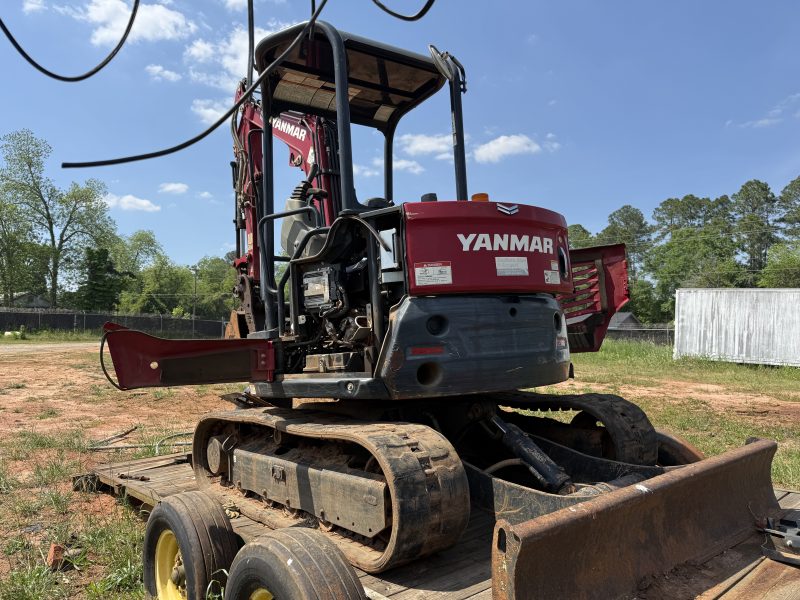
Dawson approves $68K excavator purchase after months of contradictory public statements
The decision concludes one portion of a controversy that has generated months of public scrutiny but leaves several unanswered questions regarding how the city’s original machine was damaged, whether employees were held accountable and what documentation supports the decision to replace rather than repair it.

Dawson proposes borrowing up to $420,000 to stay afloat as finances unravel
Documents obtained by The Dawson News show city officials are proposing to balance the budget through a transfer from the Public Utilities Fund while simultaneously seeking authority to borrow as much as $420,000 from a private financial institution to continue meeting payroll and other operating expenses as Dawson works to complete financial audits that have remained unfinished since 2023.
