
Emergency personnel dispatched wrecker that could not handle job
Wrecker company: ‘Tiered’ system part of reason for confusion
By Jon Gosa
ALBANY — A wreck last week on the Liberty Expressway caused some confusion for emergency operators as to which wrecker service to dispatch, adding time to the clearing of an accident that delayed traffic for hours.
On Aug. 8, a semi owned by Renewal Recycling of Phenix City, Ala., overturned in the westbound-traffic lane of the Liberty Expressway between Slappey Boulevard and Nottingham Way. The truck was hauling a load of scrap metal that was scattered along the roadside when the vehicle overturned.
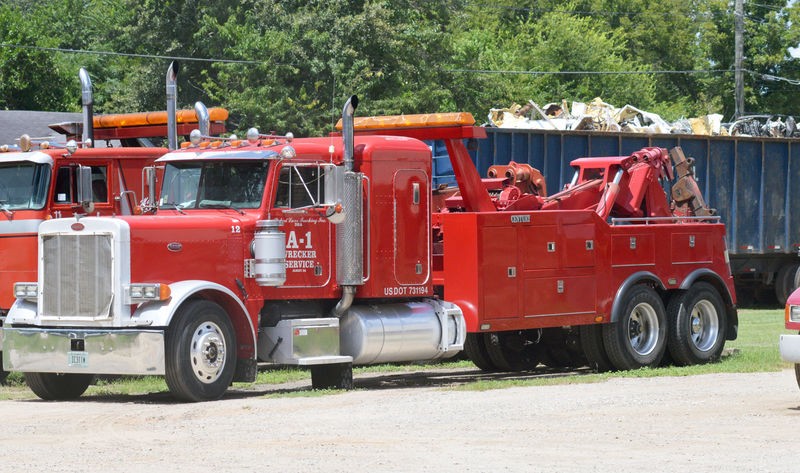
According to reports, police arrived on the scene and notified dispatch that a “Tier I” wrecker would be needed due to the size of the wrecked vehicle. The wrecker service called by emergency dispatch arrived on the scene but was not a Tier I company. It did not have the proper equipment to handle a semi. So, a second wrecker service had to be called that could handle the job.
“That company did not have the proper equipment,” said Robert Lane, owner of Albany’s A-1 Wrecker Service. “The officer on the scene called his dispatch and asked for a Tier I wrecker, which is a large wrecker able to handle a tractor-trailer. Tier II is when it is small, 1600 pounds or less. Dispatch responded that Shipp’s Wrecker Service was en route. The officer then got on the radio and told them that this is an overturned semi, a big truck, a tractor-trailer with a load scattered all over the highway. Dispatch told him again that Shipp’s was en route. Shipp’s goes up there, and then calls us to come handle the wreck.”
Attempts to contact Albany Fire Department Chief Ron Rowe, who oversees E-911 dispatch, to verify exactly what happened during the wrecker call have been unsuccessful.
The confusion at the Liberty Expressway wreck site came soon after the Albany City Commission voted at its July business meeting to rescind the part of its wrecker ordinance that required towing companies who are a part of the city’s emergency rotation to own large equipment. The city opted instead for a tiered system that requires E-911 operators to determine whether a wrecker service in the rotation has the proper equipment for the job.
“We started talking with city officials a couple of years ago because they kept adding people to the rotation who did not have the proper equipment,” said A-1 Service Manager Robert Gilliam. “We went to them asking for help, and instead we got shafted.”
Lane said his company followed the city’s existing rules to become part of the rotation by buying a large tow truck at considerable cost when he started his business in 1982. He now argues that the city’s failure to stick to its wrecker service requirements has opened the door for unqualified companies to join the rotation, which he thinks will lead to delays in clearing accident scenes, just like the one from Aug. 8 when traffic was backed up for miles and was eventually rerouted while workers cleaned up debris on the busy highway.
“This type of thing has been going on since the list got so scattered,” said Lane. “I would say for like the last three or three and a half years. I don’t think the commissioners understand the tier set-up, and they don’t understand the aggravation that they are putting on the 911 dispatchers. If you are dispatching police, fire, EMS and a wrecker, that’s several different agencies.
“You are responsible for covering the safety of the people with the police officers and the safety of the people in the wreck, because you have to get EMS out there. Then you’ve got to get fire out there, and you have to worry about what size wreck somebody can handle. It’s too complicated.”
Rowe, tasked by the City Commission to update the city’s outdated wrecker policy, originally put forth a plan that required wrecker companies to own equipment large enough to move semis, delivery trucks and other large vehicles.
This plan was met with opposition, primarily from Ward II Commissioner Bobby Coleman. Coleman said the city should have an “inclusive” policy and that it should open the door to “businesses that are reflective of the taxpayers of this community.”
Rowe was then asked to come up with an alternate plan, and the commission voted to approve the tiered policy.
“I’m afraid this is going to happen a lot more,” said Lane. “Some of the wrecker services in town will get called, and they will know right away they don’t have the equipment required to do the job. So, they’ll call us and try to ‘sell’ us the job.”
Related Articles

New commander takes helm as Marine Corps logistics adapts to evolving battlefield
Brig. Gen. Kevin G. Collins assumed command of Marine Corps Logistics Command during a change of command ceremony at Marine Corps Logistics Base Albany, succeeding Maj. Gen. Keith D. Reventlow after four years leading the organization responsible for sustaining Marine forces around the globe.
DOT says delay in Oglethorpe Bridge opening should be brief
“We know it’s not going to be July 22. We don’t think it’s going to be much later than that.”

City of Albany has big July 4 celebration planned for Saturday
“It’s going to be a lot of moving and shooting them off in a short time. It’s going to be a big show.”
