
Expert offers clarification on relationship of ADICA, DDA boards
Authorities have key roles in development of Albany’s downtown
By Carlton Fletcher
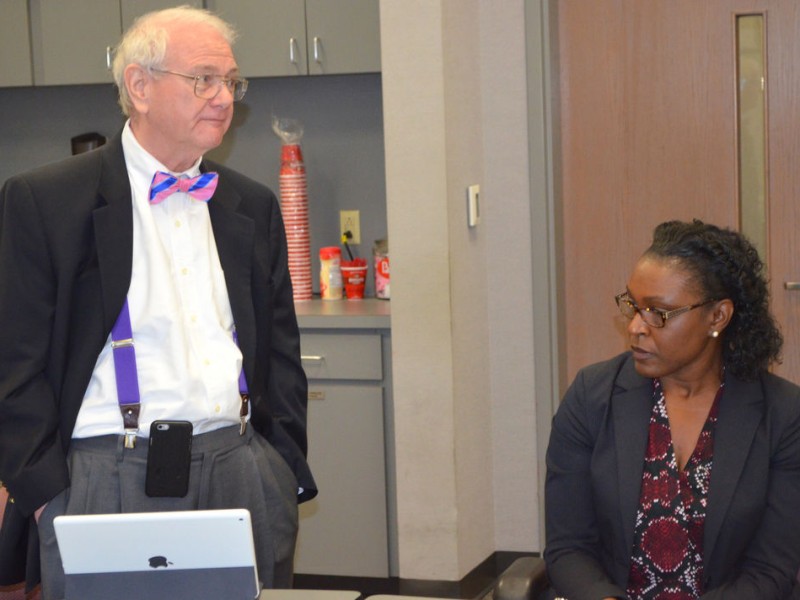
ALBANY — With the city’s downtown revitalization efforts set to kick into high gear and the Albany-Dougherty Inner City Authority in the thick of the plans, Downtown Manager Latoya Cutts called on expert Dan McRae to explain the legal issues downtown development authorities face in the process.
McRae, who is affiliated with the Atlanta-based Seyfarth Shaw firm, explained the difference in the confusing structures of ADICA and the city’s Downtown Development Authority, both of which are made up of the same seven members, at Tuesday’s ADICA board meeting.
After explaining the complex legal structure of development authorities with a hierarchy pyramid that had the U.S. and Georgia constitutions at the top with staff and attorneys at the bottom, McRae focused on the specifics of the ADICA and DDA structures.
“Federal and state laws supersede local law, so no local authority may pass a law that is in conflict with the U.S. or state constitution,” McRae said. “It’s important to note that the reason the pyramid is topped by the Constitutions is that the laws of each were passed by representatives of the people.
“Local development authorities are created to provide a buffer for local governments, to expand their powers while protecting them at the same time.”
McRae suggested that the ADICA board alter bylaws that put the authority in conflict with the DDA board, even though the two comprise the same members.
“Members of both boards are appointed by the City Commission, but the tenure for the ADICA board is two years, while terms on the DDA board are four years,” McRae said. “Members whose terms have expired on either board may continue as ‘holdover directors’ until the commission takes action to replace the board member, but the city should go through the local legislation process at the state Legislature to change the act that governs ADICA. For uniformity, both board terms should be four years.”
McRae also said each board, even if just as a formality, should conduct separate meetings and keep separate minutes.
“I know this is a lot for everyone to digest in a short amount of time, but I thought it was important to clearly define the roles of both the ADICA and DDA boards,” Cutts said. “This is going to make us more effective as a board.”
Also at Tuesday’s meeting, Albany Symphony Orchestra Executive Director Mari Wright asked ADICA to provide financial support for the symphony as it expands its reach to include all of Southwest Georgia.
“We’re planning ‘runouts,’ where after each scheduled performance we go the next day into a nearby community to perform,” Wright said. “We’re planning to perform in Tifton, Moultrie, Cordele and Thomasville this year, and we need financial sponsorships to help with the costs.
“When we perform in these smaller cities, we bring people into our community (for subsequent shows), people who eat at our restaurants and shop at our stores.”
Wright was asked to fill out a funding application that clarifies how the orchestra events impact the city’s economy.
Author

Related Articles

Dougherty Jail graduates first class of female GED recipients
“It was an escape. I can say this has been challenging. I want to express my gratitude for being able to attend this program.”

From cotton to cloud: In the data center debate, is rural Georgia once again being asked to carry the cost?
Across much of rural Georgia, the abandoned cotton warehouses and shrinking tax bases remain — enduring reminders that industries built to serve distant markets do not necessarily stay rooted in the communities that first sustained them.

Dawson Council approves $400,000 lifeline in emergency meeting as financial accountability remains elusive
Less than a week after city officials publicly acknowledged the City of Dawson cannot continue operating without additional financing, the Dawson City Council convened a hastily called emergency meeting Tuesday evening and unanimously approved authority to borrow up to $400,000 through a tax anticipation note.
