
Freddie Powell Sims touts benefits of Amendment 1 to Albany Rotarians
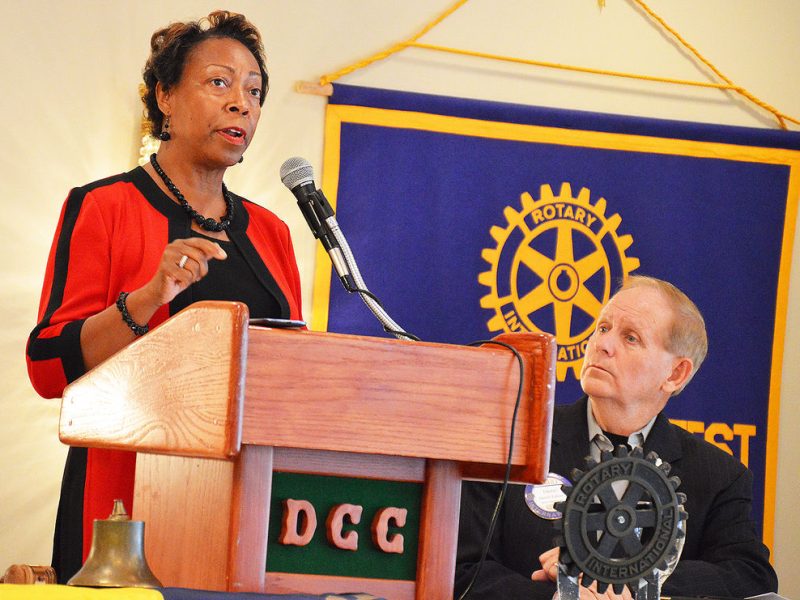
State Sen. Freddie Powell Sims, D-Dawson, talks about the benefit of passing HB 338. She is flanked by State Rep. Darrel Ealum, D-Albany. (Herald File Photo)
By Terry Lewis
ALBANY — During the last legislative session in Atlanta, when state Sen. Freddie Powell Sims, D-Dawson, co-sponsored SB 133, which eventually morphed into Amendment 1, she knew she was sticking her neck out. The Opportunity School District referendum is one of the cornerstones of Gov. Nathan Deal’s education reform package, which will be front and center in the upcoming session.
What Sims did not know is the amendment would become a political football with forces for and against willing to spend big money targeting voters in an effort to either defeat or push the Amendment into law on Nov.8.
Amendment 1 reads: Shall the Constitution of Georgia be amended to allow the state to intervene in chronically failing public schools in order to improve student performance?
In a nutshell, if passed, the amendment would allow the state to take over any public school that scores below 60 for three straight years on the College and Career Readiness Performance Index. The governor’s office would appoint an OSD superintendent, who would have the power to alter the school’s curriculum.
The proposed amendment states that no more than 20 schools would be taken in by OSD per year, so no more than 100 schools would be governed by the district at any one time. Those schools would stay in the district for five to 10 years. Amendment 1 would also allow for the closure of schools that failed to improve after that period.
Currently, 127 schools statewide fit that criteria, including four in Dougherty County: Southside Middle School and Alice Coachman, Morningside and Northside elementary schools.
Referendum opponents say passage of the amendment would cede local control from district school boards and add yet another layer to state bureaucracy.
Proponents of the amendment say passage would help students in struggling schools.
Sims presented the case for passage Thursday before the Albany Rotary Club.
“I hold in my hand a list of school districts throughout the state that have really bad audits. There are 38 districts out of 181,” Sims said. “I’m telling you this because a lot of the school boards around the state want to maintain, and always have, local control. The Opportunity School District takes nothing away from local control, absolutely nothing. A lot of the information that you are hearing in opposition to the Opportunity School District is very, very flawed.
“So let me try to help you understand exactly what this bill means to 68,000 children statewide that are in failing schools.”
Sims represents 11 Southwest Georgia counties located in one of the poorest regions of the country. Five of those counties contain failing schools.
“In Southwest Georgia, we have schools, not districts that are failing,” Sims said. “Please note there is a difference between the district and the school. So the Opportunity School District will come in to rescue the school, intervene and provide additional resources to those failing schools. If this initiative does not pass, it could be 68,000 this year, 78,000 next year and on and on and on because we will have empowered those individuals who think of this as a takeover to remain at status quo.
“A lot of the parents of these children don’t even know their schools are failing, but they are. Right now, we have just 127 failing schools out of 2,089 schools across the state. So we’re only taking about 6 percent, a relatively small number, but we still have 68,000 children at risk.”
Sims then added another layer to the onion.
“Why do we need (OSD)? Low graduation rates in these areas mean they don’t get a lot of economic development,” she said. “Just look at Southwest Georgia. Most of the smaller school districts have very low graduation rates. And companies and corporations, they look for robust, quality-driven school districts. In the last few months, a large tire company located in northwest Georgia. We’ve been making tires in Dougherty County and Southwest Georgia for many, many years. Why weren’t we in the running for this company?
“The company would respond ‘our graduation rates were not high, we didn’t have a college and career academy.’ Now we do. You cannot separate economic development and education; they go hand-in-hand. A lot of my colleagues in Atlanta and the metro area say if your school is not progressing and is failing, just go to another school.”
Sims said for many in rural Georgia, that option does not exist.
“If you are in Clay County, there is one elementary and one middle school, and they share a high school with Randolph County. Where do you go if your school is failing? What options do you have? There aren’t any,” she said. “Then they say we’re going to fire all of the teachers. The amendment does not say that. We cannot afford to get rid of an entire population of teachers because we have a shortage right now. Where are we going to get replacements? So that’s not true either.
“The school board must work hand in hand with the OSD. The information you are getting is skewed so far wrong. And we are amazed that the individuals who need (the OSD) are the ones putting up the biggest fight. The majority of the children who are failing are black and Hispanic. The NAACP is fighting against it; so are a lot of the unions. At the end of the day, if we do not educate these children now, think of the price these communities will pay later on.”
Related Articles
Albany, Dougherty County looking at data center regulations
“Data centers are going to come to Georgia. Data centers are already in Georgia. Property owners have a right to sell their property. It is the responsibility of local government to zone and protect the community you are in.”
Congress weighs packaging bill with implications for Albany manufacturers
A congressional hearing this week on proposed national packaging-labeling standards could have implications for several of Southwest Georgia’s largest manufacturers, many of which produce or package products shipped across state lines.

Dougherty County Sheriff’s Office, GBI investigate inmate death
“The sheriff’s office will conduct an administrative investigation to determine if the staff response was appropriate. We have requested that the GBI conduct an investigation.”
