
GBI meets FBI criteria for crime reporting
States required to participate in national crime database
By Jon Gosa
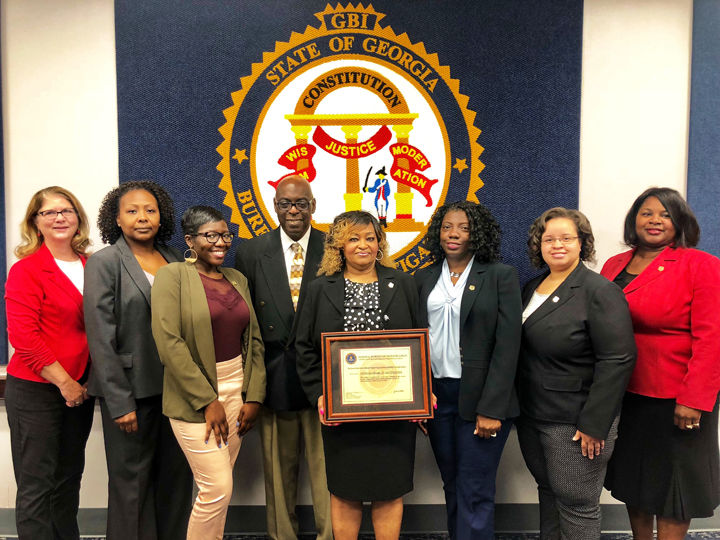
DECATUR — The Georgia Bureau of Investigation announced this week that, after an aggressive overhaul of its crime reporting system, the bureau had successfully met FBI requirements for National Incident-Based Reporting System (NIBRS) certification.
According to bureau officials, the way crimes are counted in the United States is changing in fundamental respects, shifting from monthly aggregate reporting of summary crime and arrest statistics to detailed reporting of crime and arrest activities at the incident level.
“Currently, crimes are reported using a summary reporting system,” GBI Office of Public Affairs Director Nelly Miles said. “NIBRS (incident-based) captures details on each single crime incident as well as separate offenses within the same incident. This provides a more accurate picture of statistics on crime.”
The NIBRS certification means that Georgia now joins 36 other states capable of submitting incident-based data to the FBI.
Since as early as 1985, the nation has been moving toward incident-based reporting of crime and arrest data, marking a significant shift in the manner in which law enforcement data are being collected, the level of detail captured, and the research potential of the underlying data.
Rather than simply forwarding monthly tallies for a handful of offenses, with incident-based reporting local law enforcement agencies will now be expected to collect and transmit comprehensive data on an expanded array of criminal activities.
“The FBI provided notification to states that they have until January 2021 to transition from summary-based to incident-based reporting of Uniform Crime Reporting (UCR) data,” Miles said. “To meet this mandated deadline, the GBI established an aggressive timeline to implement a system capable of capturing detailed data that could be submitted to NIBRS. The GBI worked with Optimum Technology to build a Georgia NIBRS repository and since February 2018 has been sending test transactions to the FBI.”
According to Miles, the GBI’s system successfully met the criteria for NIBRS certification for system compatibility, system responsiveness, statistical reasonableness and satisfactory error rate.
“Georgia will begin accepting test data from local agencies in the coming weeks and plans are for the system to be available to all Georgia law enforcement agencies in the fall of 2018 for manual data entry,” Miles said. “Georgia agencies using record management systems for the reporting of incident-based Uniform Crime Reporting data to GBI will have one year from the GA NIBRS go-live date to remediate their record management systems to meet the new requirements.”
NIBRS officials argue that a shift to the incident-based system would greatly expand analytic capabilities at the local, state and federal levels, but as the system has begun to be implemented, as noted in the report “Implementing the National Incident-Based Reporting System: A Project Status Report,” from the U.S. Bureau of Justice Statistics and the FBI, there has been concern from participating agencies about an “uncertainty of benefits.”
“There was considerable discussion at each of the regional focus group meetings that no clear operational value has been demonstrated for reporting of NIBRS data at the local, state or federal levels,” the FBI report said. “Absent such a demonstration, participants felt that NIBRS is of more value to researchers than to law enforcement agencies and had a general concern that NIBRS is only of value in macrolevel analyses.
“Participants consistently expressed an interest in understanding the potential value of incident-based offense and arrest data at the local level, beyond what use is currently made for general crime analysis and expressed interest in knowing the kinds of analyses that will be conducted at state and federal levels.”
The report went on to say, “Law enforcement administrators are concerned that the detailed, incident-level reporting required for NIBRS participation will require street officers to spend substantial additional time completing incident reports rather than responding to the needs of the public. This potential loss of patrol time looms as a major impediment to some large law enforcement agencies that already face an overwhelming demand for priority services.”
Administrators were also concerned, the report said, about the level of training that will be required for NIBRS participation, and the technical support that is necessary for ongoing operations.
However, pursuing the FBI vision of NIBRS being the national standard of data collection, the new systems promise improvements over more traditional reporting methods in numerous ways, according to GBI Criminal Justice Information Service Operations Manager Lisa Weaver-Johnson.
“The FBI has a vision for NIBRS to become the law enforcement community’s standard for data collection, further supporting the mission of the FBI Uniform Crime Reporting (UCR) Program to generate reliable information for use in law enforcement administration, operation and management,” Weaver-Johnson said. “Unlike data reported through the traditional Summary System, the NIBRS data goes much deeper to provide circumstances and context for crimes.”
Weaver-Johnson explained that the UCR is the nation’s primary source of information about crime and arrest activities of local law enforcement agencies. From its initiation in 1929 until the mid-1980s, the scope of the UCR program remained largely unchanged, although the scale of operations has increased.
As an aggregate reporting system, the summary UCR program produces counts of specific types of offenses, but it is incapable of permitting the examination of complex relationships among characteristics of criminal events.
Moreover, as a consequence of its aggregate reporting structure, there is no process by which an offense can be linked to its associated arrest, so that offense clearance information is not linked to information about arrestees, Weaver-Johnson explained.
Today, more than 18,000 law enforcement agencies, representing more than 97 percent of the nation’s population, contribute data to the FBI either directly or through state UCR programs.
While the program has remained true to its origins as a measure of the incidence of crime and the performance of the local law enforcement agencies, it has also become a significant social indicator used in planning and program evaluation and is broadly relied upon by the general public as an indicator of community safety.
“Each law enforcement agency is required by Georgia law (O.C.G.A. § 35-3-36) to participate in the Uniform Crime Reporting program,” Weaver-Johnson said. “Also, all agencies nationwide have to be NIBRS-ready by the FBI’s deadline of January 2021. Georgia is on track for compliance.”
According to Weaver-Johnson, NIBRS will give law enforcement agencies the ability to address the “true nature of crime in their area.”
“Having accurate statistics allows them to apply for federal grants for their agency to get much-needed resources to help combat crime in their jurisdiction,” Weaver-Johnson said. “Accurate statistics also provide justification for law enforcement agencies needing to hire more police officers and administrative personnel.”
For more information, visit: https://ucr.fbi.gov/nibrs-overview.
Related Articles

New commander takes helm as Marine Corps logistics adapts to evolving battlefield
Brig. Gen. Kevin G. Collins assumed command of Marine Corps Logistics Command during a change of command ceremony at Marine Corps Logistics Base Albany, succeeding Maj. Gen. Keith D. Reventlow after four years leading the organization responsible for sustaining Marine forces around the globe.

DOT says delay in Oglethorpe Bridge opening should be brief
“We know it’s not going to be July 22. We don’t think it’s going to be much later than that.”

City of Albany has big July 4 celebration planned for Saturday
“It’s going to be a lot of moving and shooting them off in a short time. It’s going to be a big show.”
