
Georgia College, high school students make solar-powered golf carts
High-schoolers will join college research team on July 13
From Staff Reports
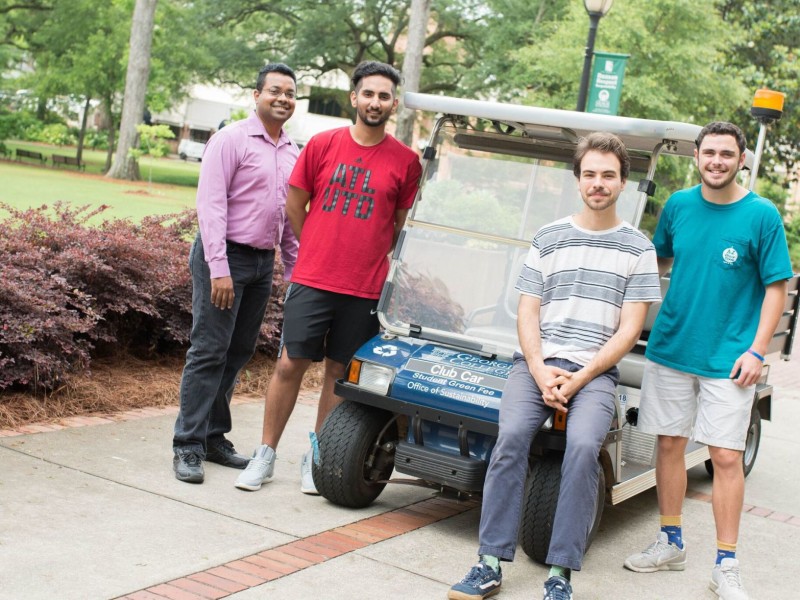
MILLEDGEVILLE — Three physics students at Georgia College and State University and two high schoolers are harnessing the power of the Georgia sun by constructing solar-powered golf carts.
Senior physics major Nowsherwan Sultan, senior Nick Palmer and physics student Amir Abdallah will continue research over the summer to make four new golf carts to join the college’s other two. They also say they hope to make current models more environmentally friendly and use aerodynamics to reduce the time it takes to charge the carts’ batteries.
The students received a $7,700 grant from Georgia College’s Office of Sustainability and another $6,000 grant from Georgia College’s MURACE (Mentored Undergraduate Research and Creative Endeavors) that provides stipends for researchers. The funds will purchase high-wattage solar panels.
Javin Wiggins from Putnam County High School and Aarya Kapani from Walton High School will join the research team through July 13 as part of the Young Scientists Academy Program at Georgia College’s Science Education Center.
“We’re trying to improve the run times, so you don’t have to charge it so much and so it runs longer,” Sultan said. “Our research here is to make solar cells more efficient so that they can collect more energy.”
In the fall of 2016, Sultan and Palmer equipped the first golf cart with a solar panel. However, the vehicle doesn’t go far, and it takes about 26 hours to recharge the battery. They said they hope to improve this by experimenting with a movable solar panel and tilting it to different angles to collect more sunlight and increase running times.
The pair also said they’ll adjust the tire pressure and find parking spots on campus where the carts can take in the most light.
In a laboratory, the Georgia College students are also experimenting with tin, which is more environmentally friendly than lead. Lead is currently the material most used to make solar cells for panels.
The students require a laboratory because they’ll be working with atomic resolutions, expensive material so tiny that a scanning electron microscope is necessary to see it. Instead of following the standard model of using only one layer of solar cells to convert sunlight into energy, Palmer said they plan to place a flexible solar cell “a few nanometers thick” one on top of another. He said he hopes this will collect more light and energy from the sun.
The group said it has big plans for an “Electra-cart infrastructure” or solar-charging station on campus as well. The station will have four solar panels with about 1,200 watts of power, which is enough to charge one or two carts in a relatively short amount of time.
Sultan and Palmer said they feel privileged to do research that’s normally reserved for graduate students at other universities.
“I don’t feel like I’m going to go into the real world someday,” Palmer said. “I feel like I’m already working in a real-world situation.”
Related Articles
Albany police investigate suspicious Sunday death
A 21-year-old Turner Job Corps student who was found unresponsive on Sunday evening was later pronounced dead at Phoebe Putney Memorial Hospital. The death is under investigation.

James Rubino installed in new role at Marine Corps Logistics Command in Albany
James L. Rubino recently assumed the role as executive deputy of Marine Corps Logistics Command in Albany. In his new role he will oversee integrated logistics support.

Rain depresses voter turnout in Dougherty County
“A lot of people don’t vote when it’s raining. People don’t do a lot of things when it’s raining.”
