
Gov. Nathan Deal vetoes ‘Religious Liberty’ bill
Governor says HB 757 might allow discrimination
By Brad McEwen
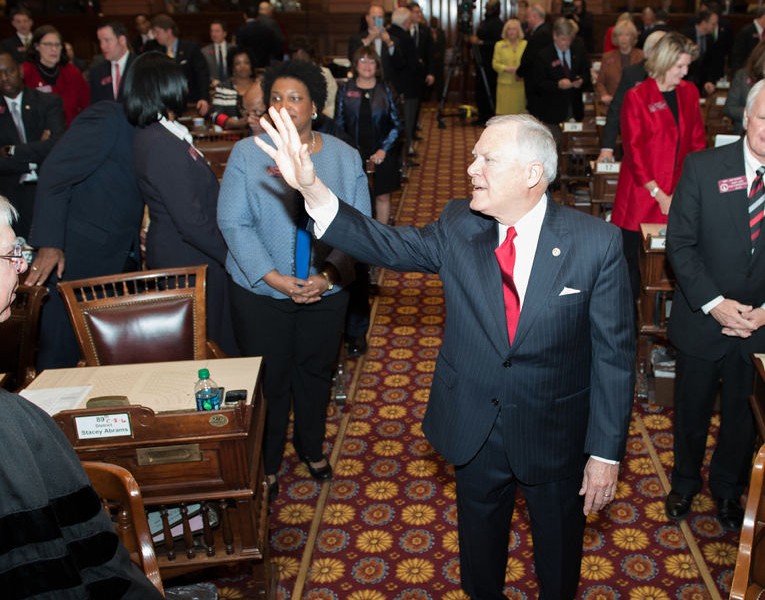
ATLANTA — In vetoing House Bill 757 this morning, Gov. Nathan Deal said the state of Georgia does not need to discriminate in order to protect the faith-based community.
Deal vetoed the controversial bill known as the “Free Protection Act,” which would have allowed religious officials to refuse to perform marriage ceremonies, perform rites, or administer sacraments in violation of their right to free exercise of religion. The bill would have also allowed faith-based groups to refuse to rent facilities for events they would deem objectionable.
When announcing his decision Deal referenced the bill in its earlier form, which was known as the “Pastor Protection Act,” saying his decision was based on the fact that the modified bill would have unintentionally allowed “state sanctioned discrimination.”
“I had no objection to the ‘Pastor Protection Act,’” Deal said in his remarks. “The other versions of the bill, however, contained language that could give rise to state sanctioned discrimination. I did have problems with that and made my concerns known as did many other individuals and organizations, including some within the faith based community.”
Deal said he felt the piece of legislation was not necessary, adding religious freedom was best handled by the First Amendment of the U.S. Constitution.
“Our Founding Fathers did not attempt to list in detail the circumstances that religious liberty embraced,” said Deal. “Instead, they adopted what the late Supreme Court Justice (Antonin) Scalia referred to as ‘negative protection.’ That is, rather than telling government what it can do regarding religion, they told government what it could not do, namely, ‘establish a religion or interfere with the free exercise thereof.’”
Deal referenced the Declaration of Independence, where the document says people are endowed “with certain unalienable rights,” which included religion liberty and others.
“They made it clear that those liberties were given by God and not by man’s government,” Deal said. “Therefore, it was unnecessary to enumerate in statute or constitution what those liberties included. In light of our history, I find it ironic that today some in the religious community feel it necessary to ask government to confer upon them certain rights and protections. If indeed our religious liberty is conferred by God and not by man-made government, we should heed the ‘hands off’ admonition of the First Amendment to our Constitution.”
Deal responded to the notion that his decision was based on fear or intimidation from those who were in favor of the legislation or by businesses and others who were opposed to it.
“Some of those in the religious community who support this bill have resorted to insults that question my moral convictions and my character,” Deal said. “Some within the business community who oppose this bill have resorted to threats of withdrawing jobs from our state. I do not respond well to insults or threats.”
In closing, Deal said that his vetoing of the bill sent a message to inside and outside the state that Georgia valued its character.
“This is about the character of our State and the character of its people,” Deal said. “Georgia is a welcoming State filled with warm, friendly and loving people. Our cities and countryside are populated with people who worship God in a myriad of ways and in very diverse settings. Our people work side by side without regard to the color of our skin, or the religion we adhere to.
“We are working to make life better for our families and our communities. That is the character of Georgia. I intend to do my part to keep it that way.”
Related Articles

DOT says delay in Oglethorpe Bridge opening should be brief
“We know it’s not going to be July 22. We don’t think it’s going to be much later than that.”

City of Albany has big July 4 celebration planned for Saturday
“It’s going to be a lot of moving and shooting them off in a short time. It’s going to be a big show.”
Brie’s Gift offers a helping hand for families affected by leukemia
“I think that would be beautiful. Brie loved her school, she loved her city. I think that would be wonderful.”
