
GBPI chief Taifa Smith Butler: Georgia needs more investment in human capital
Georgia Budget and Policy Institute executive director lays out group’s legislative agenda for 2016
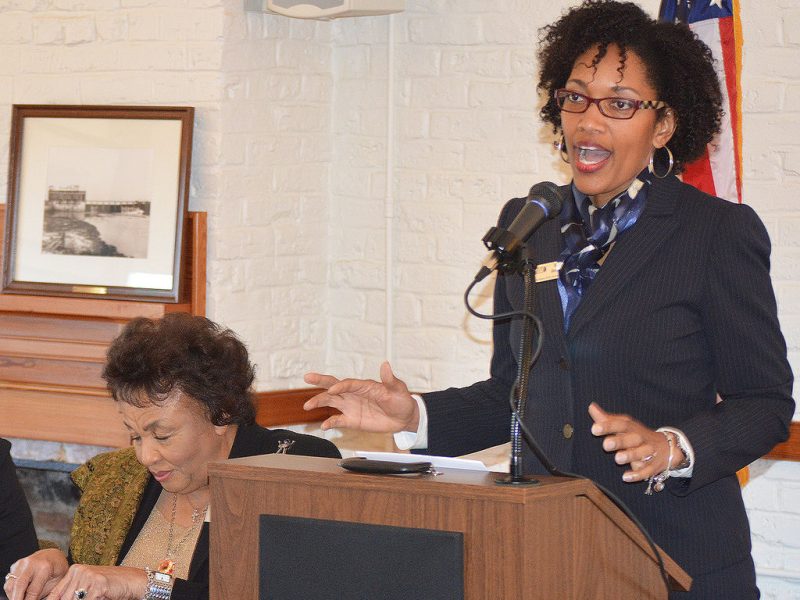
Georgia Budget and Policy Institute Executive Director Taifa Smith Butler addresses area educators, legislators and city and county officials during a meet and greet luncheon Tuesday. (Staff Photo: Terry Lewis)
By Terry Lewis
ALBANY — As next Monday’s opening of of the General Assembly draws closer, the Georgia Budget and Policy Institute held a meet and greet luncheon this week to introduce Executive Director Tiafa Smith Butler to Southwest Georgia.
In attendance Tuesday were regional educators, legislators, and city and county officials.
The GBPI bills itself as a non-partisan think tank which “produces research and state budget analysis to show Georgia ways to provide better education, healthcare and opportunity for everyone.”
Of course, it all begins with the state budget, which Butler wasted no time discussing.
“Georgia’s budget for 2016 touches the lives of people in every corner of the state,” Butler said. “From the mountains of north Georgia to the southern coastal plains, the spending plan affects the quality of life in Georgia’s communities. The state’s future prosperity depends on Georgia’s investments in essential services like education, health care, public safety and transportation, just to name a few.
“We are trying to be the voice that delivers the message to our elected officials.”
Butler, who became the GBPI’s executive director last January, spent much of her time focusing on K-12 education.
“Georgia typically ranks at the bottom of the list when it comes to children,” she said. “How can we talk about Georgia being the No. 1 state to do business in when our families aren’t doing well? And that revolves around education. We are the fifth poorest state in the United States and only 28 percent of our population over the age of 25 have more than a high school education.”
Georgia plans to spend $21.8 billion in state funds raised through taxes and fees for the 2016 fiscal year. The budget plan anticipates a revenue increase of $991 million, or 4.8 percent, from the prior year.
The state’s 2016 budget adds $280 million more for K-12 education over the prior year. It is another easing of yearly education austerity cuts after lawmakers added $314 million for public schools last year.
“But education funding still falls $466 million short measured by the state’s own formula,” Butler said. “Education investment is just one opportunity Georgia is missing to develop its workforce. We have to do a better job of connecting the dots.
“We have many assets in this state. We just need to strengthen our investment in human capital. Government alone cannot do it, but the government does have the process in place to benefit our community.”
Related Articles
Dawson’s $10.2 million sewer project leaves major financial questions unresolved
As Dawson’s finance director resigns and operating pressures mount, records show $10.2 million in sewer funding, frozen loans, missing audits and gaps in the public accounting of project money.
As assessments climb, DCSS signals sizable millage cut
As Dougherty County property owners react to sharply higher reassessed values, school officials say the Dougherty County School System expects to substantially reduce its property tax rate for the ninth consecutive year.
FACT VS. ALLEGATION: What Lee County superintendent contracts and state records actually show
After months of fierce public criticism and the Board of Education’s June 22 renewal of its superintendent’s contract, the Albany Herald obtained LCSS contracts behind the controversy to separate fact from allegation — giving Lee County residents the transparency and clarity the public debate deserves.
