
Honor Society installed at ABAC in Tifton
Nation’s oldest honor society now has chapter at ABAC
By Jon Gosa
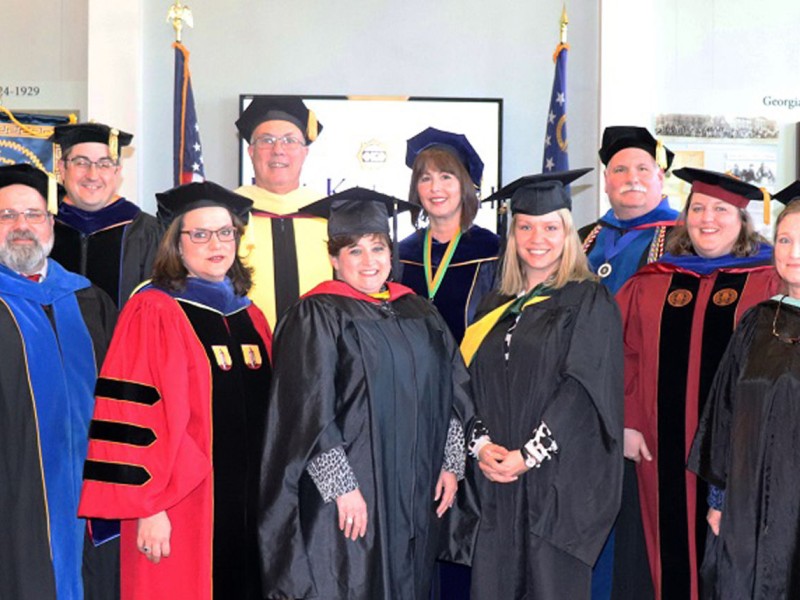
TIFTON — The Phi Kappa Phi Honor Society, the nation’s oldest and most selective all-discipline collegiate society, installed its 346th chapter at Abraham Baldwin Agricultural College this week.
The society’s mission is “to recognize and promote academic excellence in all fields of higher education and to engage the community of scholars in service to others.”
“The recognition and reputation of Abraham Baldwin Agricultural College as a baccalaureate degree-granting institution has dramatically increased over the past 10 years,” ABAC Provost and Vice President for Academic Affairs Jerry Baker said. “It is now time for ABAC to more formally recognize the achievements of our student scholars. To this end, we petitioned the Honor Society of Phi Kappa Phi.”
Phi Kappa Phi eligibility requires that an institution be a regionally accredited four-year college or university with an established reputation of excellence and express commitment to upholding the values of the society.
“The Honor Society of Phi Kappa Phi is pleased to welcome Abraham Baldwin Agricultural College to its community of scholars,” Society Executive Director Mary Todd said. “ABAC’s focus on engaged learning and its groundbreaking interdisciplinary rural studies degree are exemplars of the growth the institution has seen since its transition from a two-year college over the past 10 years.”
Officers elected by the chartering group to serve the newly installed chapter include Beth Morehead-Thornton (president), Johnny Folsom (president-elect), Joseph Falcone (secretary), Vonda Doss Fenn (treasurer) and Jerry Baker (primary contact).
“Our purpose as a member of the Honor Society of Phi Kappa Phi is to celebrate excellence by recognizing high academic achievement,” Baker said. “We will extend membership only to those who have demonstrated exceptional accomplishment over a sustained career of study or research.”
Phi Kappa Phi was founded in 1897 at the University of Maine to recognize excellence in all academic disciplines.
In 1932, the society began an awards program that has since given in excess of $15 million. Today, $1.4 million is awarded each biennium to qualifying students and members through graduate fellowships, undergraduate study-abroad grants, member and chapter awards, and grants for local and national literacy initiatives.
The society has chapters today on more than 300 campuses across the United States and the Philippines while inducting an estimated 30,000 new members annually.
Membership to the exclusive organization is by invitation only to the top 7.5 percent of juniors, and the top 10 percent of seniors and graduate students, along with faculty, professional staff and alumni who have achieved scholarly distinction.
“Because the qualities we seek to honor can be identified only on the basis of work that has matured over a period of years, our aims reach beyond the encouragement of promising potential or commendation for good progress,” Baker said. “Rather, we honor consistent performers whose persistence over time has borne fruit, distinguished work that has gained realization in genuinely extraordinary attainment.”
Related Articles

James Rubino installed in new role at Marine Corps Logistics Command in Albany
James L. Rubino recently assumed the role as executive deputy of Marine Corps Logistics Command in Albany. In his new role he will oversee integrated logistics support.

Rain depresses voter turnout in Dougherty County
“A lot of people don’t vote when it’s raining. People don’t do a lot of things when it’s raining.”

City of Albany faces shortfall for police, fire salaries
“We can’t tell staff to hire more police officers and then complain at what it costs.”
