
Lee Commission mulling Grand Island drainage issues
Lee Commission authorizes EMC engineering to look into drainage issues impacting hospital plans
By Brad McEwen
LEESBURG — In an effort to prepare for the coming development of a new 50-bed private hospital, the Lee County Board of Commissioners has engaged EMC Engineering Services to develop options for alleviating stormwater drainage issues from the Grand Island property where the hospital will be located.
The commission took that action at its regular monthly work session Tuesday, voting unanimously to approve a service contract hiring the engineering firm to look at possible solutions for handling current and potential flooding of the existing holding ponds on the golf course property.
Discussion of the matter started with County Commission Chairman Rick Muggridge providing some historical context and explaining that the drainage issues were a county concern ever since it acquired the Grand Island property, and that the county had been looking at options for some time.
“This has been a project that has been on the to-do list for Lee County; it’s been on our project tracker since we created it,” said Muggridge. “SPLOST dollars were set aside, half a million dollars, for storm drainage remediation when we did our last SPLOST.
“Even in the early 2000s we knew there was a problem at Grand Island. Basically we were taking all the water from Northwest Albany, it accumulated on Grand Island and was trapped there. There was no outfall for it.”
With the county responsible for drainage in the area, when discussion arose with developers about the hospital project in 2015, then-county Engineer Matthew Inman negotiated a deal with property owner Thorsin Development to acquire a pond north of the Grand Island property that could potentially be used to collect the stormwater that would be generated once the hospital and surrounding development were complete.
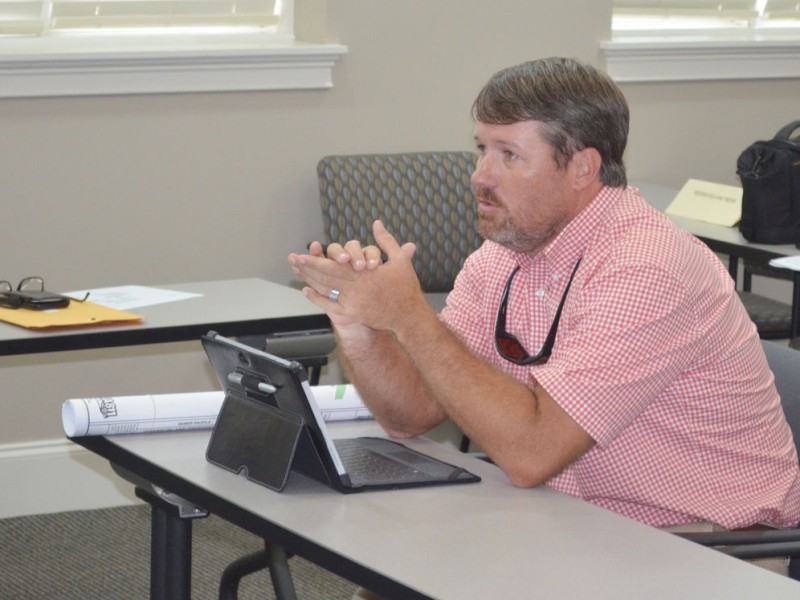
Inman, who is now with EMC, was on hand to explain the general plan that led to the acquisition of the Thorsin pond and the current contract with EMC to design a system to move water there.
According to Inman, the ponds at Grand Island are already overtaxed by stormwater from the surrounding area, including all the development around the Albany Mall and on Ledo Road. He said future development in those areas is going to create an even bigger problem.
“The ponds flood as they are, and there’s still more water to come to those ponds,” said Inman. “The site right next to Prince Automotive, where Waffle House and potentially another 12-14-acre development is locating, that water is scheduled to go in these ponds. There’s more water, 15 acres roughly, of impervious area that’s going to come to ponds that already flood.
“The site adjacent to Gander Mountain, within the perimeter of the mall, there’s about a 5-acre site there, that’s allowed to come to this pond. There’s a couple of other miscellaneous parcels planned, so with the ponds already flooding, there’s already 25-30 more acres of development to go to those ponds.”
It was for that reason that Inman looked at the option of routing the hospital storm water in another direction.
“There are challenges and concerns with those ponds,” said Inman. “If we’re going to do this future development, it would be something that the county would have to either build new ponds within the golf course property or take the water and piping, just take it in a different direction and go through Grand Island to (Thorsin) pond.”
Inman reasoned that rather than incur a greater cost to dig more ponds and simultaneously use up land that could be utilized for development, it made sense to improve the Thorsin pond and route water there. Once there, the water could move through a positive outfall on the backside of the pond and make its way ultimately to the Kinchafoonee Creek.
“This is for this development and the associated development around that property,” Inman explained. “This will have a positive discharge to Fussell Road, which then goes down to Palmyra and on to the Kinchafoonee Creek.
“What happens with the balance of the ponds on the golf course? At some point down the road, we’re going to need a pump station or something. This work is for the development we’re currently proposing, and to handle that development, not for solving all the issues of Northwest Albany.”
Although EMC’s tentative plan would handle the immediate needs of the county in regard to the coming hospital development, County Commissioner Billy Mathis said he was interested in a plan to alleviate flooding problems for the entire watershed.
Mathis said this issue had been discussed roughly 15 years ago during his last term on the County Commission and that the county had contracted with Marbury Engineering to develop a plan.
“We had a plan to take all of that water to the creek,” said Mathis. “We could alleviate the water problem from the whole watershed, all the way to the creek. We’d never have to pump any water, we’d never have to do anything else to it. I remember the commission paid Ritchey Marbury (to come up with a plan) to get that water all the way to the creek so we’d never have to worry with it again.”
Inman said he was familiar with that plan, but that at the time it was done the County Commission had deemed the project too expensive. Additionally Inman offered that the cost of executing a similar plan today would be even more costly.
“The issue was, in 2000 when the (previous study) was done, there were no grade shots, there was no grade work done, no design work done, from the standpoint of how deep those lines needed to be in the ground,” he said. “I don’t have an off-hand number (of what that project would cost today), but it would be multiple times more.”
Despite Inman’s assertion that doing a permanent fix for the entire area would be costly, Mathis said he felt the commission ought to know what that final number might be so it could make an informed decision on whether to simply handle the hospital stormwater issue through use of the Thorsin pond or tackle the drainage of the entire watershed.
“What I’m saying is, if we could resolve all of the issues finally, once and for all, which we should have done 15 years ago, I would just like to see the numbers to see what it would cost,” said Mathis. “When we hired Marbury to come to us with what we said was the very best plan to get rid of this water, and that’s what he brought us, it was to take it and run it all the way to the creek.
“So I guess what I’m saying is, can you get us an idea of what it would cost us to do the (Thorsin pond plan) versus just doing the whole project and getting that water out of there for good? I don’t want to see us come back five years from now and say, ‘Well, we have to do something else out there, we’ve got to get rid of all of this water.’ I just don’t think we have enough information yet.”
When Inman agreed that EMC could investigate both options, the commission asked that he return in two weeks with his findings.
In other matters the commission also unanimously voted to award a contract to W.J. Kirksey Construction Company of Leesburg to construct a bathroom facility on Jordan Road. At $45,382 Kirksey was the lowest of three qualified bidders.
The commission also voted to adopt a resolution authorizing the Georgia Department of Natural Resources to submit an EPD Hazardous Waste reimbursement application so the county could recoup $10,613.95 in costs associated with meeting Environmental Protection Division standards at the county landfill.
Commissioners also voted to alter the county’s 2017 Georgia Department of Transportation Local Maintenance Improvement Grant list. The change being made is removing widening of Oakland Road and adding improvements to Creekside Drive and Colonial Drive to the list.
Related Articles

James Rubino installed in new role at Marine Corps Logistics Command in Albany
James L. Rubino recently assumed the role as executive deputy of Marine Corps Logistics Command in Albany. In his new role he will oversee integrated logistics support.

Rain depresses voter turnout in Dougherty County
“A lot of people don’t vote when it’s raining. People don’t do a lot of things when it’s raining.”

City of Albany faces shortfall for police, fire salaries
“We can’t tell staff to hire more police officers and then complain at what it costs.”
