
Leesburg to consider depot overlay district proposal
Plan seeks to preserve Leesburg’s distinct history while attracting new business
By Cindi Cox
LEESBURG — When Leesburg City Council members met on Tuesday, much of the talk was about historic preservation, planning and state initiatives that could potentially help the community grow while still retaining its rural appeal.
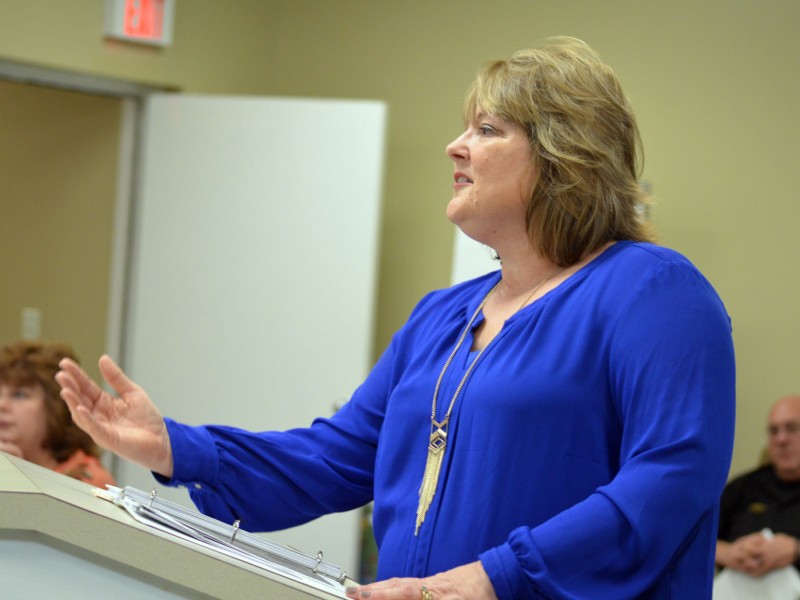
Rozanne Braswell, director of Planning, Zoning and Engineering for Lee County, presented information on issues ranging from code enforcement to economic development, and from bringing in new businesses without disturbing residential areas to obtaining grants that may potentially help Leesburg obtain tax credits for job creation, investment in and renovation of downtown properties.
“As restoration efforts of the train depot conclude, and the chamber plans for their new offices and the establishment of a Welcome Center, Leesburg is looking ahead to future opportunities with the possible development of a depot area overlay district,” Braswell said.
Overlay districts are supplemental to underlying zoning classifications, Braswell explained. In other words, she said, the proposed train depot overlay district could allow for new regulations to be imposed within a specific area. Overlay districts can also establish provisions that would apply to all applicants for rezoning, variances, plat approvals, building permits, and the reconfiguration of existing parcels and rights-of-way within the overlay districts.
“The purpose of the depot overlay district would be to support and enhance downtown Leesburg,” Braswell said.
The focus, she said, would be to develop heritage tourism and to develop a gateway corridor along U.S. Highway 19 at Walnut Avenue surrounding the historic train depot.
Braswell said that the overlay district would protect homeowners from being crowded out by commercial businesses while encouraging small business opportunities.
“A mix of small businesses with distinctive and unique character can contribute to downtown,” Braswell wrote in a proposal to city officials. She suggested businesses that offer a “taste of Lee County agriculture commodities” as appropriate businesses for the proposed overlay district.
Leesburg Mayor Jim Quinn asked if the proposed district would prohibit him from selling his house to a Dollar General store. Braswell said the overlay district would be more inclined to seek businesses that would not be high in traffic. Structures that are zoned for residential and commercial use might be welcome for accountants, architects, photographers, artists, consultants and similar occupations, while downtown boutiques, eateries and specialty shops would also be welcome.
“Homes and businesses along Walnut generally have little or no parking, narrow sidewalks and are not cohesive to rezoning for large commercial businesses,” Braswell said. “We want to keep these structures as they were built, even if they were to become joint-use residential and commercial.”
In a 15 page draft proposal for Leesburg officials to consider, Braswell wrote:
“The purpose of the depot overlay district is to support and enhance downtown Leesburg as the historic crown of the city, with a focus on the historic depot (Welcome Center) as its most sparkling jewel. The elements of the Leesburg depot area overlay shall influence the shape and scope of a new, updated and redefined downtown.”
The Overlay District proposal also lists five “incompatible commercial uses” within the district including tattoo parlors, check cashing and pay-day, or title loan, business operations, adult entertainment establishments, new drive-thru windows and new pawn shops of bail bond businesses.
Some of the proposed elements for storefront treatments include:
— Prohibiting internally illuminated of LED message signage;
— Limiting the amount of painted window signage to only 35 percent of the display area;
— The signage proposal also sets forth specifics regarding scale, materials, cornice, frame, entrances, window and secondary design elements.
Council members had several questions concerning how these ideas would be initiated and subsequently enforced.
Braswell responded that zoning ordinances would cover most of the issues for new businesses. By prohibiting high-traffic businesses while encouraging small businesses, growth could still occur without having a negative impact on traffic and parking issues, she said.
Council member Bobby Wilson said he is concerned about traffic and speeding along the U.S. 19 corridor.
“How can you enjoy the area with all the speeders?” he asked. “We need to get DOT to make them slow down.”
Braswell said if the gateways into the city were better established, Leesburg would have a scenic corridor similar to Americus and that might cut down on some of the traffic volume and the speeding.
Quinn wanted to know if existing businesses would be impacted by new depot overlay regulations.
Braswell said, “It could be written that existing businesses would have a period of time to comply.” She also mentioned that a “grandfather” clause could apply to existing businesses with or without a time limit to comply.
As an incentive to comply and to spruce up residential and commercial properties, Braswell suggested monthly recognition for the most attractive home and business.
Quinn said one of the problems he has observed in Leesburg is that current codes and ordinances are not always being enforced. As for the overlay district plan to enhance building facades and appearances, Quinn said he wanted to know how far the plan would go in requiring businesses and residents to conform to aesthetic guidelines.
Braswell said the overlay district proposal deals more with signage, zoning to define property usage and keeping historic facades intact.
After a lengthy discussion, the council took no action to adopt the proposal but did agree to take it into consideration for further action in the near future. Quinn said it is important for the public to understand that the proposed depot overlay district is not like Albany’s historic preservation initiative that has procedures and regulations that homeowners must follow if they live in a historic home.
“I think those historic preservation initiatives are set up so if I wanted to change my roof from shingles to a metal roof, I would have to get permission,” the mayor said. “That is not what we are talking about doing here in Leesburg — that is not what the overlay project is about.”
Quinn also said that before City Council members vote on the proposed overlay district, it will first have to be approved by the Lee County, Leesburg and Smithfield Planning Commission and be discussed during two public hearings.
Leesburg Manager Bob Alexander said he believes the initiative could help improve the development of downtown Leesburg.
Related Articles

James Rubino installed in new role at Marine Corps Logistics Command in Albany
James L. Rubino recently assumed the role as executive deputy of Marine Corps Logistics Command in Albany. In his new role he will oversee integrated logistics support.

Rain depresses voter turnout in Dougherty County
“A lot of people don’t vote when it’s raining. People don’t do a lot of things when it’s raining.”
City of Albany faces shortfall for police, fire salaries
“We can’t tell staff to hire more police officers and then complain at what it costs.”
