
Mental health courts seek better outcomes
Mental health crucial element of criminal justice system
By Jon Gosa
Third in a series on how mental health issues impact the local criminal justice system.
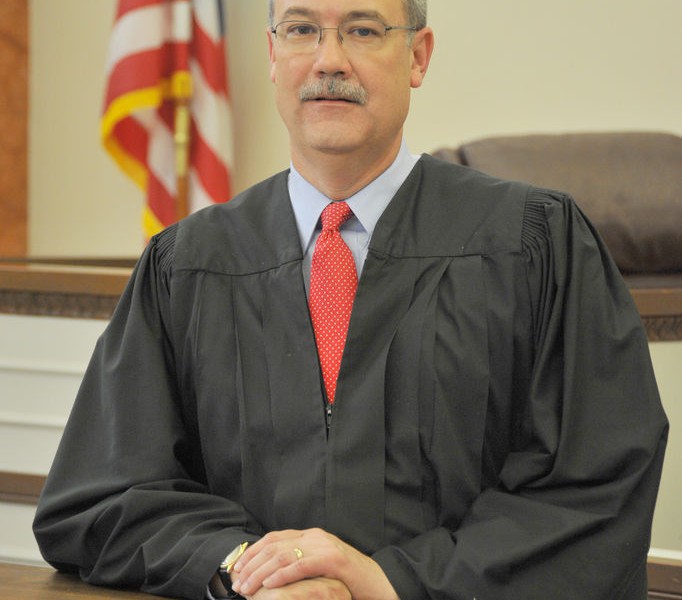
ALBANY — Each year, more than 2 million people with severe mental illnesses are incarcerated across the nation, according to Dougherty County Superior Court Judge Steve Goss.
Statistics show that almost three-quarters of these adults also have drug and alcohol problems. Once incarcerated, inmates who suffer from mental illnesses tend to stay longer in jail and, when released, they are at a much higher risk of recidivism than those without mental illnesses.
“The first mental health court program in the country started in 1997,” said Goss. “Dougherty County started in 2001, so we were kind of at the front end of it. We began to look around and take some concepts from drug courts that were in existence. We kept what worked and discarded what didn’t. We have modified the program over the course of the last 14 or 15 years to adapt to changing needs.”
The percentage of people in jails with mental illnesses is three to six times higher than that of the general public, according to the American Psychiatric Association.
“The very first mental health court programs were in more metropolitan areas,” said Goss. “Most all of them, to begin with, were diversion programs. In other words, they weren’t taking somebody in that had an aggravated assault or a burglary, it was more of the guy picked up by the local police that was off his medicine and urinating in public, panhandling outside of the store or it was a disorderly conduct kind of thing where you were just seeing the same faces over and over again.
“They were getting booked, staying in jail for a week, getting out and then they coming right back. A lot of the very first programs were pure diversion programs. So instead of booking them and really prosecuting them, we were going to link them to the local mental health clinics and the Salvation Army to get them some housing. In the beginning, the idea of the mental health court was more of a linkage or more of a front end kind of case.”
Jails spend two to three times more money on adults with mental illnesses that require intervention than on those without those needs. In addition to the increased cost to taxpayers, a significant number of inmates with mental illnesses would continue to cycle through the Criminal Justice system, often resulting in tragic outcomes.
“What we wanted, what we developed and what has become more of the norm nationwide,” said Goss, “is more of, for lack of a better term, on the back end. If somebody’s got some prior criminal history and they are already on probation, we can make participating in the program a facet of their probation. (Mental Health Court) is very heavy on case management, supervision, drug testing, daily living assistance, med management and other basic life issues.”
Counties, like Dougherty, have increased efforts to address the problem of judicial involved individuals with mental illnesses, but are often thwarted by limited resources and lack of communication/coordination between the criminal justice system, mental health treatment, substance abuse treatment and other agencies. This, according to Goss, is where the mental health court comes into play.
“Three or four years ago, Gov. Deal, who has been very supportive of the whole model of treatment court programs, put some more state budget money into play,” said Goss. “As of now, we have about 135 treatment court programs in Georgia. More than half of those are adult drug court programs, but we have about 25 to 28 felony mental health court programs. Over the last four to five years, there has been a big expansion.”
Addressing the growing crisis, many communities across Georgia and the United States have looked to Dougherty County as a model.
“Since 2006,” Goss said, “Dougherty County has served as one of the national teaching sites for mental health courts. We have actually helped a lot of the mental health court programs in Georgia get off the ground. We’ve had visitors from a number of states. We’ve had people from Kansas, Louisiana, Alabama, the Carolinas and one time a team came all the way from Guam.
“Their greatest challenge, because of their isolation out in the middle of the Pacific Ocean, was how to deliver treatment services. And of course, that is a huge challenge in a rural-based program like ours, where you have a lot of people needing service, and addiction specialists and psychiatrists are in short supply in many places in the country, including here.”
The mental health court program attempts to better deal with the underlying issue of inmates suffering from behavioral disabilities that have become judicially involved instead of incarceration.
“The concept is that this is a better way to deal with theses cases, instead of just sending people to prison and not addressing the root of the problem,” said Goss. “In the last year, Georgia has been trying to pass some legislation that would provide some uniformity. Every community is different; we have resources available in Albany that some of our smaller neighbors don’t have. Macon has resources that we don’t have, and Atlanta has resources that Macon doesn’t have.
“What we are trying to do is to get some fidelity to basic evidence-based, research-based, scientific-based programming. So, if you walk into any program, anywhere in the state of Georgia, the fundamentals are going to be the same. The decisions about who to accept or who not to accept are going to be based on validated, evidence-based, risk needs assessments and clinical criteria. There are 49 judicial circuits in Georgia, and as of this year 48 circuits have court treatment programs.”
Judicial circuits across the nation are facing a crisis. The prevalence of the mental health issue and the criminal justice system reaches far beyond Georgia.
“About 5 percent of the adult population in this country has a serious, persistent mental illness,” said Goss.
According to the U.S. Census Bureau, as of April 2016, the United States population was an estimated 323,730,000 people, 245 million of whom are adults. That means somewhere around 12,250,000 people in this country suffer from a mental illness, more people than the entire state of Georgia (population 10,214,860 as of 2015).
“We, in our program,” said Goss, “try to do the best job we can dealing with these problems.”
According to Goss, every community needs three major responses to meet the needs of individuals suffering from mental illnesses that have become involved with the criminal justice system.
First, diversion programs are needed to keep individuals with mental disorders in community treatment facilities and out of jail. Second, institutional services are needed to provide constitutionally adequate oversight in correctional facilities for inmates with mental illnesses who need to be in the criminal justice system because of the severity of their crimes.
And third, re-entry transition programs are needed that can link people suffering with mental disabilities to community-based services when they are discharged.
Related Articles

James Rubino installed in new role at Marine Corps Logistics Command in Albany
James L. Rubino recently assumed the role as executive deputy of Marine Corps Logistics Command in Albany. In his new role he will oversee integrated logistics support.

Rain depresses voter turnout in Dougherty County
“A lot of people don’t vote when it’s raining. People don’t do a lot of things when it’s raining.”

City of Albany faces shortfall for police, fire salaries
“We can’t tell staff to hire more police officers and then complain at what it costs.”
