
Parents of Dougherty County students ‘Level Up’ in career training program
The Level Up program, an initiative under the DCSS Family and Community Engagement (FACE) program offers certification programs in heavy machinery operation and to become a Certified Nursing Assistant.

ALBANY – It’s graduation season in Dougherty County for college students, high school seniors – and a group of 23 Dougherty County School System parents.
The group also will walk across a stage, some donning caps and gowns, to receive their certification from the Dougherty County School System’s Level Up program, an initiative under the DCSS Family and Community Engagement (FACE) program that offers certification programs in heavy machinery operation and in becoming a Certified Nursing Assistant. The program, funded by a Georgia Power Equity in Education grant, is completely free to parents of students in the school system.
“It’s an economic development and empowerment initiative aimed at supporting the students of DCSS and their families with an opportunity to level up their careers to have a positive impact on household income and decrease the negative impact of poverty in our area,” DCSS Superintendent Kenneth Dyer said.
FACE has been a longstanding part of DCSS. Maqueta Griswold, FACE’s director, said it meets the needs of families outside of just academics.
“We look to help our families, not only in the area of supporting their children academically but providing them with wraparound services to ensure they’re taken care of,” Griswold said.
This includes offering financial literacy courses, teen pregnancy support and even resources as simple as food, clean clothes or money to cover bills for those families that are really struggling.
Two years ago, looking for ways to expand these services, the system began the Level Up program.
The program offered families a way to take the next step in escaping poverty. It removed barriers against gaining valuable work skills and certifications. At first, the need was clear through data. Some 28% of the Albany area is below the poverty line. DCSS’s student population qualifies for free and reduced school lunch at 100%. DCSS families are negatively impacted by poor health care statistics, chronic disease and high incarceration rates.
Equipping parents with the certifications to get a higher-paying job not only means more money, it means full-time positions with health insurance and hours that allow parents to be home with their kids more often. The hope for Dyer and Griswold was a generational pivot.
“A lot of our challenges in our community go back to poverty, food insecurity, homelessness and so we feel that we could have a positive impact on family, household income,” Dyer said. “Then, we can take a blow at poverty and the challenges that our students face, that tie back to poverty.”
With the help of Albany economic leaders, DCSS identified major work force needs for the area and decided on the heavy equipment and nursing assistant programs for its parents.
“We saw an opportunity to impact economic and work force development in our area, along with the opportunity to impact the families of children that we serve every day,” Dyer said.
The first cohorts began about two years ago. FACE staff made phone calls to parents it had previously served, with propositions about the new program. Griswold said they got an enthusiastic response. The parents were ready to learn and work.
To participate, parents must pass a background test, an aptitude test to prove sufficient background knowledge in subjects like math, and remain drug free.
For each cohort, Level Up hosts an orientation. It offers $150 gift certificates, allowing parents to purchase uniforms and other supplies. It provides transportation for both parents and their children.
Each cohort is small in size – about 13 CNAs and eight in heavy equipment – to allow for an intimate learning experience. The heavy equipment training happens after hours at the 4C Academy. It’s a five-week program, with classes held one day a week. The CNA program is four weeks long, Monday through Thursday, with two different sessions offered in the morning or late afternoon.

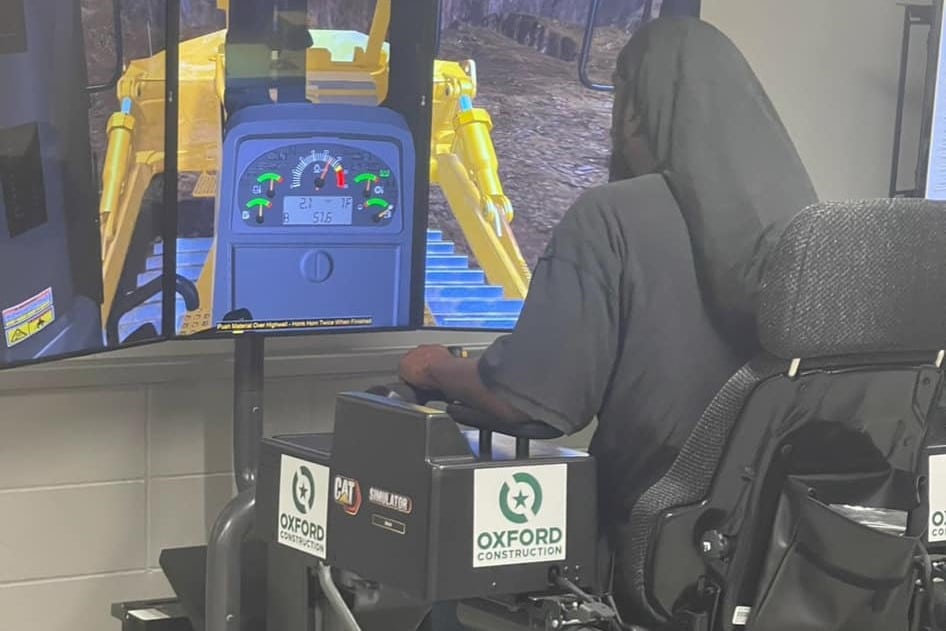
Now, two years and some 30 cohorts later, 137 parents have “leveled up.” Eighty-four parents received credentials from the CNA program, 79 of whom now hold local jobs. Fifty-three parents are certified in heavy equipment, 38 of whom now have jobs.
The completion of each cohort program calls for a graduation ceremony.
“If you were to ever come to those graduations, if you could see the kids’ faces … how excited they are to see their mom or dad graduating,” Griswold said.
There have been several success stories shared at these graduations, and with Georgia Power, which checks in on the unique program quarterly. For Rashad Ford, the heavy equipment course allowed him to get a job that sees him home every night, able to tuck his kids into bed. Before, he had to work overnights and missed those family moments.
The CNA Pathway program allowed Oceanshina Johnson to start her own business in hiring other nursing assistants locally.
For many, like 34-year-old Jalisa King, the Level Up program meant realizing a lifelong dream that for a long time felt unattainable.
King is a single mother with two daughters attending DCSS schools. In 2021, she had to have her leg amputated. She said this left her in severe depression, trying to raise two kids alone and with barely any income.
“I had been wanting to become a nurse because I love taking care of people … but I couldn’t afford to go to CNA school,” she said. “One day, I was sitting at home, and I said ‘God, show me the way.’”
“The way” took shape in a Facebook post advertising the Level Up program. King applied and was accepted.
Soon, she was immersed into the double life of a CNA student and single mom.
“I’d go to class; I’d come home and be a mama, cooking dinner and getting the girls ready for bed,” she said. “Then I’d be up until midnight, studying for my tests.”
She said there were days she thought about giving up. She said she always had the support of her peers and teachers with Integrity Health, who offered hugs and words of encouragement.
“When I was in clinicals, I had to walk around that big old building with a prosthetic leg,” King said. “Every night I’d look at my two kids, and I was just like, ‘I can’t give up.’”
She said at night, sometimes the stress would get to her. Her eldest daughter would wake up hearing sniffles from her bedroom. She’d come in and ask King, “What’s wrong?”
“You know that song, ‘Almost there,’ from ‘Princess and the Frog?’” King said. “Me and my baby, we used to listen to and sing that every day. She’d always say, ‘Mama, you’re almost there. You just have to keep going.’”
And, she did.
King finished her exams with high scores. She got ready for the graduation, a bundle of nerves and shedding tears of joy. When her name was called, she said she couldn’t believe she’d actually done it.
Along with her certificate, she received the Determination Award.

Today, King is a medical technician supervisor at Viva Senior Living Facility in Albany. She takes down medication orders, handles narcotics, etc. She plans to eventually become a medical assistant.
She said the Level Up program opened doors in the health care field that otherwise would have remained closed. It helped her see her full potential.
Now, her eldest daughter wants to be a nurse, too.
Griswold said seeing their parents accomplish great things inspires students as well.
“The kids see that, and it makes them want to do better academically,” she said. “And once the parents receive these certificates and they get their jobs, it allows them to provide a more stable home for their kids, which allows them to be more productive in the school and even better stewards of the community outside of the schools.”
Word has spread fast about the Level Up program. Graduates are encouraging their friends to participate. The program has a growing waitlist, and DCSS is looking to hopefully expand into other training opportunities like Phlebotomy and commercial truck driving.
Dyer said while DCSS is still working with Georgia Power, it’s also looking for other sustainable funding partners to keep the program alive long-term.
“It’s one of the most rewarding nontraditional programs that we provide,” Dyer said. “Contact us, and we’ll certainly talk about ways that we can work together to continue to make this impact.”
Author

Related Articles
Albany Rescue Mission in recovery but still can use some help
“We can’t do this without the community. We are so grateful for the willing vessels. We just can’t thank them enough. We also appreciate the other ministries that have sown seeds into our ministry.”

Plenty of oil, not enough diesel — and southwest Georgia farmers are paying for it
Sedrick Rowe doesn’t spray herbicides on his 10 acres of organic peanuts. He fights weeds with his tractor instead, which means he runs it more often than most farmers — and burns at least 30 gallons of diesel on a typical day. This harvest season, every one of those gallons costs more than it has at any point on record.

Dougherty schools plan task force as SNAP changes raise concern over free meals
The Dougherty County School System plans to create a task force to help families retain food assistance and navigate new reporting requirements as district officials warn that declining SNAP participation could eventually affect the federal provision that allows every student to eat free at school.
