
Phoebe Putney Health System partners with Grady EMS for transport services
Grady EMS will provide resources for critical care, neonatal patient transport in Southwest Georgia
By Jennifer Parks
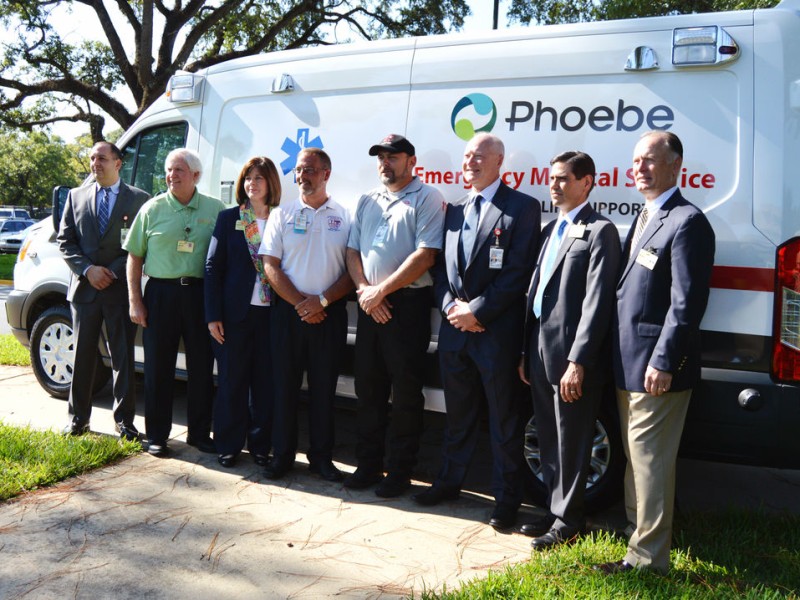
ALBANY — Beginning Sunday, Phoebe Putney Health System will enter into a partnership with Grady Emergency Services in the delivery of critical care and neonatal intensive care transport.
A known expert in the field of prehospital emergency care, officials said Grady EMS will bring enhanced services, more efficient management and cost efficiencies to EMS services for Phoebe’s patient base.
The relationship includes critical care and non-emergency patient transport between facilities and will bring at-risk newborns from the region to Phoebe Putney Memorial Hospital’s neonatal intensive care unit, hospital officials said.
The collaboration also will bring new ambulances and a stretcher van to Southwest Georgia communities and provide technology enhancements like a web-based tool for transport scheduling and real-time tracking of mobile transport, inventory control and fleet maintenance.
“Phoebe is really excited about this partnership,” said Laura Shearer, senior vice president of operations for Phoebe Putney Memorial Hospital.
Shearer said the paramedics currently providing EMS operations for Phoebe’s critical care and neonatal patients will transition to become Grady employees. She also said Grady will refurbish the vehicles currently in Phoebe’s fleet, and that there is expected to be an increase in paramedics as well as ambulances.
“I think it is a long-term partnership for us and about the needs of the community,” she added.
Phoebe officials said the transitioning paramedics would keep their tenure, benefits and pay rates.
Bill Compton, senior vice president of Emergency Medical Services at Grady, said the service has been in south Georgia facilities doing rural outreach for the last two years. A partnership like the one established with Phoebe aligns resources while further enhancing the ability to meet patient needs, he said.
“We have the expertise in rural medicine and neonatal transport,” Compton said. “With the Phoebe footprint, and (Grady infrastructure), it enhances resources.
“At the local and state level, there is a focus on regionalization. With this alliance, we can be a help in those small counties that are struggling to deliver those services.”
A program, currently in the planning phase, is expected to take the care the partnership will provide into Southwest Georgia communities rather that bring patients into the hospitals, Shearer said.


Related Articles

New commander takes helm as Marine Corps logistics adapts to evolving battlefield
Brig. Gen. Kevin G. Collins assumed command of Marine Corps Logistics Command during a change of command ceremony at Marine Corps Logistics Base Albany, succeeding Maj. Gen. Keith D. Reventlow after four years leading the organization responsible for sustaining Marine forces around the globe.

DOT says delay in Oglethorpe Bridge opening should be brief
“We know it’s not going to be July 22. We don’t think it’s going to be much later than that.”

City of Albany has big July 4 celebration planned for Saturday
“It’s going to be a lot of moving and shooting them off in a short time. It’s going to be a big show.”
