
Risk management at Marine Corps Logistics Base-Albany encourages safety culture
MCLB-Albany designated as OSHA Voluntary Protection Program Star Site in 2015
By Jennifer Parks
EDITOR’S NOTE: Following is the 28th installment of a series highlighting the various individuals and entities at Marine Corps Logistics Base-Albany.
MCLB-ALBANY — The missions at Marine Corps Logistics Base-Albany require heavy lifting, and with heavy lifting comes the potential for injury and illness.
The base’s Risk Management Office has the responsibility of diminishing the likelihood of those incidents.
The job of the office is to prevent injuries and illnesses and to provide employees, residents and guests with a safe environment. Its staff does this by providing training, as well as inspection of facilities, shops and offices and “shaping the culture” of safety for the employees and those around them.
Merrill Dickinson, installation safety manager at the base, said this also includes traffic safety, monitoring radiation exposure and explosive safety, while also taking on the Occupational Safety and Health Administration duties — specifically the Voluntary Protection Programs.
“We adopted that (VPP) system in 2010,” Dickinson said.
The installation was declared a VPP Star Site in 2015 after OSHA conducted an evaluation the year prior. Organization representatives walk through all the shops, offices and buildings to make sure they comply with its standards.
“Culture is a big thing about VPP,” Dickinson said. “Employees have to take ownership of their safety and those around them.”
The culture has paid off. The base was re-certified as a Star Site last month. From the time it adopted the system through the end of 2017, MCLB-Albany has reduced the total OSHA recordable injuries by 80 percent, the installation’s safety manager said.
There are only seven people working in risk management at MCLB, which means the employees are heavily relied upon to meet specific milestones. Staff has reached such a point of improvement, Dickinson said, that the base has become a model and begun mentoring Albany’s CINTAS and the National Security Agency at Fort Gordon on how to implement similar strategies.
Of the 2 million sites monitored by OSHA, 1,700 have reached Star Site level. There are 58 such sites in the Department of Defense, and five in the Marine Corps — with MCLB being the second in the Corps, showing it is willing to do more than the bare minimum.
“When we have a good system and employees take ownership, we can get a lot more done,” Dickinson said.
Dickinson said the results have been high credibility with its regulator, enough to which a complaint to OSHA means he will be informed by the organization and trust that an investigation will follow.
If the investigation team finds a hazard, it is either corrected on the spot or followed up on.
“Most of the time, there isn’t a hazard, but employees have a right to contact OSHA,” he said.
The training usually includes the specific hazards at a worksite, how to report hazards, education on how to use any safety equipment they may need, driver improvement classes, an OSHA course for supervisors and an emergency action plan in case of a crisis.
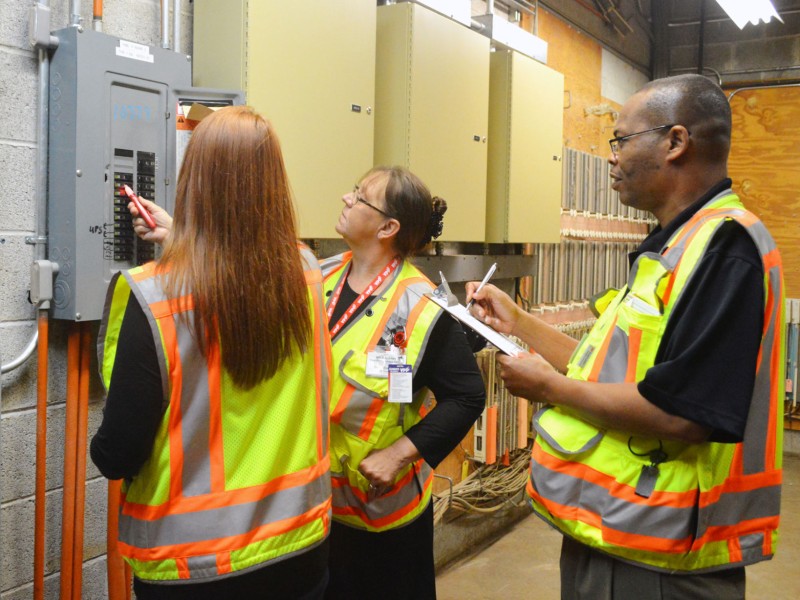
Inspections are conducted at least once a year, with high-hazard sites looked at twice a year. A photo is taken when a problem is found, the location is written down, it is given a risk code and the site’s department is given a presentation on the status of the issue.
“Our inspection program is very comprehensive, and people who visit us look at it as a best practice,” Dickinson said.
The day-to-day work, he said, is a balance of preparation and response. Any safety issue goes through the risk management office, and staff’s main job is to make sure the inspections, training and overall process of maintaining the culture of safety remains strong.
“Safety is a function of leadership,” Dickinson said, “Our job is to provide the tools and resources to keep employees safe.”
Promotion of the message is conducted through signage as well as the distribution of items including water bottles and cooling bands to continuously market safety programs and offer a gentle reminder to employees to look out for themselves and their co-workers.
“We have a lot of obstacles,” Dickinson said. “We can’t afford to have even one person recovering from injury and illness. I look at the employees first, and after that, employees’ family. It lets them come to work and provide a living. We owe it to that employees’ families to take care of them while we have them.
“When you boil it down, we all need the same thing.”
In terms of injury cost avoidance, Dickinson said the base has been able to prevent 139 injuries over seven years at a savings of $8.5 million. Going forward, the goal is to keep the safety image intact.
“We work really hard to get it (the Star Site status) and keep it,” he said.
Related Articles
New commander takes helm as Marine Corps logistics adapts to evolving battlefield
Brig. Gen. Kevin G. Collins assumed command of Marine Corps Logistics Command during a change of command ceremony at Marine Corps Logistics Base Albany, succeeding Maj. Gen. Keith D. Reventlow after four years leading the organization responsible for sustaining Marine forces around the globe.
DOT says delay in Oglethorpe Bridge opening should be brief
“We know it’s not going to be July 22. We don’t think it’s going to be much later than that.”

City of Albany has big July 4 celebration planned for Saturday
“It’s going to be a lot of moving and shooting them off in a short time. It’s going to be a big show.”
