
SR 287 discussed at Dougherty High town hall meeting
Tempers flare during opportunity schools referendum discussion
By Chauntel Powell
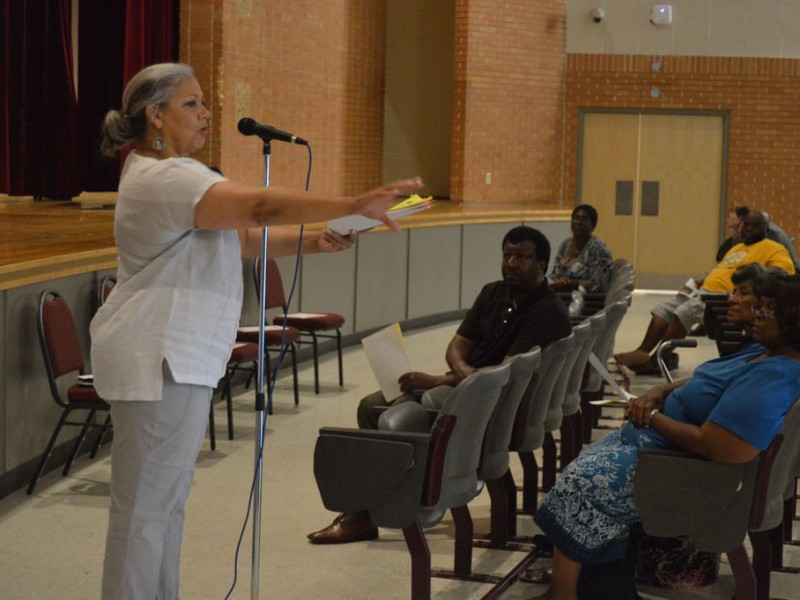
ALBANY — Divergent opinions about a Georgia constitutional amendment that will be presented to voters later this year were on display Saturday at a town hall meeting at Albany’s Dougherty High School.
The proposed amendment, known as SR 287, will be on the voter ballots this November, and if passed will change the state constitution “to allow the state to intervene in chronically failing public schools in order to improve student performance.”
Verailla Turner, president of the Georgia Federation of Teachers and opponent of the bill, was in attendance at the town hall meeting to discuss the ways the bill might negatively impact schools across the state and to share her belief that the general public was fleeced by governor Nathan Deal, who in her mind did not properly describe the amendment’s ramifications.
Turner, who likened Georgia’s leader to former Alabama governor George Wallace, also said that in her opinion Deal’s ways of garnering support for the legislation should draw more criticism from the public.
“The governor has everything stacked on his side,” said Turner. “He’s got the language stacked on his side. He wouldn’t pass the right language to tell the public the truth. Right now it’s time to know the truth and the fact that we want to bury our heads in the sand is only gonna make it worse. We need a resurgence of people power. We need people to know the truth, to dig for the truth, to have time to dig for the truth and to trust the folks who have serviced our children. Do not trust a career politician.”
After Turner showed a video, did an oral presentation and answered a few questions from the audience, state Rep. Darrel Ealum, D-Albany, took to the mic and expressed his extreme disappointment in the morning’s discussion. Ealum accused Turner of passing off misinformation and half-truths as facts, and defended Deal calling him, “one of the most progressive governors in the country,” which was met with some boos from the audience.
Ealum, a former member of the Dougherty County Board of Education, was also emphatic in saying that he believes Dougherty County schools are not in as much danger the presentation would indicate.
“I’ll put my record, I’ll put my position, I’ll put my life time credibility on the line. No school in Dougherty County is ever going to be taken over in the system,” he told the crowd. “We’re working too hard and we’re making too much progress and we are way ahead of the curve.”
Ealum challenged Turner to a debate, which she publicly declined, a move that Ealum said was telling.
“That’s very disappointing to me,” he said. “If she truly wants to get the facts, about what this entire concept is about, then why didn’t she accept my challenge?”
For Tuner, the time for talk is over. She said if there were to be and debates and discussions they should’ve taken place before the bill was put on the ballot. She added that she has read just as much material on the matter as Ealum has and is confident the facts support her stance.
For his part, Ealum said he still feels there could’ve been more balance in the information that was disseminated.
“What I would’ve liked today was a balanced program, where you were able to present facts from both sides,” he said. “Today we saw a presentation from a negative perspective of about the opportunity school district.
“The comment was continuously made that this opportunity school district could possibly take over our entire school system in Georgia,” he said. “It was implied that they were going to bring 100 schools in and at the end it could be wide open and you could bring in more. That’s inaccurate. You can bring 20 schools into the system the first year and then have up to 100 schools.”
Turner noted that she felt the Georgia Department of Education was doing a fine job and education in Georgia was already heading in the right direction. She said she believes money is at the root of the proposed changes and it could eventually affect areas like Albany despite Ealum’s claims.
“The opportunity school district has evidence behind it,” she said. “The evidence is in Detroit, it’s in New Orleans, it’s in Memphis, Tennessee. It does not work. And what it does is it actually gives all power to the governor. He can say it’s about 100 schools initially. It’s about 100 schools and that happen to be all poor schools in mostly minority areas where folk aren’t voting and folk aren’t paying attention. Just like they’ve done in New Orleans, they go back, they tweak the bill and the more the bill’s capacity, the more schools they’ll take.”
Albany City Commissioner Jon Howard, who was instrumental in organizing the event, said was disappointed at the turnout despite having worked hard the last six weeks to encourage people to attend.
“In the city of Albany, Georgia we have to face reality,” he said. “We have what you call community apathy. You can have events, you can do a lot of PR, this was well publicized, written about and [spread via] word of mouth. But a meeting of this magnitude, to have about approximately a hundred-and-something citizens, it was not the turnout I had anticipated.”
Related Articles

James Rubino installed in new role at Marine Corps Logistics Command in Albany
James L. Rubino recently assumed the role as executive deputy of Marine Corps Logistics Command in Albany. In his new role he will oversee integrated logistics support.

Rain depresses voter turnout in Dougherty County
“A lot of people don’t vote when it’s raining. People don’t do a lot of things when it’s raining.”
City of Albany faces shortfall for police, fire salaries
“We can’t tell staff to hire more police officers and then complain at what it costs.”
