
‘Pattern’ your shotgun, improve your hit-to-miss ratio
By Tom Seegmueller
[email protected]
“Finding patterns is the essence of wisdom.” ¬ Dennis Prager
Following a dove shoot decades ago, a gentleman sitting on a nearby tailgate overhead me bemoaning my habitually dismal and inconsistent performance as a wing shooter. His simple question, “Have you patterned your shotgun?” turned out to be a game-changer. The puzzled look crossing my face must have clearly exposed my ignorance of this mysterious topic he broached.
“You wouldn’t take a new rifle out of the box and go hunting without sighting it in. So why would you take a shotgun on a hunt without doing the same?” he asked.
I don’t think my response that a shotgun seemed to operate more on a spray and pray principle amused him to the degree I was hoping. Fortunately for me he was a patient man overlooking the hubris of my youth and proceeded to educate me on some of the principals relating to success behind the stock of a shotgun.
“Although a shotgun shoots multiple projectiles as opposed to a rifle’s single projectile, it is critical to know the difference, as well as the correlation between your point of aim (POA) and the point of impact (POI),” he said. “POA is where you aim the shotgun, and POI is where the shot hits the target.”
The simplest way to determine a shotgun’s POA is to take a minimum of three large sheets of paper measuring at least 36 inches by 36 inches. (I recommend using paper table covers which can be bought inexpensively and, in the quantity necessary to do this correctly). Draw a 6-inch highly visible circle in the center of each sheet. This will be your POA for the test.
Place these targets on a backstop at 40 yards from the firing line or at the distance you will be firing during your hunt. Use a steady rest the same as you would when “zeroing” a rifle and fire a single shot at each target using the shot and choke you will be using in the field. Where the pellets from your shot hit the target is the POI for this combination.
Now take each of these targets and draw a horizontal line through the center of each target to further clarify the difference in “elevation” between the POA and POI. Drawing a similar vertical line will do the same for clarifying the difference in “windage” between the POA and POI. Measure the distance between the center of the aiming point and center of the shot pattern on each target.
Record each distance and then average the total to determine the difference between POA and POI. You now know the difference between the distance and location of the two. It’s important to realize that this POI may change in respect to the distance to the target as well as any change in choke or ammunition.
The second part of the patterning process is to determine the choke and shell combination that will give the most even spread of pellets within a 30-inch circle. Once again, the test can be done at the distance which shots will be taken or at a standard 40-yard distance. In this case create another series of 36-inch targets with a 4-inch centered POA. If the distances for shots on the hunt are unknown, or gun/choke/shell combination has never been tested, some experts recommend testing at 20 yards as well.
Whatever method you choose, once again shoot three separate targets at each distance being tested. Locate the densest concentration of pellets on each target and stick a tack in the center of this concentration as a center point. Now use the string and marker to draw a 30-inch circle around this point on each target. Count and record how many pellet holes are in each circle.
Using the manufacturer’s information or count the pellets in an unfired shell identical to the ones used in your test. Divide your test average by this number for the percentage of pellets in the 30-inch “pattern.” A percentage between 55% to 60% is generally the accepted goal.
If the average is lower than that, you will see many gaps where no pellets would come in contact with the target be it a gamebird or sporting clay. This can easily be seen if you take a tennis ball and move it around in the encircled pattern. Placing an X on the target everywhere the ball would fit without having been touched by a pellet gives you an idea how effective the given choke/shell combination is.
The first time I did this was an eye-opening exercise in why my idea of “spray and pray” let so many birds live another day. You more readily understand the importance of an evenly disbursed pattern within the accepted percentage. If you have a gun with choke tubes you can repeat the experiment until you find one that works best with the shell you have chosen. However, do not change both in the same test or you will not know which was responsible for the change.
Turkey hunters may wish to conduct the experiment measuring the pattern within a tighter 20-inch circle as a turkey’s head, which is the target of most hunters, is only about the size of a golf ball. Take a golf ball and see how many gaps you can find in the pattern that would not be fatal.
The four standard chokes available today on most shotguns should cover most shooters’ needs. The most open is the improved cylinder, which is slightly more open than the unaltered cylinder. The modified choke is slightly tighter than cylinder and full is the tightest standard choke offered. Most shotguns being manufactured today come with a selection of “choke tubes.”
When considering choke selection for a specific application, it is important to remember that the choke does not control the distance the pellets in a shell will travel when fired. The choke controls the density of the pattern the same way the nozzle on a garden hose controls the pattern of the water being dispersed.
A wide variety of specialty tubes are available for more specific needs if a more open or tighter choke is required.
Although this sounds like a rather elaborate process and one that requires shooting a lot of shells, it is quite enjoyable. In regard to burning up ammo, it will actually lead to conserving it as your shot-to-hit ratio improves.
Author

Related Articles

Regional catering business finds new home at Warrior Creek Mercantile
For months, Marchbanks said she had been asking God for an opportunity to serve others. “I just kept praying, ‘God, use me as a servant,'” she recalled. “I didn’t care what it was. I just wanted to be used to help people.”

Houston, Ford advance in contentious Lee County school board race
According to unofficial election results, challenger George Parrish Houston led the three-candidate field with 534 votes, or 42%, followed by incumbent Donna Ford with 478 votes, or 37.6%. Candidate Lavendra Shootes received 261 votes, or 20.5%.
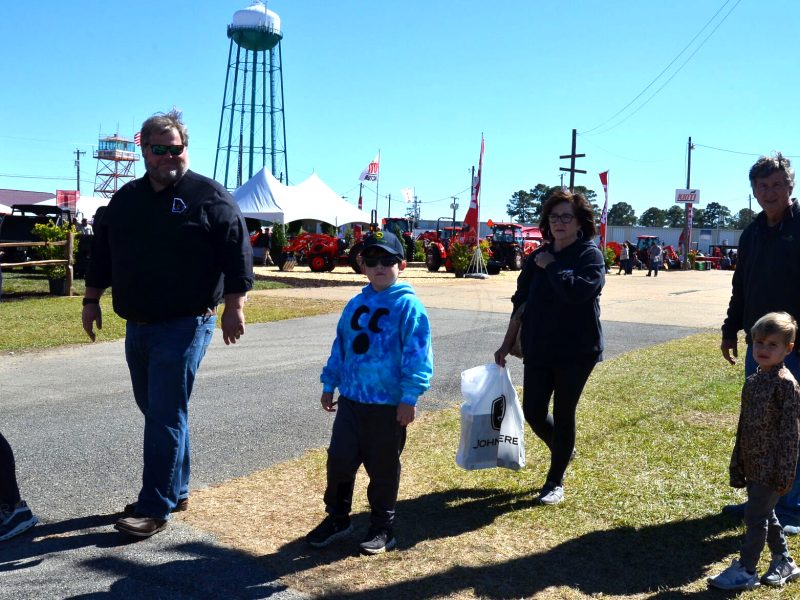
RecX to bring outdoor equipment, activities to Moultrie during three-day show
“We’ll have the latest four-wheelers, side-by-sides … Kawasaki, Honda, Polaris and more/ There will be small recreational land management equipment from Kubota, Koyote, Mahindra. There will be a lot of different things … campers, just a lot going on.”
