
Pioneering Marine brings military history to life at MCLB-Albany
“They expected them to fail They proved their worth in the Battle of Saipan, at Okinawa, in Korea and in Vietnam. The military we know today, the integration they started, is the reflection of their proving this stereotype wasn’t right.”
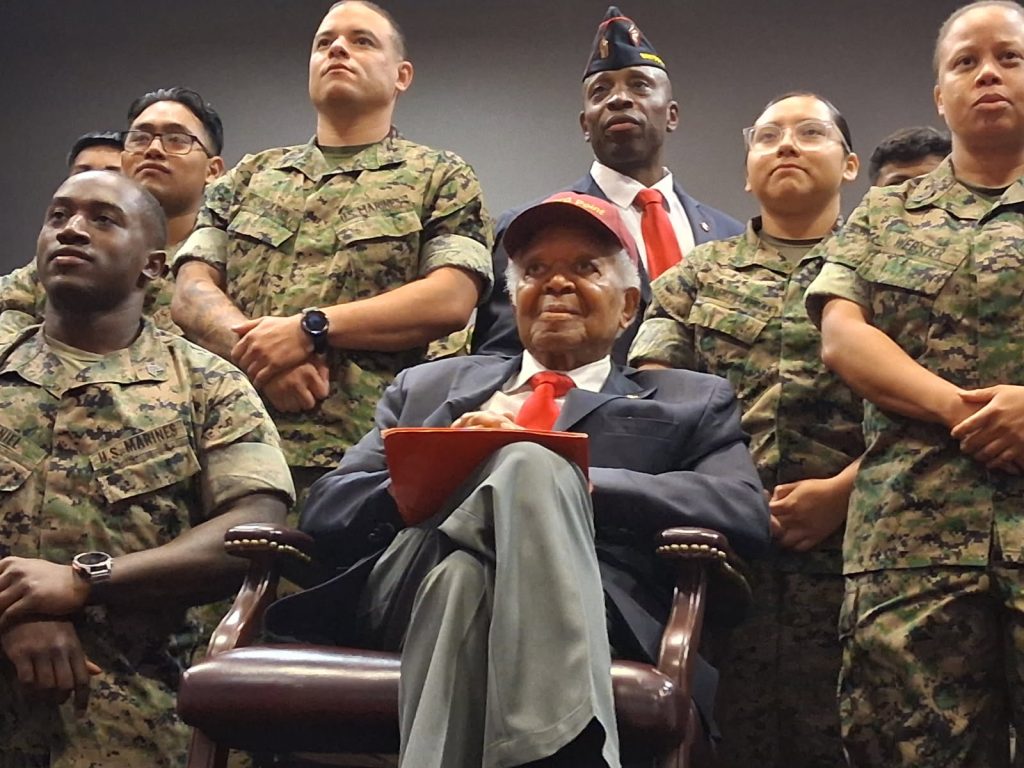
MARINE CORPS LOGISTICS BASE-ALBANY – At a time when most of the U.S. public wasn’t in favor of black men and women serving in the Marines, a contingent that included the commandant of the U.S. Marine Corps and the Army, the men who were serving in the same uniform, had a little more tolerance.
That was the take of Theodore R. Britton Jr., who was among the first black men to put on the uniform after the U.S. Marine Corps began accepting black recruits as a result of President Franklin D. Roosevelt’s executive order 8802 signed in 1941.
The order prohibited discrimination by race in defense industries and opened the door for black members into military service.
Britton, who later became a U.S. ambassador and served during World War II and the Korean War, was among the 20,000 or so recruits who went through boot camp at the segregated Montford Point Marine facility in North Carolina.
Today, it’s hard to believe that the South Carolina native was not allowed to train at the Marine Corps Recruit Depot Parris Island in his home state due to the prevailing racial attitude at the time. A 1927 study produced by the U.S. Army War College titled “The Use of Negro Manpower in War” stated that black soldiers were unsuited for modern warfare.
The centenarian shared some of his experiences on Wednesday at Marine Corps Logistics Base-Albany, with a group of young Marines. Asked about the resistance the Marines of the 1940s and 1950s faced while initially in segregated units and later after military integration, he said fellow Marines defended their own.
“At one time on the bus, the driver refused to take on one of the black Marines,” Britton told a Herald reporter during an interview following his remarks. “One of the white Marines said ‘This bus is not going to move without him.’ The bus driver said ‘It’s not going anywhere with him on it.’ They kicked him (the driver) off the bus and one of the white Marines drove it to where they were going.”
That incident was illustrative of how things went during the years even before the U.S. Civil Rights Movement, Britton said.
“They (Marines) always stuck together,” he said. “There was never such a thing as a second-class Marine. When you were in (a) Marine Corps uniform, you had the support of all the Marines.”
At the time he enlisted during the Great Depression, shoes were a luxury that were dispensed with during the summer in order to reduce wear and only put on again in the late fall when the weather started turning cooler. As was the case for many of his Southern counterparts, black and white, the Marines offered three meals a day and regular medical care, something that was not available for many.
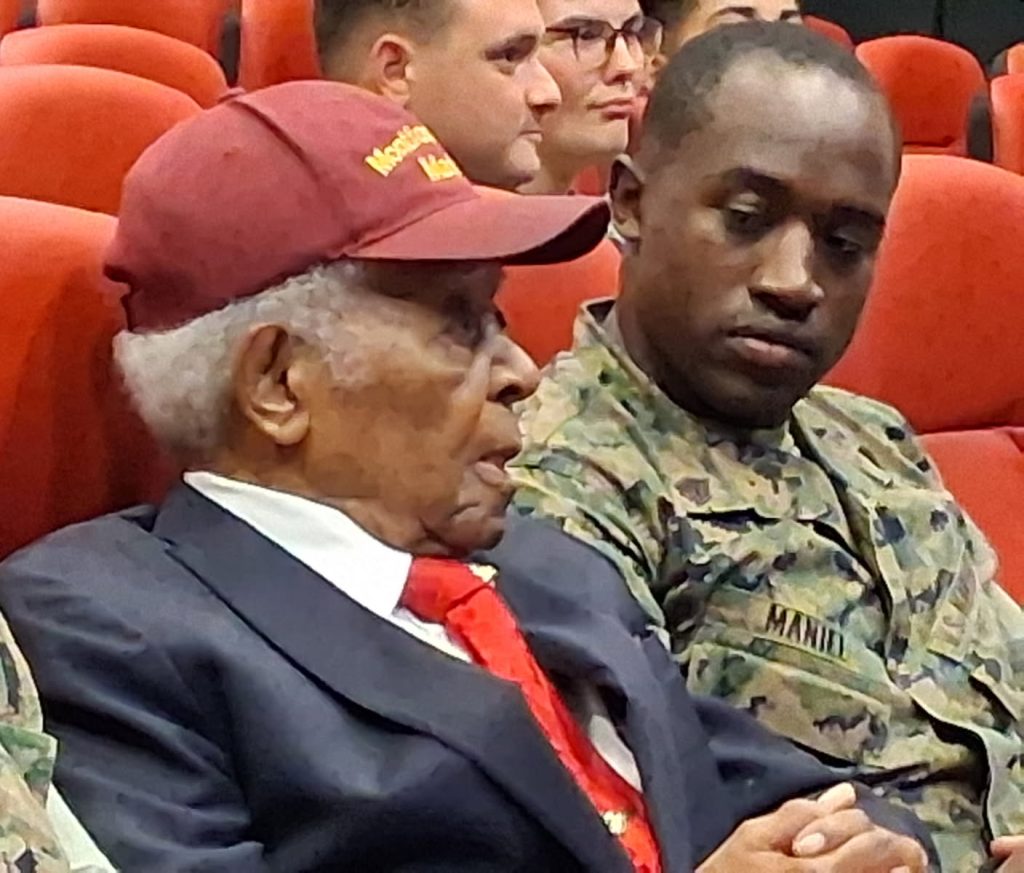
The commandant of the Marines at the time apparently agreed with the War College’s report and refused to allow the black recruits to attend boot camp in San Diego or at Parris Island, Britton said. The commandant expected them to fail, and he wanted that failure to occur somewhere other than the established Marine training centers.
The black recruits went on to succeed there and later in World War II battles across the Pacific Ocean.
Initially given support duties in battle, the black Marines were able to prove their value and were transitioned to combat roles later in the war.
Part of the purpose of Britton’s visit to Albany was to publicize the National Montford Point Marine Association, which is seeking to identify the living relatives of black Marines who were the pioneers of integration and trained at the facility during the years it was in operation from 1942 through 1949.
In 2011, President Barack Obama signed legislation that awarded those Marines the Congressional Gold Medal, the nation’s highest civilian award.
“In spite of racism … they exceeded all expectations,” Johnny Higdon, president of the association’s Atlanta chapter, told the audience. “Those Marines paved the way for the integration of the United States Marine Corps. When they went away to fight for freedom, they came home to segregation. A lot of them, unfortunately, took their stories to their graves.”
Today only about 75 of the 20,000 are still alive. Higdon encouraged black families who have relatives who served in the Marines during the 1940s and 1950s to seek recognition for those family members and hold it as a point of pride.
Individuals interested in learning more can visit https://montfordpointmarines.org/.
“They expected them to fail,” Higdon said. “They proved their worth in the Battle of Saipan, at Okinawa, in Korea and in Vietnam. The military we know today, the integration they started, is the reflection of their proving this stereotype wasn’t right.”
Author

Related Articles
PHOTOS: Albany State campus tour with Senator Jaha Howard
Click the arrow to scroll through the photos.

Foreclosures jump 52.9% across the region as buyers regain negotiating power
In Dougherty County, the number of residential properties advertised for foreclosure has nearly doubled this year. In neighboring Lee County, developers are preparing to add hundreds of new houses and apartments, including homes aimed at buyers who have struggled to find newer housing at an attainable price.
PHOTOS: Albany State New Employees Luncheon
Click the arrow to scroll through the photos.
