
Researchers find improved treatments for removing ‘forever chemicals’
Special Photo: Gary L. Hawkins/UGA
By Emily Cabrera
UGA/CAES
GRIFFIN — University of Georgia researchers in the College of Agricultural and Environmental Sciences and the College of Engineering are wrapping up the final year of a study to develop improved, cost-effective treatment systems with advanced technologies for removing polyfluoroalkyl and perfluoroalkyl substances (PFAS) from water, wastewater and biosolids.
Dubbed “forever chemicals,” PFAS are a group of manufactured chemicals developed in the late 1930s that have been widely used in industry and consumer products due to their fire-resistant properties and ability to repel oil and water. The team was awarded nearly $1.6 million through a congressionally mandated grant from the Environmental Protection Agency to mitigate PFAS, which take a long time to break down and can build up in people, animals, water and soil over time.
PFAS are commonly found in paper food packaging, stain-resistant and waterproof clothing and furniture, fire-repellants, and nonstick cookware.
“From a purely scientific perspective, I found these chemicals to be fascinating — they are the most long-lasting manmade chemicals in existence,” Qingguo (Jack) Huang, a crop and soil sciences professor on the UGA-Griffin campus and primary investigator on the grant, said. “My work as a water-quality chemist and environmental engineer is solutions-driven, so figuring out how to degrade these persistent compounds presents an interesting challenge that I’m committed to answering.”
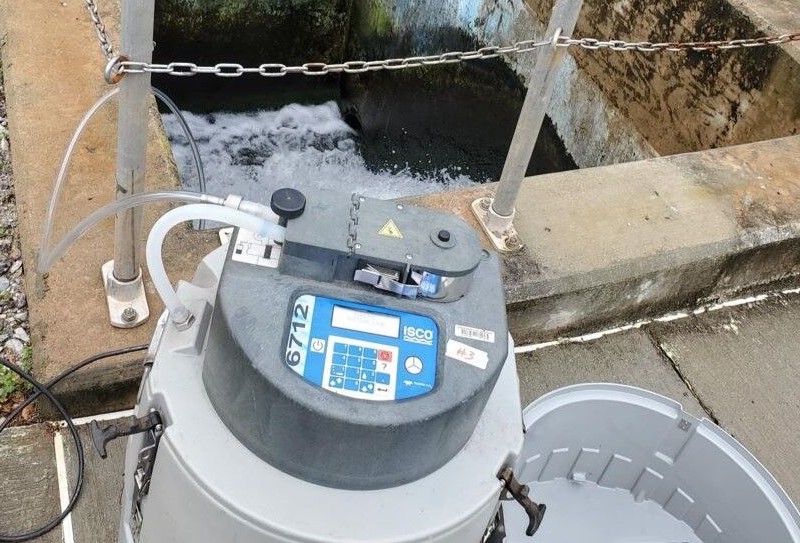
In collaboration with researchers from Georgia Tech, the team has increased monitoring efforts throughout the nation by collecting samples from wastewater treatment facilities, which act as the “sink” of a community — receiving and processing a slew of contaminants — making them an obvious place to look for these ubiquitous compounds, Huang explained.
One of the more promising technologies the team is investigating is a destruction-type treatment called electrochemical oxidation (EO). Using this method, an electric charge is sent through contaminated water to degrade PFAS compounds. Huang developed the UGA-patented technology in 2016, and because it has since garnered a lot of attention, he is now working with a prominent industrial partner to commercialize the method.
Gary Hawkins, a water resource management and policy specialist for UGA Cooperative Extension in the Department of Crop and Soil Sciences, said many new technologies are complicated, energy-intensive and expensive. Standard wastewater treatment processes have limited capability for removing PFAS from contaminated water.
“Larger wastewater treatment facilities tend to have budgets that allow them to utilize some of the PFAS removal technologies, whereas smaller, rural communities don’t always have the financial capacity to put these in place,” Hawkins said. “That’s why we are trying to find the best treatment technologies to help these facilities.”
In recognition of financial limitations, Ke (Luke) Li in the UGA College of Engineering is developing mathematical models to help determine the cost-effectiveness of different treatment trains to help facilities choose the best option for their budget.
Nearly a decade ago, Huang was one of the first researchers to explore a biological solution for removing PFAS from soil — a novel enzyme-based technology. After years of improvements in this technology, the team continues investigating enzymes as well as several fungal strains that essentially devour PFAS compounds. They hope these biological solutions will facilitate faster breakdown of PFAS in soil and reduce the concentrations over time.
“Because this is such a widespread and tough problem to deal with, it’s going to take some time to thoroughly address,” he said. “There still isn’t a great replacement technology to use in many everyday products that we rely on, and while manufacturers have phased out some types of PFAS, decades of use have led to a buildup of these persistent compounds in the environment.”
Huang said he is grateful to work with a talented team on the project, “and we are especially proud that our research will provide some cost-effective solutions to combat PFAS water contamination, particularly for rural areas.”
Long-term, he said he plans to address combining technologies with a focus on reducing contamination of recycled water in agricultural settings.
“As researchers, it’s important to keep pushing the boundary,” Huang said. “To drive forward, you have to have the vision of what is needed.”
Author

Related Articles

Albany recycling center enacts material separation rule
Mixed items will no longer be accepted at the Albany recycling center at its 2521 Meredyth Drive facility. Individuals will now be required to separate items befor they will be accepted.

Wild Game Dinner marks 34 years as South Georgia Scouting reaches for next generation
More than a century after organized Scouting first took root in Southwest Georgia, local leaders say the program is working to preserve its traditional mission while adapting to a new generation of young people.

Albany City Commission takes action on proposed downtown hotel, two theater renovation projects
“We’re taking the original building back to, hopefully, it’s glory days. One of the cool things about the project is we are going to restore the balcony. It’s going to have a balcony, so it’s going to be super cool.”
