
Residents demand accountability as fingers point in Lee County tax controversy
The forum, intended as an opportunity for voters to hear from candidates ahead of the upcoming election, was not designed to investigate the issue. No officials were under oath, no documents were presented, and no formal answers were required.
But for the taxpayers in the room, it became one of the first opportunities to ask questions directly — and publicly — about a tax situation that may have resulted in significantly higher bills without the legally required notice.

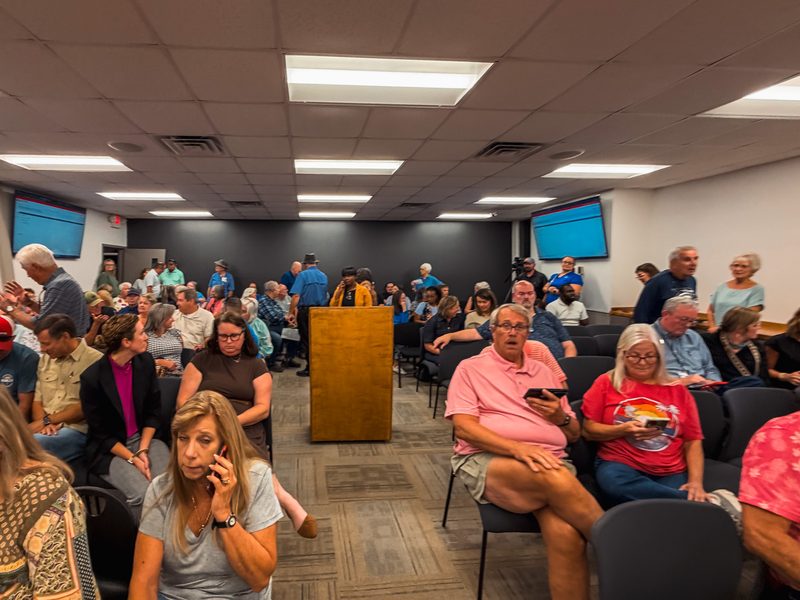
LEE COUNTY — What was scheduled as a routine Republican candidate forum Tuesday night quickly turned into something else: a public airing of frustration over a property tax system many residents say failed them — and a pointed demand for accountability from those in office.
The forum, intended as an opportunity for voters to hear from candidates ahead of the upcoming election, was not designed to investigate the issue. No officials were under oath, no documents were presented, and no formal answers were required.
But for the taxpayers in the room, it became one of the first opportunities to ask questions directly — and publicly — about a tax situation that may have resulted in significantly higher bills without the legally required notice.
At the center of that exchange was Philip Hussain, the new chairman of Lee County’s Board of Tax Assessors, laid out the issue in plain terms before turning directly to District 1 incumbent Donna Ford, who also serves as vice chair of the school board.
“My question to you is that your board consciously and deliberately opted out, and I’d like for you to answer why,” Hussain said, referencing House Bill 581. “Second question — after opting out, you increased property taxes by a humongous amount. Why did you increase it so significantly?”
Hussain’s framing cut to the core of what many residents say they experienced: a tax bill that went up — even as officials pointed to calculations suggesting the opposite.
“I would almost be willing to say every taxpayer … saw zero or two or three dollars up or down on their county tax bills,” he said. “On yours, it was the entire increase.”
House Bill 581, passed by the Georgia General Assembly in 2024 and signed by Gov. Brian Kemp, was designed to limit how quickly property taxes can rise by capping annual increases in a home’s taxable value to inflation. The law applies to homestead properties and is intended to protect homeowners from sharp spikes in tax bills following large reassessments. However, a provision in the law allows for local taxing authorities — including school systems — to opt out, which many schools did, citing concerns over lost revenue and limited options to replace it.
In Lee County, the county government opted in, while the school system chose to opt out, meaning school taxes continued to reflect the full impact of rising property values.
But while House Bill 581 adds further complexity to the error, misinformation and lack of public understanding surrounding property tax and millage rates has led to heightened scrutiny.
Under Georgia law, school boards have authority over setting their own millage rate; however, property taxes are not set in a single decision but follow a defined process.
The Board of Tax Assessors determines property values and is required to review them annually, using market data, sales trends and statistical modeling. In practice, larger increases often occur when several years of market growth are applied during a broader reassessment.
Those values are then compiled by the tax commissioner into the county’s tax digest — the master record used by local governments to estimate revenue, set millage rates and build budgets.
Before any tax bills are issued, one calculation plays a critical role: the rollback rate. The rollback rate is the tax rate that would keep property tax revenue roughly the same as the previous year, even if property values increase.
If a taxing authority sets its millage rate above that number, it is legally considered a tax increase and must be publicly advertised with three hearings. If the rate is set at or below the rollback rate, no hearings are required.
That determination is documented on the state-required PT32.1 form, which must be signed by the chairman of the Board of Tax Assessors, the tax commissioner and the chairman of the Board of Education, each certifying that the numbers used are accurate.
According to the PT32.1 form used in Lee County, just $6.7 million in reassessed property value was reported for the year — a figure that helped produce a rollback rate higher than the school system’s adopted millage rate. On paper, that resulted in a 5.49% tax decrease, eliminating the requirement for public hearings.
In reality, residents say they saw the opposite.
Local resident Mike Sabot, who first raised concerns, pointed out that thousands of properties were reassessed, suggesting the true increase in value was far greater than what was reported. If that figure was understated, the implications are significant. The rollback rate would be artificially inflated. The classification would shift. And what was presented as a tax decrease could, in fact, be a tax increase — one that should have triggered public hearings under state law.
The tax digest itself does not change individual property values, but if it misrepresents how much values increased overall, it can distort the calculation that determines whether taxes went up or down.
During the forum, Ford defended the school board’s role, emphasizing that it does not control property valuations.
“It wasn’t the Board of Education that did the re-evaluation,” she said. “All of that was sent to the tax commissioner to come up with a digest.”
She also defended the board’s decision to opt out of House Bill 581, saying, “We have no way to levy funds once the digest is in,” arguing that limiting revenue growth could lead to larger class sizes.
Ford attributed the spike in property values to delayed reassessments.
“We went about three or four years without doing re-evaluation, and so when it hit, it took a quantum leap,” she said.
But the issue raised Tuesday night was not whether property values increased. It was whether those increases were accurately reported and properly translated into tax decisions — and whether the system functioned as intended.
If the discrepancy is confirmed, the failure is not isolated. For the current outcome to occur, multiple safeguards would have had to break down: reassessment values incorrectly calculated or classified, the rollback rate miscalculated, the PT32.1 form signed regardless — or even bypassed altogether — the Georgia Department of Revenue approving the digest, and tax bills issued and collected based on those figures.
Potentially, not a single-point error but a systemic failure across multiple levels of review.
No official at Tuesday’s forum provided a definitive explanation for the discrepancy, with some candidates further highlighting the lack of public understanding surrounding common taxation practices.
Lee County has since engaged a third-party firm to review the tax digest, and state officials have been notified. The findings could determine whether taxpayers are owed refunds, whether hearings should have been held, and whether further legal action is necessary.
For residents, the issue is no longer technical. It is a question of whether they paid more than they were told, and whether the system designed to protect them failed to do so.
For officials, it is a question of responsibility: not just who made the apparent error, but who reviewed it, who certified it, and who allowed it to move forward.
Related Articles

‘Flywheel’ comes home as Kendrick brothers bring Brazilian remake to Albany
Twenty-three years after a $20,000 movie made with church volunteers launched their filmmaking careers, Alex and Stephen Kendrick returned Thursday to the Albany theater where “Flywheel” first reached an audience — this time with a Brazilian cast telling the story.
Heated exchanges, lengthy delays precede Lee school board’s 17.96-mill vote
The Lee County Board of Education adopted a 17.96-mill operating tax rate Thursday after a crowded public hearing and a lengthy wait for a vote that left frustrated residents at the meeting until close to 9:30 p.m.
Turnout steady during first week of early voting in Dougherty County
Early voting started statewide on Tuesday, giving voters three weeks to cast ballots ahead of the Nov. 3 election.
