
Sponsor of HBCU bill cancels Albany appearance
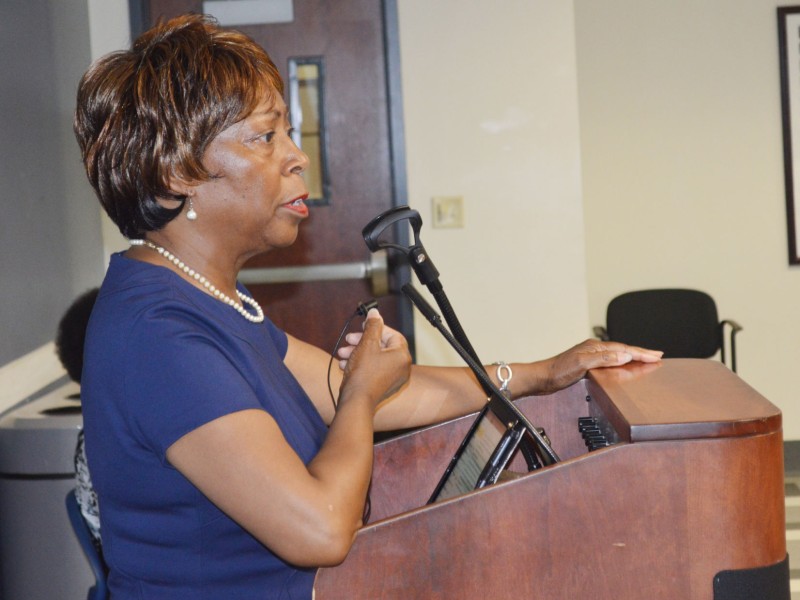
State Sen. Freddie Powell Sims has been appointed to serve as a member of the Georgia Council on Literacy.
File Photo: Carlton FletcherBy Alan Mauldin
[email protected]
ALBANY – Supporters of Albany State University have been waiting for answers to the question of why an effort to provide more funding for traditionally black colleges somehow morphed into legislation they believe could turn them into second-tier institutions.
They’re still waiting.
State Sen. Lester Jackson, D-Savannah, in January sponsored Senate Bill 278 that would create a Georgia Agricultural and Mechanical University System to encompass ASU, Fort Valley State University and Savannah State University, the state’s three public historically black universities.
Jackson was scheduled to appear at a Thursday-night forum in Albany but canceled prior to the event.
Ward I Albany City Commissioner Jon Howard said he got a letter earlier in the week announcing that Jackson would not appear.
The letter said that due to Hurricane Dorian, Jackson, a dentist, had patients whose appointments had been delayed and had meetings in his district, Howard said. Jackson also offered to reschedule for a later date.
ASU alumni have said they are not optimistic about what would happen if HB 278 becomes law.
It would remove the three historically black universities from the University System of Georgia, for one thing. The legislation also calls for having a 19-member board, 11 of whose members would be selected by the governor.
State Sen. Freddie Powell Sims, D-Dawson, who represents Dougherty County, addressed the issue during the Thursday forum at Union Missionary Baptist Church.
She said she was part of a study group that included several other senators, including Jackson.
“(This) morphed into something that we did not want it to be,” Sims said. “Why this all of a sudden? What is the reason? There has to be a clear reason.”
The state senator said the bill sought by the study group was originally intended to deal with the disparities between HBCUs and predominantly white institutions.
Sims, a Fort Valley State graduate, said that traditionally black colleges date back to the post-Civil War era and have been important in educating minority students for generations.
During that time, she said, the colleges and universities have provided a safe space for those students to fully participate in campus life in a way that they might not have been able to do at a predominantly white institution.
Black colleges played a role in the civil rights movement and still provide an environment where issues of equality and inclusion can be discussed and fostered, she said.
“Many of the civil rights marches began on college campuses,” Sims said. “Just imagine where we would be if we did not have HBCUs.”
The institutions also play a role in advancing economic freedom for students through the education they receive, she said.
“You can get a better home, a better car; you can send your children to college. You can give back to your community,” Sims said. “You can do all these things. On our campuses across the country, HBCUs build legacies.”
ASU Student Government Association President-elect Quadre Curry-Wilkerson told the audience of more than 100 that it was tough attending a high school in Gwinnett County, where he was one of only about 20 black students. He did not always feel accepted in that environment.
“Albany State really changed my life,” he said. “At ASU, I’ve been more than accepted. I want to make sure that’s an opportunity for people to have over and over again.”
Author

Related Articles
Albany Herald – June 25, 2026
Dougherty Commission considers $104
million budget for… Theatre Albany’s first 55-over production set for… Homeschool students reduce prep time for ‘Anastasia’…

Classifieds – June 25, 2026
Classifieds; Legals; Garage Sales; Auctions, etc.
Dougherty Commission considers $104 million budget for 2026-2027 budget year
“The other side of the coin is you could have higher revenues than projected. We’re very conservative in budgeting revenues. That also reduces the need to use fund balance”
