
Terrell schools acknowledge career-training gaps, seek employers’ help to rebuild
Terrell County schools are working to establish a formal work-based learning program after an assessment identified gaps in employer partnerships, student placements and the coordination needed to connect classroom instruction with job experience.

DAWSON — Terrell County schools are working to establish a formal work-based learning program after an assessment identified gaps in employer partnerships, student placements and the coordination needed to connect classroom instruction with job experience.
Superintendent Shereca Harvey said Monday that the district does not currently have the program, despite offering career courses intended to prepare students for employment and further training.
“Our priority is to establish a work-based learning program,” Harvey said in an Oct. 5 interview with The Dawson News.
Her explanation adds context to the Fiscal Year 2027 Perkins career education plan approved by the school board Sept. 14. The document shows strong graduation and career pathway completion results alongside low rates of industry credentials and structured workplace learning.
Harvey said the district previously offered a separate workforce initiative, but it did not meet the requirements for work-based learning.
“The community needs to know that our CTAE program is not where it’s supposed to be,” she said.
The district is assessing what it needs to rebuild career, technical and agricultural education, commonly called CTAE, while seeking employers who can help shape instruction and provide opportunities for students.
“This year will serve as a baseline for growing the program and expanding the program to where it needs to be,” Harvey said.
The assessment identifies shortcomings within the district as well as challenges facing a small rural community.
It cites an “absence of a full-time or adequately supported WBL coordinator” and inconsistent procedures for placing, monitoring and evaluating students. Transportation and scheduling also limit participation.
Harvey said establishing the program will require personnel certified to observe and monitor students in workplaces. The district is considering whether teachers who lead career pathways could also serve as work-based learning coordinators.
The next step, she said, is understanding what local employers need so those needs can help guide student training.
One potential connection is emergency dispatching. Harvey said Dawson police and the sheriff’s office have expressed interest in training students for jobs as 911 dispatchers, positions the agencies have difficulty filling.
The district is working to extend its law and justice pathway to provide that preparation.
“We want to make sure our pathways align with the needs of our local community,” Harvey said.
The approach would give employers a role in what students learn, alongside opportunities to host them for job shadowing, internships and other workplace experiences.
Existing connections vary considerably by program.
Agriculture has consistent support from farmers, agricultural businesses and community partners, according to the assessment. Criminal justice has some involvement from law enforcement and public safety agencies through guest speakers and occasional career activities.
Business and Technology has “minimal employer engagement beyond classroom instruction,” the report says. Few businesses participate in advisory meetings, internships or structured work-based learning related to that pathway.
“This limits opportunities for students to gain real-world experience in business, finance, and technology-related careers,” the assessment states.
The document also notes that students’ available jobs are often concentrated in retail and food service. Those jobs provide experience, but positions connected to students’ coursework could offer a more direct route into their chosen fields.
The performance figures illustrate that gap.
Terrell’s Fiscal Year 2023 result, however, was 22.22%, below the state target of 43.64% and statewide result of 63.55%. That measure tracks industry-recognized credentials aligned with students’ career pathways.
Work-based learning participation was reported at 0%, compared with a state target of 40.92% and statewide result of 41.61%.
The plan separately cites participation of 1.59%. Harvey’s explanation that Terrell lacks a formal program helps clarify the reported zero, but the interview did not establish how the separate figure was calculated.
Of the 10 performance measures listed in the report, Terrell met or exceeded five targets and fell below five. Nine measures are labeled Fiscal Year 2025; the extended graduation measure is labeled Fiscal Year 2024.
The district’s proposed response includes earlier identification of students interested in workplace learning, preparation in resumes and interviews, and expanded outreach to employers. Participation would be reviewed quarterly through placement rosters and employer documentation.
For credentials, the plan calls for certification preparation within coursework, additional review sessions, testing fees and remediation, and retesting when permitted.
Health care is the district’s highest-ranked development priority.
While the Perkins plan sets a broader Fiscal Year 2029 goal, Harvey said the district intends to offer all health care pathway classes during the 2027-28 school year through an accelerated schedule.
“We are looking at an accelerated model, so students would not take one course per year; they would take one course per semester,” she said.
The implementation outline she provided places introductory and essential health care courses in ninth grade, followed by support services and patient care fundamentals in 10th grade. It then anticipates technical college dual enrollment and work-based learning during the later high school years.
An accompanying checklist marks qualified staffing, and two classroom beds as completed. Other outstanding needs include wheelchairs, blood pressure cuffs, stethoscopes, CPR mannequins and equipment for practicing patient care.
The district also needs clinical partners, student supervision procedures, placement agreements and transportation plans for experiences outside the county. Potential partners include hospitals, nursing homes, assisted living facilities, rehabilitation centers and home health agencies.
Community members also can help shape those programs through advisory councils.
Harvey said Terrell previously operated with one council for career education. The district is now establishing separate councils for individual programs, including health care, teaching, agriculture, construction, and law and justice.
“In the past, there had been one council, and that did not meet the requirements for CTAE programs,” she said.
The advisory meetings are open to the public, Harvey said. Dates listed in the Perkins plan will be revised to reflect current needs and members’ schedules.
The department also has new leadership. Harvey said the plan was submitted by former CTAE Director Vivian Laster and that Moore now leads the department at Terrell County High School.
Employers and residents interested in advisory service, guest speaking, job shadowing or student placements can contact the new CTAE director, Moore, at (229) 995-2544 or [email protected], according to Harvey.
Harvey said some program decisions and funding commitments were already in place before the current school year and could not be changed for the current academic year; however, assessing the district’s starting point will help determine how it expands.
“I think it’s necessary for us to properly assess our current status in order to expand the program in the right way,” she said. For Harvey, the rebuilding effort starts with connecting students’ education to opportunities close to home.
Related Articles

PHOTOS: Albany State Homecoming Royal Court Coronation
Four galleries, click the arrow to scroll through the images.
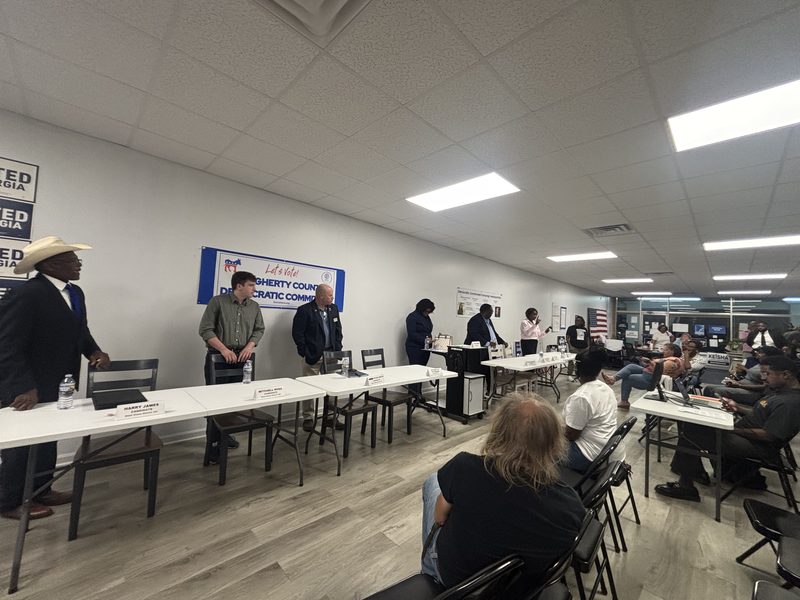
Candidates debate health care, development, rural investment at Albany forum
Candidates seeking to represent Southwest Georgia called for greater investment in health care, education and infrastructure during an Oct. 1 forum, but differed over data centers, economic development and how to work across party lines.

Former Dougherty Commissioner Harry James challenges ‘dean of legislature,’ Gerald Greene
Georgia voters go to the polls on Nov. 3.Among the state House races on the ballot in southwest Georgia is District 154, where incumbent Republican Gerald Greene will face Democratic nominee Harry James.
