
Trial delays approach one-year mark for Dougherty County
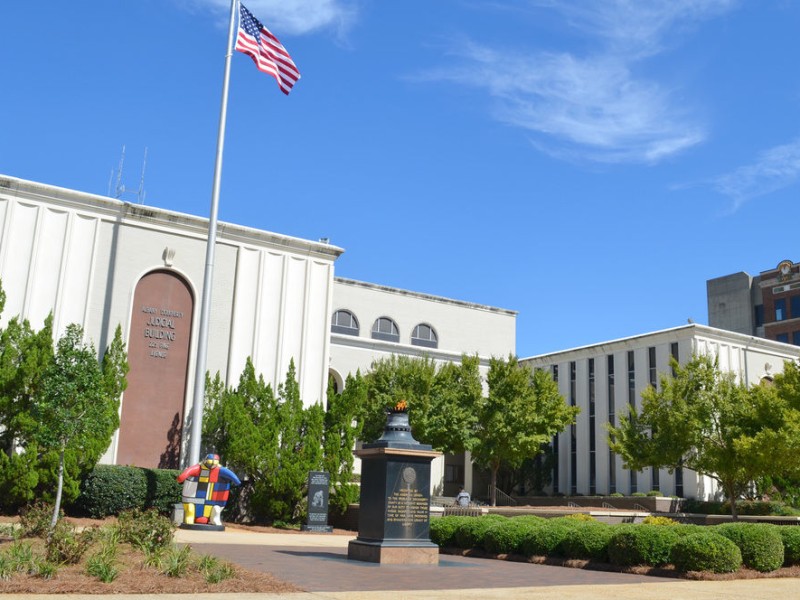
File Photo
By Alan Mauldin
[email protected]
ALBANY — The origin of the phrase “Justice denied is justice delayed” remains in the murky past, but the words are very relevant in the present where Dougherty County’s courts are on course to go a year without holding jury trials.
This week, after Harold Melton, chief justice of the Georgia Supreme Court, suspended all jury trials “indefinitely” in the state, the Dougherty County Superior Court canceled all scheduled trial dates through Feb. 19.
The order was formulated “due to the disturbing spread of the coronavirus,” the Dougherty Judicial Circuit’s Chief Judge, Willie Lockette, said.
Prior to the latest order, courts had been allowed to hold some jury proceedings if there was a plan in place to make the process safe. One grand jury session was held during that window, but no trial juries were seated.
“As we have done throughout this pandemic, we will continue to keep the health and safety of our citizens as our No. 1 priority,” Lockette said. “Hopefully, we will be able to resume conducting jury trials at some point in the near future.”
Jurors scheduled to report for the planned trial dates will be notified of cancellations.
Non-trial court proceedings will continue. Individuals who receive notices to appear in person at the Dougherty County Judicial or participate through teleconference or video conference will be required to attend.
In December, the Dougherty County District Attorney’s Office was able to hold two days of grand jury proceedings, issuing indictments in hundreds of cases.
As it has throughout the pandemic and shutdown of courts since March 2020, the office will continue to prepare cases and conduct pretrial hearings for the eventual re-opening of courts for criminal trials, District Attorney Greg Edwards said.
In the interim, defendants and victims remain in legal limbo, he said.
“Everybody wants to get their case done,” Edwards said. “Victims want justice done. Defendants want their day in court.”
In addition to canceling trials, the chief justice has suspended action on motions for speedy trial by defendants, he said.
Dougherty County had formulated a game plan to hold trials safely, but the order likely takes in consideration of the state as a whole, where some jurisdictions have been hit harder in the second wave of novel coronavirus spread and illness than Albany, Edwards said.
About 90 percent of criminal cases are disposed of through plea deals arranged by his office and defendants’ attorneys and the court, and Edwards’ office is continuing work on cases where such arrangements can be made. Currently, however, there are some 500 people in the Dougherty County Jail awaiting disposition of cases.
“That’s going to be on a case-by-case basis,” the district attorney said. “We will try to resolve cases as we can.”
In other criminal cases, parties cannot work out a bargain acceptable to all, and some cases call for a hearing in front of jurors.
“There are some cases that have to be tried,” Edwards said. “Every case is important. Homicide cases are important, but there are other cases that are important: aggravated assault cases, rapes and cases where tens of thousands of dollars are alleged to have been stolen.”
And unlike the grand jury proceedings recently held, a criminal matter does not lend itself to some protective measures.
Defense attorneys and defendants need to be able to judge the demeanor, including facial expressions, of potential jurors as they answer questions during the selection process, he said. And the same holds for jurors’ need to see the faces of witnesses to form an opinion on their reliability.
With work continuing on preparing and hearing motions ahead of trials, the office is preparing to move forward with cases in a timely manner once courts get the green light.
“We just ask that everybody who has some interest in some aspect of the criminal justice system be patient,” Edwards said.
Author

Related Articles
Dougherty Commission considers $104 million budget for 2026-2027 budget year
“The other side of the coin is you could have higher revenues than projected. We’re very conservative in budgeting revenues. That also reduces the need to use fund balance”
PHOTOS: Albany State Summer Success Academy
Photos by Reginald Christian, Albany State University
Albany gas prices among Georgia’s lowest as summer fuel costs decline
According to AAA, the average price for a gallon of regular gasoline in the Albany metro area was approximately $3.45 this week, making Albany the second-least expensive metro market in Georgia behind Dalton at $3.41 and slightly ahead of Brunswick at $3.48.
