
DOUG PORTER: The matriarch
Special Photo
By Doug Porter
Special to The Albany Herald
We faced each other like a couple of gunslingers at high noon. I was a young zookeeper, armed with a three-foot-long stick called a bull hook. My opponent brought his pair of impressive ivory tusks and six-thousand-pounds of bulk. Bwana stood about 20 yards away, facing me with his trunk up and his ears fanned out in a threat display. He was a nine-year-old male African elephant, and he was testing me to see who was in charge.
If he had been in the wild, there would have been no doubt who was boss. It would have been his mother. That’s because wild African elephants live in a matriarchal society — a world that is dominated by the females.
A mother elephant will usually try to set an unruly youngster right with a gentle nudge in the right direction or, if that doesn’t work, a sharp slap with her trunk. And when a young male like Bwana approaches puberty at 10 to 12 years of age, his mother probably won’t try to coax him back like I did. At that age, she is more likely to force him out of the herd. Adult males lead solitary lives or live temporarily in a smaller herd with other young bulls until it is time to breed.
Another matriarchal society that some might find surprising is a fearsome, ocean-dwelling creature that hunts in packs, chases seals for sport, and can kill a great white shark. That’s right, Killer Whales are also ruled by their mothers. Killer Whales, or Orcas, are the largest member of the dolphin family. They live in female-led groups or pods where they hunt together and share responsibility for raising young and taking care of the sick or injured.
Thinking about matriarchal societies seems like a good way to remember my own mother on Mother’s Day. She came to motherhood at an early age and took it on with tenacity. She married my father at 18 and had me a year later. She tragically lost her second child — her only daughter — in childbirth but went on to have three more sons. Perhaps the most remarkable thing about Carol Porter is how unremarkable her story is. But I am glad we set aside a day for me to continue to honor her, even though she would say she was just doing her job as a mother.
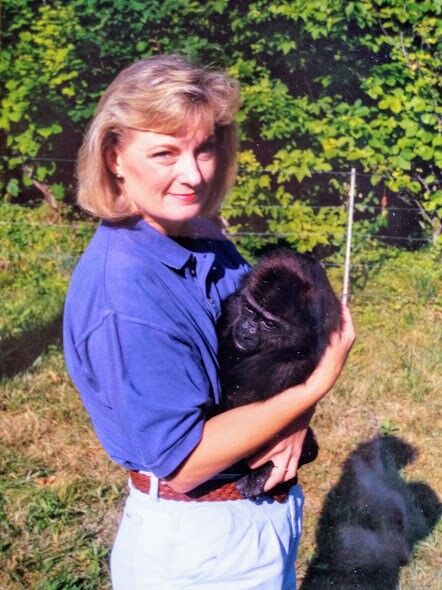
I should honor my wife, too. She may not be my mother, but she is the best mother I know. And her motherly love can even cross species barriers. In the late 1990s, a female gorilla in a zoo at which I worked gave birth but was unable to care for her baby for a while. When zookeepers stepped in to care for the infant, we had to find surrogate mothers to hold the baby on a regular basis and to bottle-feed it around the clock. A group of dedicated volunteers — including my wife — agreed to take turns caring for the infant gorilla until its mother was able to resume her duties.
In fact, I can think of no better example of motherhood in the animal kingdom than the female gorilla. Gorillas live in groups, or troops, from a few to a few dozen members that are led by an adult, dominant, silverback male. Zoo Atlanta announced the birth of an infant on April 24, and they report that the infant appears healthy and strong, is nursing normally, and is receiving appropriate maternal care. I would expect nothing less from a gorilla mom.
Zoo visitors who are fortunate enough to see the infant might note that gorillas are born with an instinctive ability to hold on to their mothers’ chests, but in most other respects, they are helpless. Mothers support their babies for the first few months of life but, unlike humans, gorilla mothers seldom allow other gorillas to hold or carry their infants. Babies learn to crawl and ride on their mothers’ backs at about three months of age and may continue to ride on their mothers’ backs, chests or legs for three or four years. If we had a Mother’s Day for the animal kingdom, mother gorillas would be high on the list of honorees.
We humans are, I suppose, neither matriarchal nor patriarchal — although America seems to be a more gorilla-like as a patriarchal society. My home growing up was certainly male-dominated. My mom was outnumbered by me, my three brothers and my dad. The toilet seat was always up in our house.
But that’s not to say my mom didn’t exert her influence. She could, at times, seem as powerful as a hurricane or as gentle as a summer breeze. She could bandage a skinned knee, soothe an injured ego, or send us outside to break a switch off the willow tree so she could use it on our bare behinds.
My mom stayed home until my youngest brother was in school, then she gave up that quaint notion that the woman’s place is in the home. She got a job with Bell Telephone and stayed with them for the rest of her working life.
She died a few years ago, and I miss her terribly. I wish I could send her a card or call her on Mother’s Day to tell her I love her — and to thank her for not chasing me out of the house like a mother elephant would have when I reached puberty.
Author

Related Articles

WILL THAULT: Can Ranch dressing cool our differences?
A German tourist driving through Georgia marveled at our landscape, discovering Waffle House and Buc-ee’s for the first time
CARLTON FLETCHER: Looking for a modern-day Rosa Parks
The year was 1955, and while the civil rights movement was slowly building momentum in the United States, laws such as the one enacted in Montgomery were common.
Squawkbox – July 4, 2026
Regarding the changes to the Squawkbox… Lee County officials encountered a screw-up with… Bo and Preacher Lorenzo and his disciples should reflect on why…
